
-

-
REFERENCES
[1] Douglas C. Engelbart. (1962). Augmenting human intellect: A conceptual framework. Stanford Research Institute, Summary Report AFOSR-3223, SRI Project No. 3578. https://www.dougengelbart.org/pubs/augment-3906.html [2] Nobel Prize Outreach. (2024). Transcript from an interview with Demis Hassabis. https://www.nobelprize.org/prizes/chemistry/2024/hassabis/1924974-interview-transcript [3] Hanchen Wang, Tianfan Fu, Yuanqi Du, et al. (2023). Scientific discovery in the age of artificial intelligence. Nature 620:47−60. DOI:10.1038/s41586-023-06221-2 [4] John Jumper, Richard Evans, Alexander Pritzel, et al. (2021). Highly accurate protein structure prediction with AlphaFold. Nature 596:583−589. DOI:10.1038/s41586-021-03819-2 [5] Ben Shneiderman. (2020). Human-centered artificial intelligence: Reliable, safe & trustworthy. Int. J. Hum.-Comput. Interact. 36:495−504. DOI:10.1080/10447318.2020.1741118 -
ABOUT THIS ARTICLE
Cite this article:
Zhou S., Wang W., Liu T., et al. (2026). AI PLUS: Toward a paradigm of human–AI co-evolution. AI Plus 1:100001. https://doi.org/10.59717/ipj.aiplus.2026.100001
Welcome!
To request copyright permission to republish or share portions of our works, please visit Copyright Clearance Center's (CCC) Marketplace website at marketplace.copyright.com.
Export File
Citation
Zhou S., Wang W., Liu T., et al. (2026). AI PLUS: Toward a paradigm of human–AI co-evolution. AI Plus 1:100001. https://doi.org/10.59717/ipj.aiplus.2026.100001

Format
Content
 DownLoad:
-
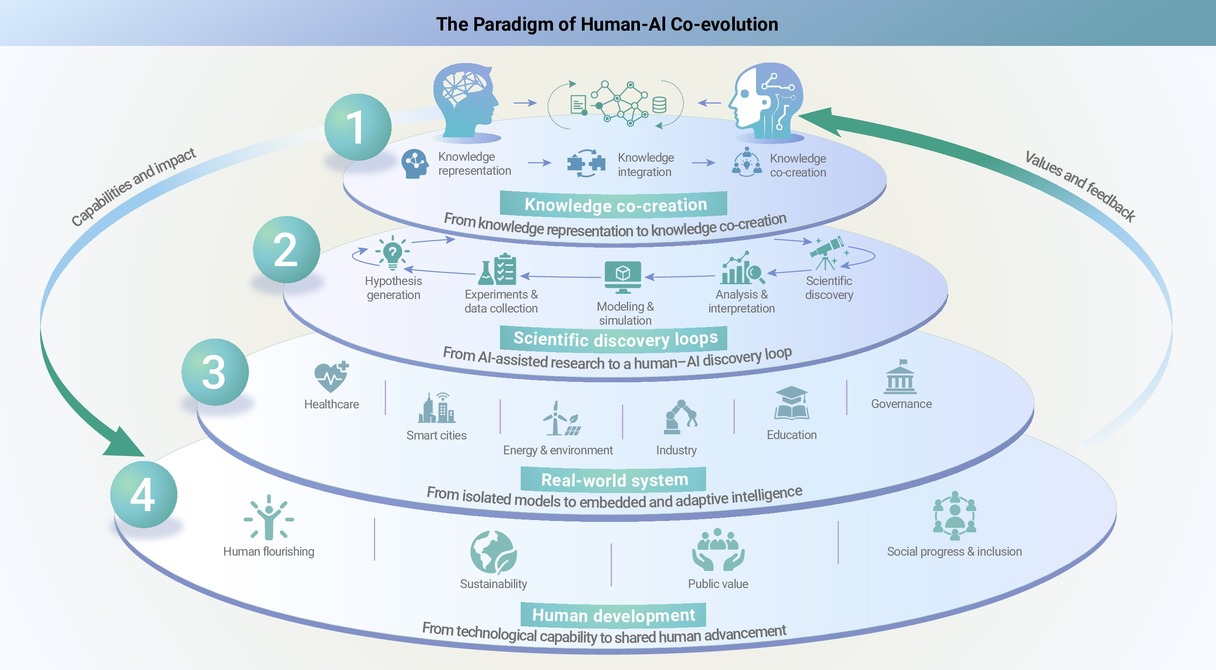
Figure 1.
Four nested levels of human–AI co-evolution: knowledge as the epistemic foundation, science as the mechanism of discovery, complex systems as the arena of real-world interaction, and human development as the ultimate direction and normative criterion.