
New-generation artificial intelligence boosts product forward design capability in manufacturing industry
-
ABSTRACT
Product forward design is generally posited as an essential pathway for surmounting bottlenecks in technological innovation and augmenting the core capabilities of the manufacturing industry. Bolstered by knowledge engineering, new-generation intelligent products are distinguished by the salient attributes of self-sensing, self-adaptation, self-learning, and self-decision-making. These advancements are propelling mechanical design to evolve from a traditional paradigm rooted in single-discipline expertise, empirical heuristics, and function-satisfaction orientation, toward a sophisticated framework that features multidisciplinary coupling, collaborative architecture-knowledge driving, and integrated lifecycle-wide optimization—from which defining characteristics including innovativeness, customizability, intelligence, virtuality, sustainability, optimality, and human-machine collaboration distinctly emerge. This perspective hereby explores the conceptual essence of product forward design, elaborates on the enabling role of frontier artificial intelligence technologies thereof, and underscores their typical application scenarios in high-end equipment, where these intelligent capabilities substantively drive breakthroughs in performance and adaptive functionality. -

-
REFERENCES
[1] Xu J., Chen X., Zhang S., et al. (2017). Thermal design of large plate-fin heat exchanger for cryogenic air separation unit based on multiple dynamic equilibriums. Appl. Therm. Eng. 113:774−790. DOI:10.1016/j.applthermaleng.2016.10.177 [2] Xu J., Wang K., Sheng H., et al. (2020). Energy efficiency optimization for ecological 3D printing based on adaptive multi-layer customization. J. Cleaner Prod. 245:118826. DOI:10.1016/j.jclepro.2019.118826 [3] Xu J., Tao M., Gao M., et al. (2025). Super-resolution 3D reconstruction from low-dose biomedical images based on expertized multi-layer refining. Expert Syst. Appl. 281:127474. DOI:10.1016/j.eswa.2025.127474 [4] Xu J., Liu K., Wang L., et al. (2023). Robustness optimization for rapid prototyping of functional artifacts based on visualized computing digital twins. Vis. Comput. Ind. Biomed. Art. 6:1−18. DOI:10.1186/s42492-023-00131-w [5] Chen C., Xu J., Zhang S. (2026). Reducing idle trajectory for numerical controlled manufacturing of porous structures via neighborhood stratified heuristic. Comput. Aided Des. 194:104049. DOI:10.1016/j.cad.2026.104049 [6] Zhang S. and Xu J. (2009). Acquisition and active navigation of knowledge particles throughout product variation design process. Chin. J. Mech. Eng. 22:395−402. DOI:10.3901/cjme.2009.03.395 [7] Zhang S., Xu J., Gou H., et al. (2017). A research review on the key technologies of intelligent design for customized products. Engineering 3:631−640. DOI:10.1016/j.eng.2017.04.005 [8] Boiko D. A., MacKnight R., Kline B., et al. (2023). Autonomous chemical research with large language models. Nature. 624:570−578. DOI:10.1038/s41586-023-06792-0 [9] Alenjareghi M. J., Ghorbani F., Keivanpour S., et al. (2026). Proactive safety reasoning in human-robot collaboration in disassembly through LLM-augmented STPA and FMEA. Robot. Comput.-Integr. Manuf. 98:103162. DOI:10.1016/j.rcim.2025.103162 [10] Huy T. H. B., Duy N. T. M., Van Phu P., et al. (2024). Robust real-time energy management for a hydrogen refueling station using generative adversarial imitation learning. Appl. Energy. 373:123847. DOI:10.1016/j.apenergy.2024.123847 [11] Watson J. L., Juergens D., Bennett N. R., et al. (2023). De novo design of protein structure and function with RFdiffusion. Nature. 620:1089−1100. DOI:10.1038/s41586-023-06415-8 [12] Okumura K., Bonnet F., Tamura Y., et al. (2023). Offline time-independent multiagent path planning. IEEE Trans. Robot., 39:2720−2737. DOI:10.1109/TRO.2023.3258690 [13] Rassil A., Chougrad H. and Zouaki H. (2023). Deep multi-agent fusion Q-Network for graph generation. Knowl.-Based Syst. 269:110509. DOI:10.1016/j.knosys.2023.110509 [14] Sartore C., Elobaid M., Rapetti L., et al. (2026). Towards shared embodied intelligence in humanoid robots through optimization, development and testing of the human-aware ergoCub robot. Nat. Mach. Intell. 8:1221-1237. DOI:10.1038/s42256-026-01272-2 [15] Polonara M., Yang X., Carbonari L., et al. (2026). VL-GRiP3: A hierarchical pipeline leveraging vision-language models for autonomous robotic 3D grasping. Robot. Comput.-Integr. Manuf. 100:103244. DOI:10.1016/j.rcim.2026.103244 [16] Karniadakis G. E., Kevrekidis I. G., Lu L., et al. (2021). Physics-informed machine learning. Nat. Rev. Phys. 3:422−440. DOI:10.1038/s42254-021-00314-5 [17] Haarnoja T., Moran B., Lever G., et al. (2024). Learning agile soccer skills for a bipedal robot with deep reinforcement learning. Sci. Robot. 9:eadi8022. DOI:10.1126/scirobotics.adi8022 [18] Ferrari A. and Willcox K. (2024). Digital twins in mechanical and aerospace engineering. Nat. Comput. Sci. 4:178−183. DOI:10.1038/s43588-024-00613-8 [19] Dubarry M., Howey D. and Wu B. (2023). Enabling battery digital twins at the industrial scale. Joule, 7:1134−1144. DOI:10.1016/j.joule.2023.05.005 [20] Song L. and Gao G. (2026). Deep Learning-Based Error Compensation for High-Precision CNC Machining. Array, 32:101074. DOI:10.1016/j.array.2026.101074 [21] Panzer H., Wenzler D. L., Rauner D., et al. (2026). Prediction and homogenization of optical tomography images and microstructure during powder bed fusion of metals using a laser beam by means of a style-based generative adversarial network. Addit. Manuf. 116:105077. DOI:10.1016/j.addma.2026.105077 [22] Chen K., Qiu C., Liu Z., et al. (2026). A novel performance-geometry collaborated generative design frame for complex surface product. Aerosp. Sci. Technol. 176:112049. DOI:10.1016/j.ast.2026.112049 [23] Kender R., Kaufmann F., Rößler F., et al. (2021). Development of a digital twin for a flexible air separation unit using a pressure-driven simulation approach. Comput. Chem. Eng. 151:107349. DOI:10.1016/j.compchemeng.2021.107349 [24] Deng Q. and Chen M. (2026). Graph neural network-accelerated multi-objective design optimization of fractal flow fields for anion exchange membrane electrolyzers. J. Power Sources, 690:240841. DOI:10.1016/j.jpowsour.2026.240841 -
ABOUT THIS ARTICLE
Cite this article:
Xu J., Chen M., Chen C., et al. (2026). New-generation artificial intelligence boosts product forward design capability in manufacturing industry. AI Plus 1:100002. https://doi.org/10.59717/ipj.aiplus.2026.100002
Welcome!
To request copyright permission to republish or share portions of our works, please visit Copyright Clearance Center's (CCC) Marketplace website at marketplace.copyright.com.
Export File
Citation
Xu J., Chen M., Chen C., et al. (2026). New-generation artificial intelligence boosts product forward design capability in manufacturing industry. AI Plus 1:100002. https://doi.org/10.59717/ipj.aiplus.2026.100002

Format
Content
 DownLoad:
-
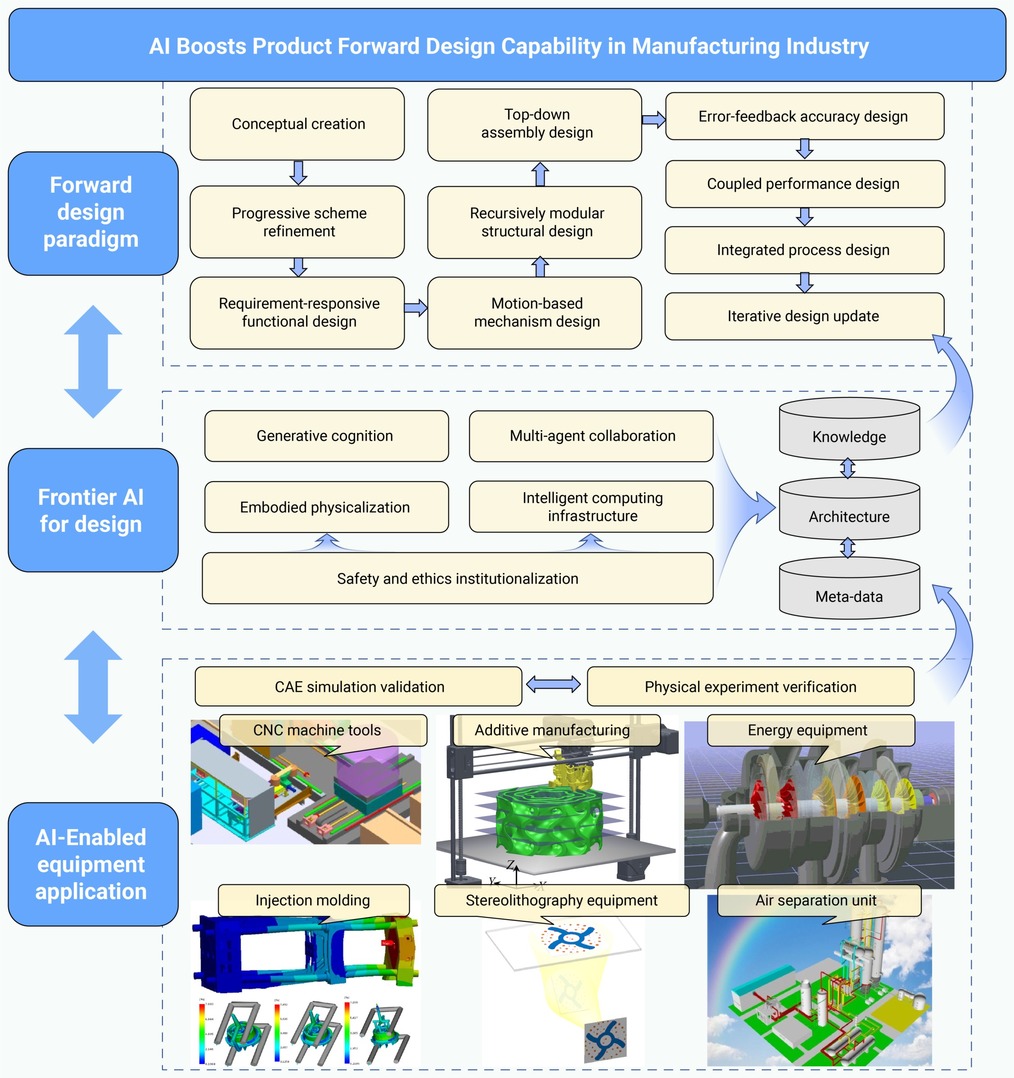
Figure 1.
AI boosts product forward design capability in manufacturing industry