
A survey on AI agent security: Reasoning, Acting, and Self-Evolving
-
GRAPHICAL ABSTRACT
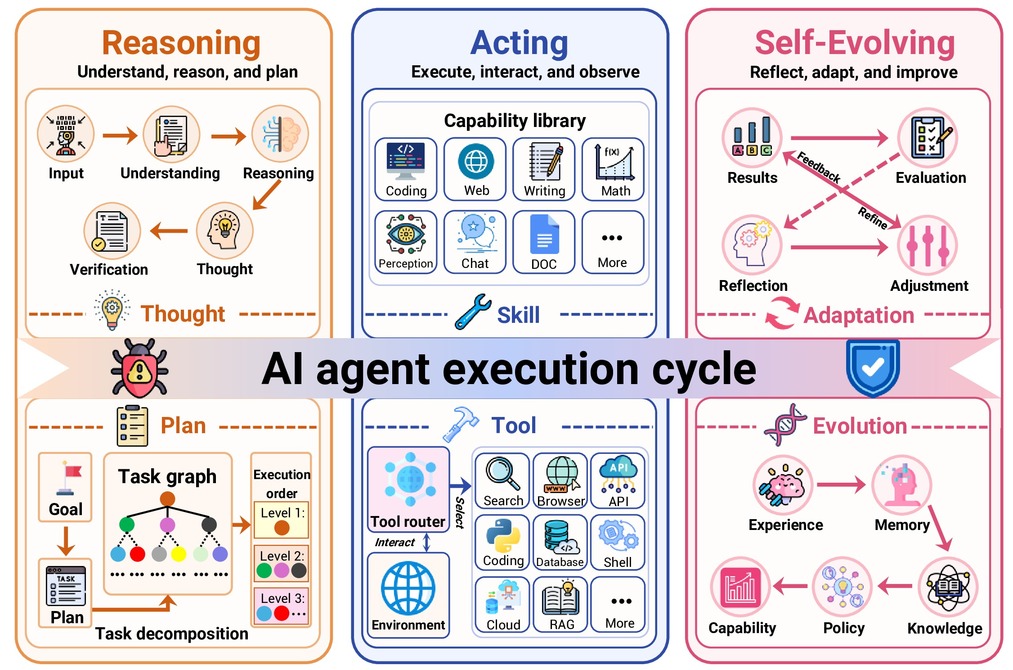
 DownLoad:
Full size image
DownLoad:
Full size image
-
PUBLIC SUMMARY
-
Artificial intelligence (AI) agents are becoming increasingly autonomous and capable.
Their growing autonomy introduces new security risks across the entire execution process.
This survey provides an execution cycle taxonomy of AI agent security challenges and solutions.
We summarize existing threats, defenses, benchmarks, and future research opportunities.
-
-
ABSTRACT
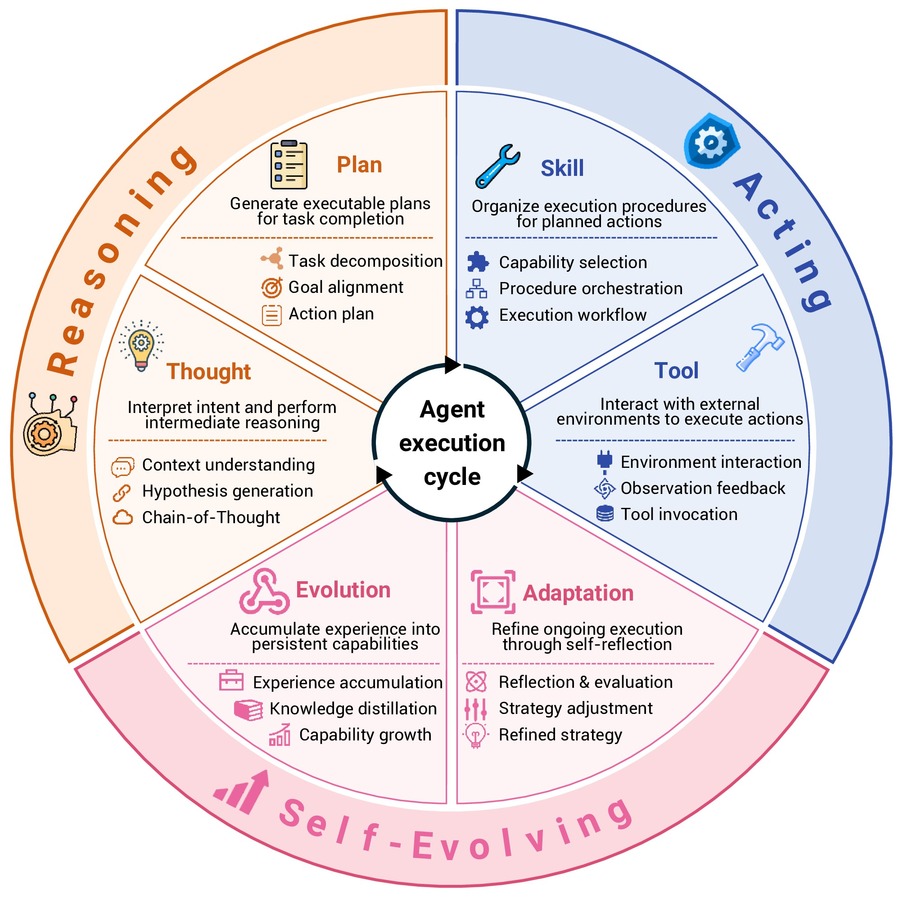
Artificial intelligence (AI) agents are rapidly evolving into autonomous systems capable of reasoning, acting, and continual evolving. Their increasing autonomy enables powerful real-world applications but also introduces security risks throughout the entire agent execution cycle. However, the security challenges arising across different stages of the agent execution cycle have not yet been systematically reviewed. In this survey, we provide a comprehensive review of AI agent security from the perspective of the AI agent execution cycle. Specifically, we establish a unified taxonomy that organizes AI agent execution into three sequential stages: Reasoning, Acting, and Self-Evolving. Each stage is further divided into two interconnected components, resulting in six components in total: Thought, Plan, Skill, Tool, Adaptation, and Evolution. We then systematically review the threats, defense mechanisms, and evaluation benchmarks associated with each component, providing a comprehensive understanding of security challenges throughout the complete execution pipeline. Finally, we discuss current limitations and promising future research directions toward building secure, robust, and trustworthy AI agents. We believe that this survey provides a unified understanding of AI agent security and facilitates future research on the secure deployment of increasingly autonomous AI systems.-
Keywords:
- AI agents /
- AI agent security /
- Agent execution cycle /
- Reasoning /
- Acting /
- Self-Evolving
-

-
REFERENCES
[1] Yang A., Li A., Yang B., et al. (2025). Qwen3 technical report. arXiv preprint arXiv: 2505.09388 [2] Chen Z., Wu J., Wang W., et al. (2024). Internvl: Scaling up vision foundation models and aligning for generic visual-linguistic tasks. Proceedings of the IEEE/CVF conference on computer vision and pattern recognition : 24185–24198. [3] Liu A., Feng B., Xue B., et al. (2024). Deepseek-v3 technical report. arXiv preprint arXiv: 2412.19437. [4] Achiam J., Adler S., Agarwal S., et al. (2023). Gpt-4 technical report. arXiv preprint arXiv: 2303.08774. [5] Team G., Anil R., Borgeaud S., et al. (2023). Gemini: A family of highly capable multimodal models. arXiv preprint arXiv: 2312.11805. [6] Yao Y., Duan J., Xu K., et al. (2024). A survey on large language model (llm) security and privacy: The good, the bad, and the ugly. High-Confid. Comput. 4:100211. DOI:10.1016/j.hcc.2024.100211 [7] Alberts I. L., Mercolli L., Pyka T., et al. (2023). Large language models (LLM) and Chat-GPT: what will the impact on nuclear medicine be? Eur. J. Nucl. Med. Mol. Imaging 50:1549−1552. DOI:10.1007/s00259-023-06172-w [8] Li Y., Huang Y., Yang B., et al. (2024). Snapkv: Llm knows what you are looking for before generation. Adv. Neural Inf. Process. Syst. 37:22947−22970. DOI:10.52202/079017-0722 [9] Wu S., Fei H., Qu L., et al. (2023). Next-gpt: Any-to-any multimodal llm. arXiv preprint arXiv: 2309.05519. [10] Wang L., Ma C., Feng X., et al. (2024). A survey on large language model based autonomous agents. Front. Comput. Sci. 18:186345. DOI:10.1007/s11704-024-40231-1 [11] Wooldridge M. (1999). Intelligent agents. Multiagent systems: A modern approach to distributed artificial intelligence 1:27−73. [12] Jennings N. R. and Wooldridge M. (1998). Applications of intelligent agents. Agent technology: foundations, applications, and markets (Springer), pp: 3–28. [13] Nwana H. S. (1996). Software agents: An overview. Knowl. Eng. Rev. 11:205−244. DOI:10.1017/S026988890000789X [14] Zhao A., Huang D., Xu Q., et al. (2024). Expel: Llm agents are experiential learners. Proceedings of the AAAI conference on artificial intelligence 38:19632−19642. [15] Zhou S., Xu F. F., Zhu H., et al. (2024). Webarena: A realistic web environment for building autonomous agents. International conference on learning representations 2024:15585−15606. [16] Deng X., Gu Y., Zheng B., et al. (2023). Mind2web: Towards a generalist agent for the web. Adv. Neural Inf. Process. Syst. 36:28091−28114. [17] Koh J. Y., Lo R., Jang L., et al. (2024). Visualwebarena: Evaluating multimodal agents on realistic visual web tasks. Proceedings of the 62nd Annual Meeting of the Association for Computational Linguistics (Volume 1: Long Papers): 881–905. [18] He H., Yao W., Ma K., et al. (2024). Webvoyager: Building an end-to-end web agent with large multimodal models. Proceedings of the 62nd Annual Meeting of the Association for Computational Linguistics (Volume 1: Long Papers): 6864–6890. [19] Ning L., Liang Z., Jiang Z., et al. (2025). A survey of webagents: Towards next-generation ai agents for web automation with large foundation models. Proceedings of the 31st ACM SIGKDD Conference on Knowledge Discovery and Data Mining V. 2 : 6140–6150. [20] Chae H., Kim N., Ong K., et al. (2025). Web agents with world models: Learning and leveraging environment dynamics in web navigation. International conference on learning representations 2025:63707−63738. [21] Nguyen D., Chen J., Wang Y., et al. (2025). Gui agents: A survey. Findings of the association for computational linguistics: ACL 2025 : 22522–22538. [22] Yao S., Chen H., Yang J., et al. (2022). Webshop: Towards scalable real-world web interaction with grounded language agents. Adv. Neural Inf. Process. Syst. 35:20744−20757. [23] Hong W., Wang W., Lv Q., et al. (2024). Cogagent: A visual language model for gui agents. Proceedings of the IEEE/CVF conference on computer vision and pattern recognition : 14281–14290. [24] Cheng K., Sun Q., Chu Y., et al. (2024). Seeclick: Harnessing gui grounding for advanced visual gui agents. Proceedings of the 62nd Annual Meeting of the Association for Computational Linguistics (Volume 1: Long Papers) : 9313–9332. [25] Gou B., Wang D. R., Zheng B., et al. (2025). Navigating the digital world as humans do: Universal visual grounding for gui agents. International conference on learning representations 2025:30851−30883. [26] Zhang C., He S., Qian J., et al. (2024). Large language model-brained gui agents: A survey. arXiv preprint arXiv: 2411.18279. [27] Wang S., Liu W., Chen J., et al. (2024). Gui agents with foundation models: A comprehensive survey. arXiv preprint arXiv: 2411.04890. [28] Chen W., Cui J., Hu J., et al. (2025). Guicourse: From general vision language model to versatile gui agent. Proceedings of the 63rd Annual Meeting of the Association for Computational Linguistics (Volume 1: Long Papers) : 21936–21959. [29] Wu Q., Cheng K., Yang R., et al. (2026). Gui-actor: Coordinate-free visual grounding for gui agents. Adv. Neural Inf. Process. Syst. 38:15101−15128. [30] Liu Y., Li P., Wei Z., et al. (2026). Infiguiagent: A multimodal generalist gui agent with native reasoning and reflection. Proceedings of the 19th Conference of the European Chapter of the Association for Computational Linguistics (Volume 1: Long Papers) : 1035–1051. [31] Wang X., Wang B., Lu D., et al. (2026). Opencua: Open foundations for computer-use agents. Adv. Neural Inf. Process. Syst. 38:139756−139806. [32] Sager P. J., Meyer B., Yan P., et al. (2026). A comprehensive survey of agents for computer use: Foundations, challenges, and future directions. J. Artif. Intell. Res. 85. [33] Agashe S., Wong K., Tu V., et al. (2025). Agent s2: A compositional generalist-specialist framework for computer use agents. arXiv preprint arXiv: 2504.00906. [34] Sun Z., Liu Z., Zang Y., et al. (2025). Seagent: Self-evolving computer use agent with autonomous learning from experience. arXiv preprint arXiv: 2508.04700. [35] Lai H., Liu X., Zhao Y., et al. (2025). Computerrl: Scaling end-to-end online reinforcement learning for computer use agents. arXiv preprint arXiv: 2508.14040. [36] Kuntz T., Duzan A., Zhao H., et al. (2026). Os-harm: A benchmark for measuring safety of computer use agents. Adv. Neural Inf. Process. Syst. 38. [37] Li M., Zhao S., Wang Q., et al. (2024). Embodied agent interface: Benchmarking llms for embodied decision making. Adv. Neural Inf. Process. Syst. 37:100428−100534. [38] Feng Z., Xue R., Yuan L., et al. (2026). Multi-agent embodied ai: Advances and future directions. Sci. China Inf. Sci. 69:151202. DOI:10.1007/s11432-025-4820-4 [39] Zhang H., Du W., Shan J., et al. (2024). Building cooperative embodied agents modularly with large language models. International conference on learning representations 2024:19373−19401. [40] Fan L., Wang G., Jiang Y., et al. (2022). Minedojo: Building open-ended embodied agents with internet-scale knowledge. Adv. Neural Inf. Process. Syst. 35:18343−18362. [41] Xia F., Zamir A. R., He Z., et al. (2018). Gibson env: Real-world perception for embodied agents. Proceedings of the IEEE conference on computer vision and pattern recognition : 9068–9079. [42] Franklin S. (1997). Autonomous agents as embodied AI. Cybernetics & Systems 28:499−520. [43] Dorri A., Kanhere S. S. and Jurdak R. (2018). Multi-agent systems: A survey. IEEE Access 6:28573−28593. DOI:10.1109/ACCESS.2018.2831228 [44] Maldonado D., Cruz E., Torres J. A., et al. (2024). Multi-agent systems: A survey about its components, framework and workflow. IEEE Access 12:80950−80975. DOI:10.1109/ACCESS.2024.3409051 [45] Du H., Thudumu S., Vasa R., et al. (2024). A survey on context-aware multi-agent systems: techniques, challenges and future directions. arXiv preprint arXiv: 2402.01968. [46] Li A., Xie Y., Li S., et al. (2025). Agent-oriented planning in multi-agent systems. International conference on learning representations 2025:19495−19517. [47] Wang Y. and Chen X. (2025). Mirix: Multi-agent memory system for llm-based agents. arXiv preprint arXiv: 2507.07957. [48] Alzubi S., Provenzano N., Bingham J., et al. (2026). Evoskill: Automated skill discovery for multi-agent systems. arXiv preprint arXiv: 2603.02766. [49] Qiao S., Fang R., Zhang N., et al. (2024). Agent planning with world knowledge model. Adv. Neural Inf. Process. Syst. 37:114843−114871. [50] Xu W., Liang Z., Mei K., et al. (2026). A-mem: Agentic memory for llm agents. Adv. Neural Inf. Process. Syst. 38:17577−17604. [51] Kang J., Ji M., Zhao Z., et al. (2025). Memory os of ai agent. Proceedings of the 2025 conference on empirical methods in natural language processing : 25972–25981. [52] He Z., Wang Y., Zhi C., et al. (2026). Memoryarena: Benchmarking agent memory in inter-dependent multi-session agentic tasks. arXiv preprint arXiv: 2602.16313. [53] Masterman T., Besen S., Sawtell M., et al. (2024). The landscape of emerging ai agent architectures for reasoning, planning, and tool calling: A survey. arXiv preprint arXiv: 2404.11584. [54] Rahimi A. (2026). Agentic and multi-agent systems: A systematic review of tool use, benchmarks, and governance. [55] Lumer E., Gulati A., Nizar F., et al. (2026). Tool and agent selection for large language model agents in production: A survey. 2026 IEEE conference on artificial intelligence (CAI) : 701–708. [56] Liu M. M., Garcia D., Parllaku F., et al. (2026). Toolscope: Enhancing llm agent tool use through tool merging and context-aware filtering. Proceedings of the 64th Annual Meeting of the Association for Computational Linguistics (Volume 1: Long Papers) : 34095–34119. [57] Xu R. and Yan Y. (2026). Agent skills for large language models: Architecture, acquisition, security, and the path forward. arXiv preprint arXiv: 2602.12430. [58] Li X., Chen W., Liu Y., et al. (2026). SkillsBench: Benchmarking how well agent skills work across diverse tasks. arXiv preprint arXiv: 2602.12670. [59] Ni J., Liu Y., Liu X., et al. (2026). Trace2skill: Distill trajectory-local lessons into transferable agent skills. arXiv preprint arXiv: 2603.25158. [60] Yue L., Bhandari K. R., Ko C. Y., et al. (2026). From static templates to dynamic runtime graphs: a survey of workflow optimization for llm agents. arXiv preprint arXiv: 2603.22386. [61] Jenkins A., Kitkowska A., Maidhof C., et al. (2026). Security and privacy in agentic AI: grand challenges and future directions. arXiv preprint arXiv: 2607.06608. [62] Zhang D., Feng G., Shi Y., et al. (2021). Physical safety and cyber security analysis of multi-agent systems: A survey of recent advances. IEEE/CAA J. Autom. Sin. 8:319−333. DOI:10.1109/JAS.2021.1003820 [63] Cui T., Wang Y., Fu C., et al. (2024). Risk taxonomy, mitigation, and assessment benchmarks of large language model systems. arXiv preprint arXiv: 2401.05778. [64] Gan Y., Yang Y., Ma Z., et al. (2024). Navigating the Risks: A Survey of Security, Privacy, and Ethics Threats in LLM-Based Agents. CoRR abs/2411.09523 (2024). arXiv preprint arXiv: 2411.09523. [65] Liu D., Yang M., Qu X., et al. (2025). A survey of attacks on large vision–language models: Resources, advances, and future trends. IEEE Trans. Neural Netw. Learn. Syst. [66] Deng Z., Guo Y., Han C., et al. (2025). Ai agents under threat: A survey of key security challenges and future pathways. ACM Comput. Surv. 57:1−36. [67] Luo J., Zhang W., Yuan Y., et al. (2025). Large language model agent: A survey on methodology, applications and challenges. arXiv preprint arXiv: 2503.21460. [68] Chen A., Wu Y., Zhang J., et al. (2025). A survey on the safety and security threats of computer-using agents: JARVIS or ultron? arXiv preprint arXiv: 2505.10924. [69] Wang K., Zhang G., Zhou Z., et al. (2025). A comprehensive survey in llm (-agent) full stack safety: Data, training and deployment. arXiv preprint arXiv: 2504.15585. [70] Ma X., Gao Y., Wang Y., et al. (2026). Safety at scale: A comprehensive survey of large model and agent safety. Found. Trends Priv. Secur. 8:1−240. [71] Zhou M., Duan N., Liu S., et al. (2020). Progress in neural NLP: modeling, learning, and reasoning. Engineering 6:275−290. DOI:10.1016/j.eng.2019.12.014 [72] Lopez M. M. and Kalita J. (2017). Deep Learning applied to NLP. arXiv preprint arXiv: 1703.03091. [73] Su Y., Lan T., Li H., et al. (2023). Pandagpt: One model to instruction-follow them all. Proceedings of the 1st Workshop on Taming Large Language Models: Controllability in the era of Interactive Assistants! : 11–23. [74] Zhou J., Lu T., Mishra S., et al. (2023). Instruction-following evaluation for large language models. arXiv preprint arXiv: 2311.07911. [75] Lou R., Zhang K. and Yin W. (2024). Large language model instruction following: A survey of progresses and challenges. Comput. Linguist. 50:1053−1095. DOI:10.1162/coli_a_00523 [76] Wu X., Yao W., Chen J., et al. (2024). From language modeling to instruction following: Understanding the behavior shift in llms after instruction tuning. Proceedings of the 2024 conference of the north american chapter of the association for computational linguistics: Human language technologies (volume 1: Long papers) : 2341–2369. [77] Qin Y., Song K., Hu Y., et al. (2024). Infobench: Evaluating instruction following ability in large language models. Findings of the association for computational linguistics: ACL 2024 : 13025–13048. [78] Eigner E. and Händler T. (2024). Determinants of llm-assisted decision-making. arXiv preprint arXiv: 2402.17385. [79] Ma S., Chen Q., Wang X., et al. (2025). Towards human-ai deliberation: Design and evaluation of llm-empowered deliberative ai for ai-assisted decision-making. Proceedings of the 2025 CHI conference on human factors in computing systems : 1–23. [80] Xu F. F., Song Y., Li B., et al. (2026). Theagentcompany: benchmarking llm agents on consequential real world tasks. Adv. Neural Inf. Process. Syst. 38. [81] Dong G., Lu J., Huang J., et al. (2026). Agent-world: Scaling real-world environment synthesis for evolving general agent intelligence. arXiv preprint arXiv: 2604.18292. [82] Sun S., Song H., Huang L., et al. (2026). SWE-world: Building software engineering agents in docker-free environments. arXiv preprint arXiv: 2602.03419. [83] Ferrag M. A., Tihanyi N. and Debbah M. (2026). From llm reasoning to autonomous ai agents: A comprehensive review. IEEE Access. [84] Putta P., Mills E., Garg N., et al. (2024). Agent q: Advanced reasoning and learning for autonomous ai agents. arXiv preprint arXiv: 2408.07199. [85] Zhou A., Yan K., Shlapentokh-Rothman M., et al. (2023). Language agent tree search unifies reasoning acting and planning in language models. arXiv preprint arXiv: 2310.04406. [86] Fang J., Peng Y., Zhang X., et al. (2025). A comprehensive survey of self-evolving ai agents: A new paradigm bridging foundation models and lifelong agentic systems. arXiv preprint arXiv: 2508.07407. [87] Gupta A., Savarese S., Ganguli S., et al. (2021). Embodied intelligence via learning and evolution. Nat. Commun. 12:5721. DOI:10.1038/s41467-021-25874-z [88] Zhai Y., Tao S., Chen C., et al. (2025). Agentevolver: Towards efficient self-evolving agent system. arXiv preprint arXiv: 2511.10395. [89] Shao S., Ren Q., Qian C., et al. (2025). Your agent may misevolve: Emergent risks in self-evolving llm agents. arXiv preprint arXiv: 2509.26354. [90] Liu Y., Zhang R., Luo H., et al. (2025). Secure multi-LLM agentic AI and agentification for edge general intelligence by zero-trust: A survey. arXiv preprint arXiv: 2508.19870. [91] Zhou L., Varadharajan V. and Hitchens M. (2013). Achieving secure role-based access control on encrypted data in cloud storage. IEEE Trans. Inf. Forensics Secur. 8:1947−1960. DOI:10.1109/TIFS.2013.2286456 [92] Huang K., Mehmood Y., Atta H., et al. (2025). Fortifying the Agentic Web: A Unified Zero-Trust Architecture Against Logic-layer Threats. arXiv preprint arXiv: 2508.12259. [93] Andreotta A. J., Kirkham N. and Rizzi M. (2022). AI, big data, and the future of consent. AI Soc 37:1715−1728. DOI:10.1007/s00146-021-01262-5 [94] Lindqvist H. (2006). Mandatory access control. Master’s thesis in computing science, Umea University, Department of Computing Science, SE-901 87. [95] Wei J., Wang X., Schuurmans D., et al. (2022). Chain-of-thought prompting elicits reasoning in large language models. Adv. Neural Inf. Process. Syst. 35:24824−24837. DOI:10.59350/hqv3w-d3q61 [96] Zhang Z., Zhang A., Li M., et al. (2022). Automatic chain of thought prompting in large language models. arXiv preprint arXiv: 2210.03493. [97] Lyu Q., Havaldar S., Stein A., et al. (2023). Faithful chain-of-thought reasoning. Proceedings of the 13th International Joint Conference on Natural Language Processing and the 3rd Conference of the Asia-Pacific Chapter of the Association for Computational Linguistics (Volume 1: Long Papers) : 305–329. [98] Chen Q., Qin L., Liu J., et al. (2026). Towards reasoning era: A survey of long chain-of-thought for reasoning large language models. Sci. China Inf. Sci. 69:161101. DOI:10.1007/s11432-025-4665-8 [99] Feng G., Zhang B., Gu Y., et al. (2023). Towards revealing the mystery behind chain of thought: a theoretical perspective. Adv. Neural Inf. Process. Syst. 36:70757−70798. [100] Hu Y., Cai Y., Du Y., et al. (2025). Self-evolving multi-agent collaboration networks for software development. International conference on learning representations 2025:23007−23039. [101] Ou Y., Zhou W., Ding S., et al. (2025). Symbolic learning enables self-evolving agents. AI Open 6:314−322. DOI:10.1016/j.aiopen.2025.11.004 [102] Ouyang S., Yan J., Hsu I., et al. (2025). Reasoningbank: Scaling agent self-evolving with reasoning memory. arXiv preprint arXiv: 2509.25140. [103] Wang X., Wei J., Schuurmans D., et al. (2022). Self-consistency improves chain of thought reasoning in language models. arXiv preprint arXiv: 2203.11171. [104] Tan X., Wang X., Liu Q., et al. (2025). Paths-over-graph: Knowledge graph empowered large language model reasoning. Proceedings of the ACM on web conference 2025:3505−3522. [105] Li W., Wei W., Qu X., et al. (2023). Trea: Tree-structure reasoning schema for conversational recommendation. Proceedings of the 61st Annual Meeting of the Association for Computational Linguistics (Volume 1: Long Papers) : 2970–2982. [106] Jin B., Xie C., Zhang J., et al. (2024). Graph chain-of-thought: Augmenting large language models by reasoning on graphs. Findings of the association for computational linguistics: ACL 2024 : 163–184. [107] Kuo M., Zhang J., Ding A., et al. (2025). H-cot: Hijacking the chain-of-thought safety reasoning mechanism to jailbreak large reasoning models, including openai o1/o3, deepseek-r1, and gemini 2.0 flash thinking. arXiv preprint arXiv: 2502.12893. [108] Ye C., Cui J. and Hadfield-Menell D. (2026). Prompt injection as role confusion. arXiv preprint arXiv: 2603.12277. [109] Xiang Z., Jiang F., Xiong Z., et al. (2024). Badchain: Backdoor chain-of-thought prompting for large language models. arXiv preprint arXiv: 2401.12242. [110] Liu S., Li R., Yu L., et al. (2026). Badthink: Triggered overthinking attacks on chain-of-thought reasoning in large language models. Proceedings of the AAAI conference on artificial intelligence 40:32141−32149. [111] Cao Y., Gu N., Shen X., et al. (2024). Defending large language models against jailbreak attacks through chain of thought prompting. 2024 International conference on networking and network applications (NaNA) : 125–130. [112] Wang W., Hosseini P. and Feizi S. (2025). Chain-of-defensive-thought: Structured reasoning elicits robustness in large language models against reference corruption. arXiv preprint arXiv: 2504.20769. [113] Xue Z., Bi Z., Ma L., et al. (2025). Thought purity: A defense framework for chain-of-thought attack. arXiv preprint arXiv: 2507.12314. [114] Jacovi A., Bitton Y., Bohnet B., et al. (2024). A chain-of-thought is as strong as its weakest link: A benchmark for verifiers of reasoning chains. Proceedings of the 62nd Annual Meeting of the Association for Computational Linguistics (Volume 1: Long Papers) : 4615–4634. [115] Jiang D., Zhang R., Guo Z., et al. (2025). Mme-cot: Benchmarking chain-of-thought in large multimodal models for reasoning quality, robustness, and efficiency. arXiv preprint arXiv: 2502.09621. [116] Chen Q., Qin L., Zhang J., et al. (2024). M3cot: A novel benchmark for multi-domain multi-step multi-modal chain-of-thought. Proceedings of the 62nd Annual Meeting of the Association for Computational Linguistics (Volume 1: Long Papers) : 8199–8221. [117] Zhang H., Huang J., Mei K., et al. (2025). Agent security bench (asb): Formalizing and benchmarking attacks and defenses in llm-based agents. International conference on learning representations 2025:35331−35366. [118] Li Z., Chang Y. and Wu Y. (2025). Think-bench: Evaluating thinking efficiency and chain-of-thought quality of large reasoning models. arXiv preprint arXiv: 2505.22113. [119] Bailey L., Ong E., Russell S., et al. (2023). Image hijacks: Adversarial images can control generative models at runtime. arXiv preprint arXiv: 2309.00236. [120] Cui X., Aparcedo A., Jang Y. K., et al. (2024). On the robustness of large multimodal models against image adversarial attacks. Proceedings of the IEEE/CVF conference on computer vision and pattern recognition : 24625–24634. [121] Fu X., Wang Z., Li S., et al. (2023). Misusing tools in large language models with visual adversarial examples. arXiv preprint arXiv: 2310.03185. [122] Gao K., Bai Y., Gu J., et al. (2024). Inducing high energy-latency of large vision-language models with verbose images. arXiv preprint arXiv: 2401.11170. [123] Luo H., Gu J., Liu F., et al. (2024). An image is worth 1000 lies: Adversarial transferability across prompts on vision-language models. arXiv preprint arXiv: 2403.09766. [124] Rahmatullaev T., Druzhinina P., Kurdiukov N., et al. (2025). Universal adversarial attack on aligned multimodal llms. arXiv preprint arXiv: 2502.07987. [125] Schlarmann C. and Hein M. (2023). On the adversarial robustness of multi-modal foundation models. Proceedings of the IEEE/CVF international conference on computer vision : 3677–3685. [126] Shao Z., Liu H., Hu Y., et al. (2024). Refusing safe prompts for multi-modal large language models. arXiv preprint arXiv: 2407.09050. [127] Tan Z., Zhao C., Moraffah R., et al. (2024). The wolf within: Covert injection of malice into mllm societies via an mllm operative. arXiv preprint arXiv: 2402.14859. [128] Wang Z., Han Z., Chen S., et al. (2024). Stop reasoning! when multimodal llm with chain-of-thought reasoning meets adversarial image. arXiv preprint arXiv: 2402.14899. [129] Wu C. H., Shah R., Koh J. Y., et al. (2024). Dissecting adversarial robustness of multimodal LM agents. arXiv preprint arXiv: 2406.12814. [130] Dong Y., Chen H., Chen J., et al. (2023). How robust is google’s bard to adversarial image attacks? arXiv preprint arXiv: 2309.11751. [131] Guo Q., Pang S., Jia X., et al. (2024). Efficient generation of targeted and transferable adversarial examples for vision-language models via diffusion models. IEEE Trans. Inf. Forensics Secur. 20:1333−1348. [132] Kim H. S., Kim M. and Kim C. (2024). Doubly-universal adversarial perturbations: Deceiving vision-language models across both images and text with a single perturbation. arXiv preprint arXiv: 2412.08108. [133] Tu H., Cui C., Wang Z., et al. (2024). How many are in this image a safety evaluation benchmark for vision LLMs. European conference on computer vision : 37–55. [134] Wang H., Dong K., Zhu Z., et al. (2024). Transferable multimodal attack on vision-language pre-training models. 2024 IEEE symposium on security and privacy (SP) : 1722–1740. [135] Wang X., Ji Z., Ma P., et al. (2023). Instructta: Instruction-tuned targeted attack for large vision-language models. arXiv preprint arXiv: 2312.01886. [136] Wang Y., Liu C., Qu Y., et al. (2024). Break the visual perception: Adversarial attacks targeting encoded visual tokens of large vision-language models. Proceedings of the 32nd ACM International Conference on Multimedia : 1072–1081. [137] Zhang J., Ye J., Ma X., et al. (2025). Anyattack: Towards large-scale self-supervised adversarial attacks on vision-language models. Proceedings of the computer vision and pattern recognition conference : 19900–19909. [138] Zhao Y., Pang T., Du C., et al. (2023). On evaluating adversarial robustness of large vision-language models. Adv. Neural Inf. Process. Syst. 36:54111−54138. [139] Liu D., Yang M., Qu X., et al. (2024). Pandora’s box: Towards building universal attackers against real-world large vision-language models. Adv. Neural Inf. Process. Syst. 37:52127−52158. [140] Yang Y., Wang L., Yang X., et al. (2025). Effective black-box multi-faceted attacks breach vision large language model guardrails. arXiv preprint arXiv: 2502.05772. [141] Zhang H., Shao W., Liu H., et al. (2024). B-avibench: Toward evaluating the robustness of large vision-language model on black-box adversarial visual-instructions. IEEE Trans. Inf. Forensics Secur. 20:1434−1446. [142] Carlini N., Nasr M., Choquette-Choo C. A., et al. (2023). Are aligned neural networks adversarially aligned? Adv. Neural Inf. Process. Syst. 36:61478−61500. [143] Chen T., Wang K. and Wei H. (2026). Zer0-Jack: A memory-efficient gradient-based jail-breaking method for black box Multi-modal Large Language Models. Proceedings of the 19th Conference of the European Chapter of the Association for Computational Linguistics (Volume 1: Long Papers) : 4328–4344. [144] Gu X., Zheng X., Pang T., et al. (2024). Agent smith: A single image can jailbreak one million multimodal llm agents exponentially fast. arXiv preprint arXiv: 2402.08567. [145] Zaitang L., Chen P. Y. and Ho T. Y. (2025). Retention score: Quantifying jailbreak risks for vision language models. Proceedings of the AAAI conference on artificial intelligence 39:27446−27454. [146] Niu Z., Ren H., Gao X., et al. (2024). Jailbreaking attack against multimodal large language model. arXiv preprint arXiv: 2402.02309. [147] Oh S., Jin Y., Sharma M., et al. (2024). Uniguard: Towards universal safety guardrails for jailbreak attacks on multimodal large language models. arXiv preprint arXiv: 2411.01703. [148] Schaeffer R., Valentine D., Bailey L., et al. (2024). When do universal image jailbreaks transfer between vision-language models? Workshop on responsibly building the next generation of multimodal foundational models. [149] Wang R., Ma X., Zhou H., et al. (2024). White-box multimodal jailbreaks against large vision-language models. Proceedings of the 32nd ACM International Conference on Multimedia : 6920–6928. [150] Gong Y., Ran D., Liu J., et al. (2025). Figstep: Jailbreaking large vision-language models via typographic visual prompts. Proceedings of the AAAI conference on artificial intelligence 39:23951−23959. [151] Li Y., Guo H., Zhou K., et al. (2024). Images are achilles’ heel of alignment: Exploiting visual vulnerabilities for jailbreaking multimodal large language models. European conference on computer vision : 174–189. [152] Liu X., Zhu Y., Gu J., et al. (2024). Mm-safetybench: A benchmark for safety evaluation of multimodal large language models. European conference on computer vision : 386–403. [153] Liu Y., Cai C., Zhang X., et al. (2024). Arondight: Red teaming large vision language models with auto-generated multi-modal jailbreak prompts. Proceedings of the 32nd ACM International Conference on Multimedia : 3578–3586. [154] Luo W., Ma S., Liu X., et al. (2024). Jailbreakv: A benchmark for assessing the robustness of multimodal large language models against jailbreak attacks. arXiv preprint arXiv: 2404.03027. [155] Ma S., Luo W., Wang Y., et al. (2024). Visual-roleplay: Universal jailbreak attack on multimodal large language models via role-playing image character. arXiv preprint arXiv: 2405.20773. [156] Teng M., Xiaojun J., Ranjie D., et al. (2024). Heuristic-induced multi-modal risk distribution jailbreak attack for multimodal large language models. arXiv preprint arXiv: 2412.05934. [157] Wang Y., Zhou X., Wang Y., et al. (2025). Jailbreak large vision-language models through multi-modal linkage. Proceedings of the 63rd Annual Meeting of the Association for Computational Linguistics (Volume 1: Long Papers) : 1466–1494. [158] Wu Y., Li X., Liu Y., et al. (2023). Jailbreaking gpt-4v via self-adversarial attacks with system prompts. arXiv preprint arXiv: 2311.09127. [159] Zhao S., Duan R., Wang F., et al. (2025). Jailbreaking multimodal large language models via shuffle inconsistency. Proceedings of the IEEE/CVF international conference on computer vision : 2045–2054. [160] Wei R., Niu P., Shen X., et al. (2025). The trojan knowledge: Bypassing commercial llm guardrails via harmless prompt weaving and adaptive tree search. arXiv preprint arXiv: 2512.01353. [161] Xiong C., Chen P. Y. and Ho T. Y. (2026). CoP: agentic red-teaming for large language models using composition of principles. Adv. Neural Inf. Process. Syst. 38:104257−104291. [162] Bagdasaryan E., Hsieh T. Y., Nassi B., et al. (2023). Abusing images and sounds for indirect instruction injection in multi-modal LLMs. arXiv preprint arXiv: 2307.10490. [163] Kimura S., Tanaka R., Miyawaki S., et al. (2024). Empirical analysis of large vision-language models against goal hijacking via visual prompt injection. arXiv preprint arXiv: 2408.03554. [164] Qraitem M., Tasnim N., Teterwak P., et al. (2024). Vision-llms can fool themselves with self-generated typographic attacks. arXiv preprint arXiv: 2402.00626. [165] Chen Y., Mendes E., Das S., et al. (2023). Can language models be instructed to protect personal information? arXiv preprint arXiv: 2310.02224. [166] Qi X., Huang K., Panda A., et al. (2024). Visual adversarial examples jailbreak aligned large language models. Proceedings of the AAAI conference on artificial intelligence 38:21527−21536. [167] Shayegani E., Dong Y. and Abu-Ghazaleh N. (2024). Jailbreak in pieces: Compositional adversarial attacks on multi-modal language models. International conference on learning representations 2024:30853−30885. [168] Yang Y., Li Y., Yao H., et al. (2026). ShadowCode: Towards (automatic) external prompt injection attack against code LLMs. IEEE Trans. Dependable Secure Comput. 23:10527-10540. DOI:10.1109/TDSC.2026.3703498 [169] Xu Y., Yao J., Shu M., et al. (2024). Shadowcast: Stealthy data poisoning attacks against vision-language models. Adv. Neural Inf. Process. Syst. 37:57733−57764. [170] Liang J., Liang S., Liu A., et al. (2025). Vl-trojan: Multimodal instruction backdoor attacks against autoregressive visual language models. Int. J. Comput. Vis. 133:3994−4013. DOI:10.1007/s11263-025-02368-9 [171] Liang S., Liang J., Pang T., et al. (2025). Revisiting backdoor attacks against large vision-language models from domain shift. Proceedings of the computer vision and pattern recognition conference : 9477–9486. [172] Lu D., Pang T., Du C., et al. (2024). Test-time backdoor attacks on multimodal large language models. arXiv preprint arXiv: 2402.08577. [173] Ni Z., Ye R., Wei Y., et al. (2024). Physical backdoor attack can jeopardize driving with vision-large-language models. arXiv preprint arXiv: 2404.12916. [174] Tao X., Zhong S., Li L., et al. (2025). Imgtrojan: Jailbreaking vision-language models with one image. Proceedings of the 2025 conference of the nations of the americas chapter of the association for computational linguistics: Human language technologies (volume 1: Long papers) : 7048–7063. [175] Xiong C., Qi X., Chen P. Y., et al. (2025). Defensive prompt patch: A robust and generalizable defense of large language models against jailbreak attacks. Findings of the association for computational linguistics: ACL 2025 : 409–437. [176] Hu X., Chen P. Y. and Ho T. Y. (2025). Token highlighter: Inspecting and mitigating jailbreak prompts for large language models. Proceedings of the AAAI conference on artificial intelligence 39:27330−27338. [177] Hu X., Chen P. Y. and Ho T. Y. (2024). Gradient cuff: Detecting jailbreak attacks on large language models by exploring refusal loss landscapes. Adv. Neural Inf. Process. Syst. 37:126265−126296. [178] Hung K. H., Ko C. Y., Rawat A., et al. (2025). Attention tracker: Detecting prompt injection attacks in llms. Findings of the association for computational linguistics: NAACL 2025 : 2309–2322. [179] Chern S., Fan Z. and Liu A. (2024). Combating adversarial attacks with multi-agent debate. arXiv preprint arXiv: 2401.05998. [180] Lin G., Tanaka T. and Zhao Q. (2024). Large language model sentinel: Llm agent for adversarial purification. arXiv preprint arXiv: 2405.20770. [181] Barua S., Rahman M., Sadek M. J., et al. (2025). Guardians of the agentic system: Preventing many shots jailbreak with agentic system. arXiv preprint arXiv: 2502.16750. [182] Zeng Y., Wu Y., Zhang X., et al. (2024). Autodefense: Multi-agent llm defense against jailbreak attacks. arXiv preprint arXiv: 2403.04783. [183] Ni Z., Wang H. and Wang H. (2025). Shieldlearner: A new paradigm for jailbreak attack defense in llms. arXiv preprint arXiv: 2502.13162. [184] Chang M., Chhablani G., Clegg A., et al. (2025). Partnr: A benchmark for planning and reasoning in embodied multi-agent tasks. International conference on learning representations 2025:65205−65268. [185] Valmeekam K., Marquez M., Olmo A., et al. (2023). Planbench: An extensible benchmark for evaluating large language models on planning and reasoning about change. Adv. Neural Inf. Process. Syst. 36:38975−38987. [186] Geng L. and Chang E. Y. (2025). Realm-bench: A real-world planning benchmark for llms and multi-agent systems. arXiv preprint arXiv: 2502.18836. [187] Yin S., Pang X., Ding Y., et al. (2024). Safeagentbench: A benchmark for safe task planning of embodied llm agents. arXiv preprint arXiv: 2412.13178. [188] Wang Z., Li Y., Wu Y., et al. (2026). Who Pays the Price? Stakeholder-Centric Prompt Injection Benchmarking for Real-world Web Agents. arXiv preprint arXiv: 2606.13385. [189] Schmotz D., Abdelnabi S. and Andriushchenko M. (2025). Agent skills enable a new class of realistic and trivially simple prompt injections. arXiv preprint arXiv: 2510.26328. [190] Liu Y., Wang W., Feng R., et al. (2026). Agent skills in the wild: An empirical study of security vulnerabilities at scale. arXiv preprint arXiv: 2601.10338. [191] Liu Y., Chen Z., Zhang Y., et al. (2026). Malicious agent skills in the wild: A large-scale security empirical study. arXiv preprint arXiv: 2602.06547. [192] Liu S., Li C., Wang C., et al. (2026). Clawkeeper: Comprehensive safety protection for openclaw agents through skills, plugins, and watchers. arXiv preprint arXiv: 2603.24414. [193] Schmotz D., Beurer-Kellner L., Abdelnabi S., et al. (2026). Skill-inject: Measuring agent vulnerability to skill file attacks. arXiv preprint arXiv: 2602.20156. [194] Jin C., Wang A., Wei Z., et al. (2026). SkillSafetyBench: Evaluating agent safety under skill-facing attack surfaces. arXiv preprint arXiv: 2605.12015. [195] Jiang Y., Zhang Y., Backes M., et al. (2026). HarmfulSkillBench: How do harmful skills weaponize your agents? arXiv preprint arXiv: 2604.15415. [196] Betser R., Bose S., Giloni A., et al. (2026). AgenTRIM: Tool risk mitigation for agentic AI. arXiv preprint arXiv: 2601.12449. [197] Hu Y., Jia Y., Li M., et al. (2026). MalTool: Malicious tool attacks on LLM agents. arXiv preprint arXiv: 2602.12194. [198] Zhan Q., Liang Z., Ying Z., et al. (2024). Injecagent: Benchmarking indirect prompt injections in tool-integrated large language model agents. Findings of the association for computational linguistics: ACL 2024 : 10471–10506. [199] Lee L. F., Chang Y. Y., Yu C. M., et al. (2026). WebMCP tool surface poisoning: Runtime manipulation attacks on LLM agents. arXiv preprint arXiv: 2606.06387. [200] Liu L., Han T., Liu Z., et al. (2026). ShareLock: A stealthy multi-tool threshold poisoning attack against MCP. arXiv preprint arXiv: 2606.27027. [201] He Y., Zhu H., Li Y., et al. (2026). AttriGuard: Defeating indirect prompt injection in LLM agents via causal attribution of tool invocations. arXiv preprint arXiv: 2603.10749. [202] Ye H., Zhang Z., Jia J., et al. (2026). Trustdesc: Preventing tool poisoning in llm applications via trusted description generation. arXiv preprint arXiv: 2604.07536. [203] Zhao W., Li Z., Zhang P., et al. (2026). ClawGuard: A runtime security framework for tool-augmented LLM agents against indirect prompt injection. arXiv preprint arXiv: 2604.11790. [204] Sigdel A. and Baral R. (2026). ToolMisuseBench: An offline deterministic benchmark for tool misuse and recovery in agentic systems. arXiv preprint arXiv: 2604.01508. [205] Mou Y., Xue Z., Li L., et al. (2026). ToolSafe: Enhancing Tool Invocation Safety of LLM-based agents via Proactive Step-level Guardrail and Feedback. arXiv preprint arXiv: 2601.10156. [206] Wang Z., Gao Y., Wang Y., et al. (2026). Mcptox: A benchmark for tool poisoning on real-world mcp servers. Proceedings of the AAAI conference on artificial intelligence 40:35811−35819. [207] Li X., Yu S., Pan M., et al. (2026). Unsafer in many turns: Benchmarking and defending multi-turn safety risks in tool-using agents. arXiv preprint arXiv: 2602.13379. [208] Madaan A., Tandon N., Gupta P., et al. (2023). Self-refine: Iterative refinement with selffeedback. Adv. Neural Inf. Process. Syst. 36:46534−46594. [209] Zelikman E., Wu Y. and Goodman N. D. (2022). Star: Self-taught reasoner. Proceedings of the NIPS 22:3. [210] Hosseini A., Yuan X., Malkin N., et al. V-star: Training verifiers for self-taught reasoners, 2024. URL https://arxiv.org/abs/2402.06457. [211] Weng Y., Zhu M., Xia F., et al. (2023). Large language models are better reasoners with self-verification. Findings of the association for computational linguistics: EMNLP 2023 : 2550–2575. [212] Wang K., Lou J., Zhou Z., et al. (2026). OEP: Poisoning self-evolving LLM agents via locally correct but non-transferable experiences. arXiv preprint arXiv: 2605.18930. [213] Wang Z., Wang K., Wang Q., et al. (2025). Ragen: Understanding self-evolution in llm agents via multi-turn reinforcement learning. arXiv preprint arXiv: 2504.20073. [214] Yu T., Yang Y., Luo X., et al. (2026). UNSEEN: A cross-stack LLM unlearning defense against AR-LLM social engineering attacks. arXiv preprint arXiv: 2604.23141. [215] Zheng J., Xu J., Luo Y., et al. (2026). Self-Guard: Defending Large Reasoning Models via enhanced self-reflection. arXiv preprint arXiv: 2602.00707. [216] Wang H., Wang Y., Li H., et al. (2026). Be your own red teamer: Safety alignment via self-play and reflective experience replay. arXiv preprint arXiv: 2601.10589. [217] Zhong Q., Ding L., Liu J., et al. (2023). Self-evolution learning for discriminative language model pretraining. Findings of the association for computational linguistics: ACL 2023 : 4130–4145. [218] Wu S., Lu K., Xu B., et al. (2023). Self-evolved diverse data sampling for efficient instruction tuning. arXiv preprint arXiv: 2311.08182. [219] Yuan W., Pang R. Y., Cho K., et al. (2024). Self-rewarding language models. arXiv preprint arXiv: 2401.10020. [220] Yang K., Klein D., Celikyilmaz A., et al. (2024). RLCD: Reinforcement learning from contrastive distillation for LM alignment. International conference on learning representations 2024:21179−21218. [221] Pang J. C., Wang P., Li K., et al. (2023). Language model self-improvement by reinforcement learning contemplation. arXiv preprint arXiv: 2305.14483. [222] Wu R., Wang X., Mei J., et al. (2025). Evolver: Self-evolving llm agents through an experience-driven lifecycle. arXiv preprint arXiv: 2510.16079. [223] Zhao A., Wu Y., Wu T., et al. (2026). Absolute zero: Reinforced self-play reasoning with zero data. Adv. Neural Inf. Process. Syst. 38:105816−105879. [224] Han S., Xiong K., Liu J., et al. (2025). Alignment tipping process: How self-evolution pushes llm agents off the rails. arXiv preprint arXiv: 2510.04860. [225] Huang T., Hu S., Ilhan F., et al.Safety tax: Safety alignment makes your large reasoning models less reasonable, 2025. URL https://arxiv.org/abs/2503.00555. [226] Li J. and Kim J. E. (2025). Safety alignment can be not superficial with explicit safety signals. arXiv preprint arXiv: 2505.17072. [227] Li J., Zhang Z., Zhou S., et al. (2026). When safe models merge into danger: Exploiting latent vulnerabilities in LLM fusion. arXiv preprint arXiv: 2604.00627. [228] Zhang D., Liu X., Cheng L., et al. (2026). Selaur: Self evolving llm agent via uncertainty-aware rewards. Pacific-asia conference on knowledge discovery and data mining : 424–436. [229] Huang J., Cheng F., Jiang J., et al. (2026). BenchTrace: A benchmark for testing reflection ability and controlled evolution in LLM agents. arXiv preprint arXiv: 2605.29225. [230] Jiang S., Ma L., Hong Z., et al. (2026). SEA-eval: A benchmark for evaluating self-evolving agents beyond episodic assessment. arXiv preprint arXiv: 2604.08988. [231] Chan A., Salganik R., Markelius A., et al. (2023). Harms from increasingly agentic algorithmic systems. Proceedings of the 2023 ACM conference on fairness, accountability, and transparency : 651–666. [232] Vallor S. and Vierkant T. (2024). Find the gap: AI, responsible agency and vulnerability. Minds Mach. (Dordr.) 34:20. DOI:10.1007/s11023-024-09674-0 [233] European Parliament and Council of the European Union (2016). Regulation (EU) 2016/679 of the European Parliament and of the Council of 27 April 2016 on the protection of natural persons with regard to the processing of personal data and on the free movement of such data, and repealing Directive 95/46/EC (General Data Protection Regulation). [234] European Parliament and Council of the European Union (2024). Regulation (EU) 2024/1689 of the European Parliament and of the Council of 13 June 2024 on laying down harmonised rules on Artificial Intelligence and amending Regulations (EC) No 300/2008, (EU) No 167/2013, (EU) No 168/2013, (EU) 2018/858, (EU) 2018/1139 and (EU) 2019/2144 and Directives 2014/90/EU, (EU) 2016/797 and (EU) 2020/1828 (Artificial Intelligence Act). [235] Baldoni M., Baroglio C., Micalizio R., et al. (2023). Accountability in multi-agent organizations: from conceptual design to agent programming. Auton. Agent Multi-Agent Syst. 37:7. DOI:10.1007/s10458-022-09590-6 [236] Acharya D. B., Kuppan K. and Divya B. (2025). Agentic AI: Autonomous intelligence for complex goals—A comprehensive survey. IEEE Access 13:18912−18936. DOI:10.1109/ACCESS.2025.3532853 [237] Kapoor S., Gruver N., Roberts M., et al. (2024). Large language models must be taught to know what they don’t know. Adv. Neural Inf. Process. Syst. 37:85932−85972. [238] Susser D., Roessler B. and Nissenbaum H. (2019). Online manipulation: Hidden influences in a digital world. Geo. L. Tech. Rev. 4:1. [239] Guidotti R. (2024). Counterfactual explanations and how to find them: literature review and benchmarking: R. guidotti. Data Min. Knowl. Discov. 38:2770−2824. DOI:10.1007/s10618-022-00831-6 [240] Giovannoni C., Metta C., Monreale A., et al. (2026). A survey on multimodal explainable Artificial Intelligence. Intell. Syst. Appl. : 200671. [241] OpenAI (2026). Sandbox agents. [242] High-Level Expert Group on Artificial Intelligence (2019). Ethics guidelines for trustworthy AI. (European Commission). [243] OECD (2019). Recommendation of the council on artificial intelligence. [244] UNESCO (2021). Recommendation on the ethics of artificial intelligence. [245] The IEEE Global Initiative on Ethics of Autonomous and Intelligent Systems (2019). Ethically Aligned Design: A Vision for Prioritizing Human Well-being with Autonomous and Intelligent Systems: First Edition. (IEEE). [246] Floridi L. and Cowls J. (2019). A unified framework of five principles for AI in society. Harv. Data Sci. Rev. 1. DOI:10.1162/99608f92.8cd550d1 [247] Aristotle (2000). Nicomachean ethics. Crisp R. (ed). (Cambridge University Press). [248] Kant I. (2012). Groundwork of the metaphysics of morals. Timmermann J. (ed). (Cambridge University Press). [249] Mill J. S. (2001). Utilitarianism. Sher G. (ed). (Hackett Publishing Company). [250] Habermas J. (1990). Moral consciousness and communicative action. (MIT Press). -
ABOUT THIS ARTICLE
Cite this article:
Liu D., Luo T., Huang S., et al. (2026). A survey on AI agent security: Reasoning, Acting, and Self-Evolving. AI Plus 1:100004. https://doi.org/10.59717/ipj.aiplus.2026.100004
Welcome!
To request copyright permission to republish or share portions of our works, please visit Copyright Clearance Center's (CCC) Marketplace website at marketplace.copyright.com.
Export File
Citation
Liu D., Luo T., Huang S., et al. (2026). A survey on AI agent security: Reasoning, Acting, and Self-Evolving. AI Plus 1:100004. https://doi.org/10.59717/ipj.aiplus.2026.100004

Format
Content
-
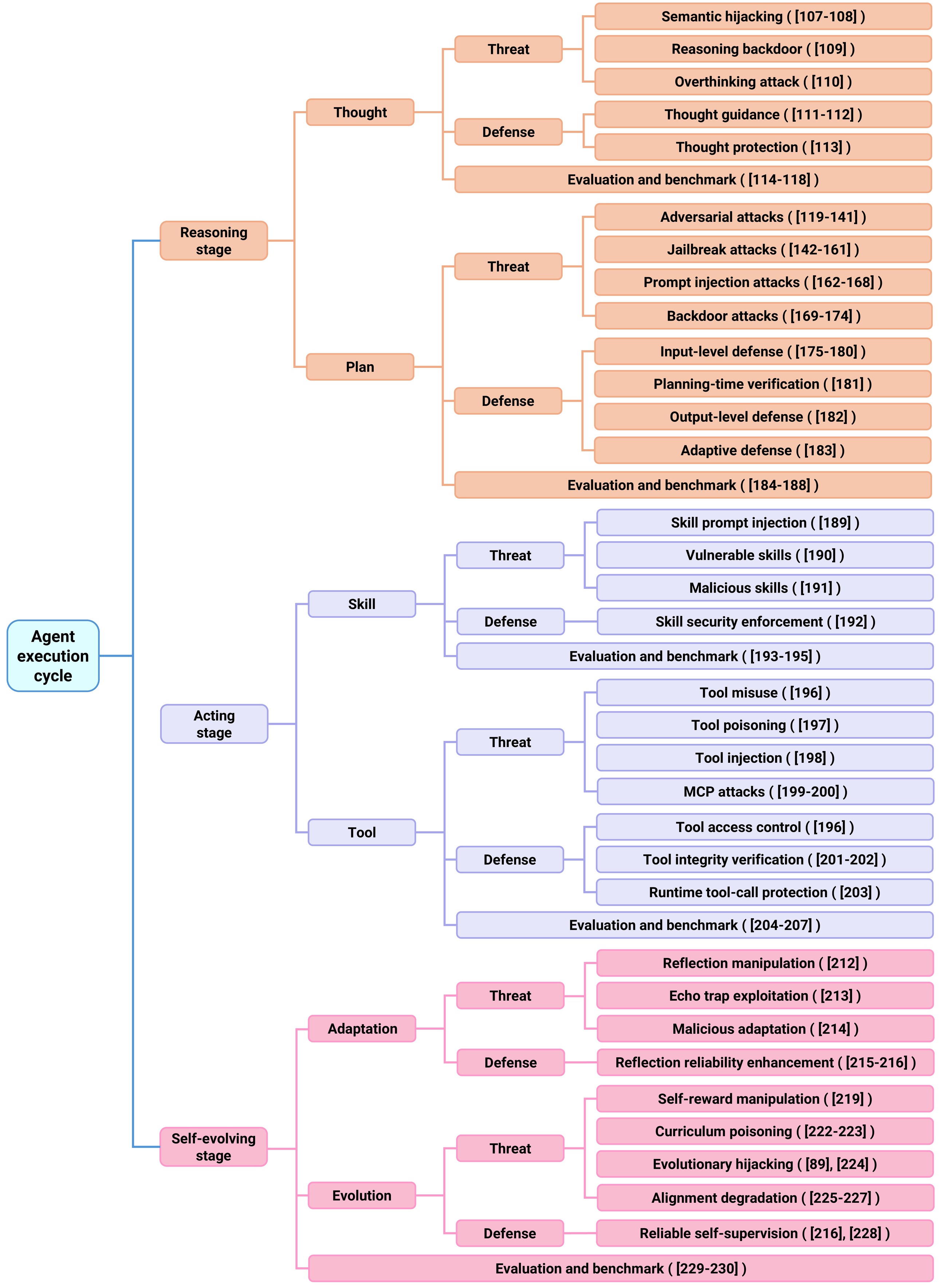
Figure 1.
Taxonomy of existing studies on agent security
-
Figure 2.
Overview of our taxonomy for AI agent security
-
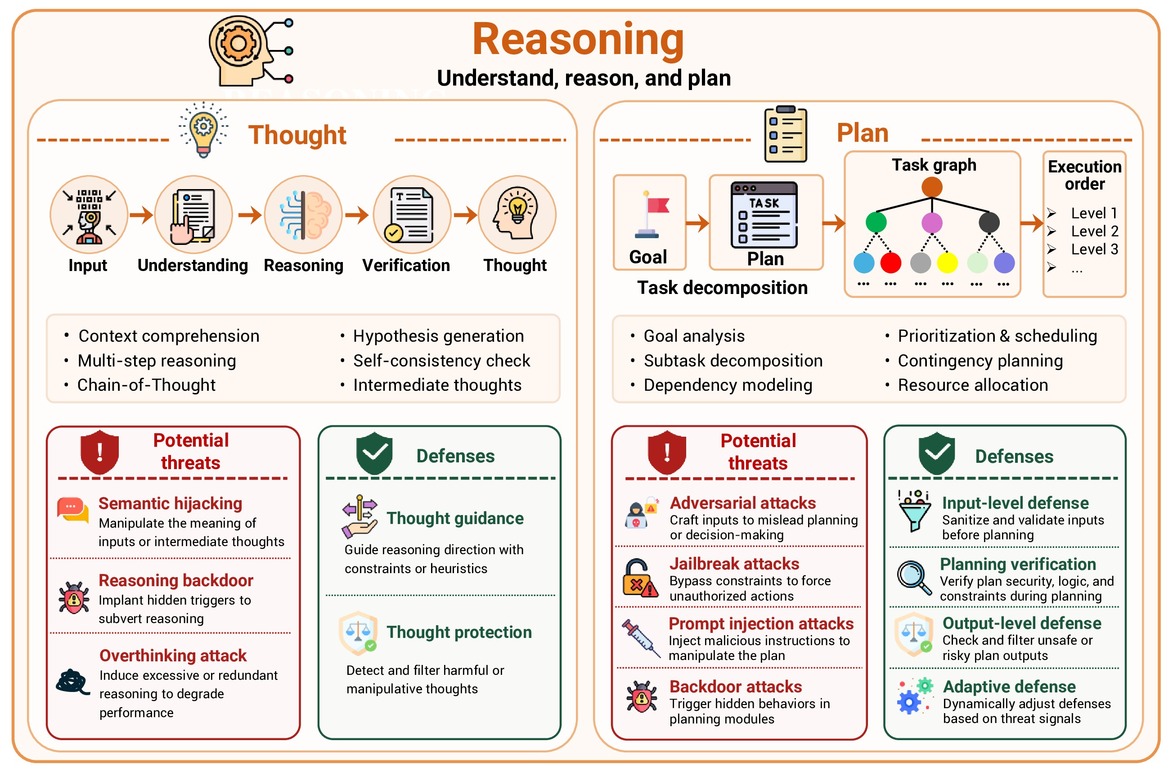
Figure 3.
Overview of reasoning security in the AI agent execution cycle
-
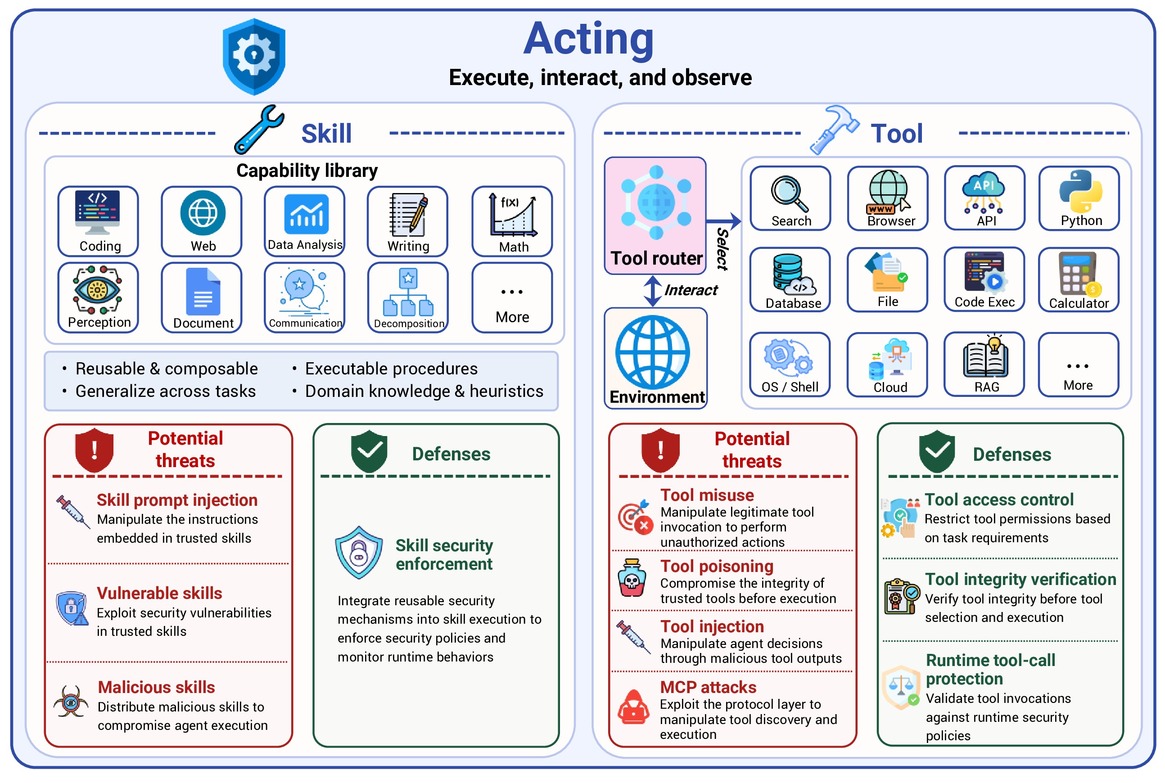
Figure 4.
Overview of acting security in the AI agent execution cycle
-
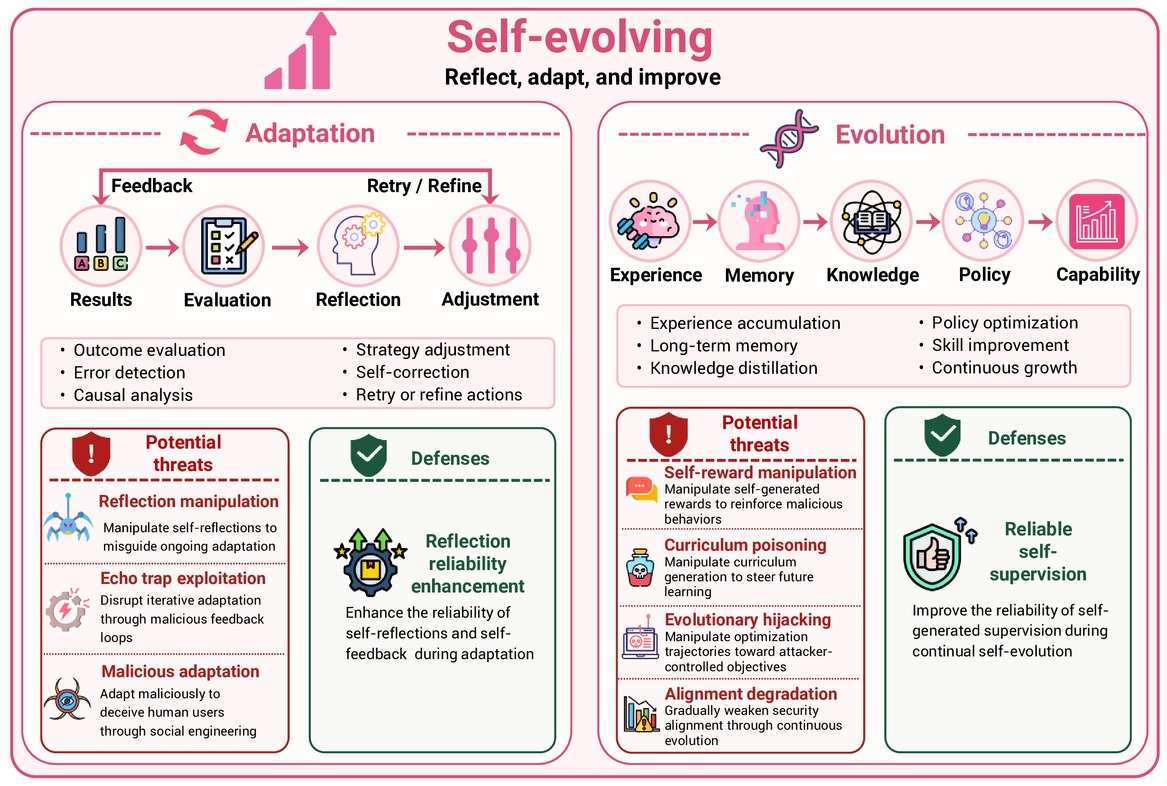
Figure 5.
Overview of self-evolving security in the AI agent execution cycle