
Bohrium + SciMaster: Building the infrastructure and ecosystem for agentic science at scale
-
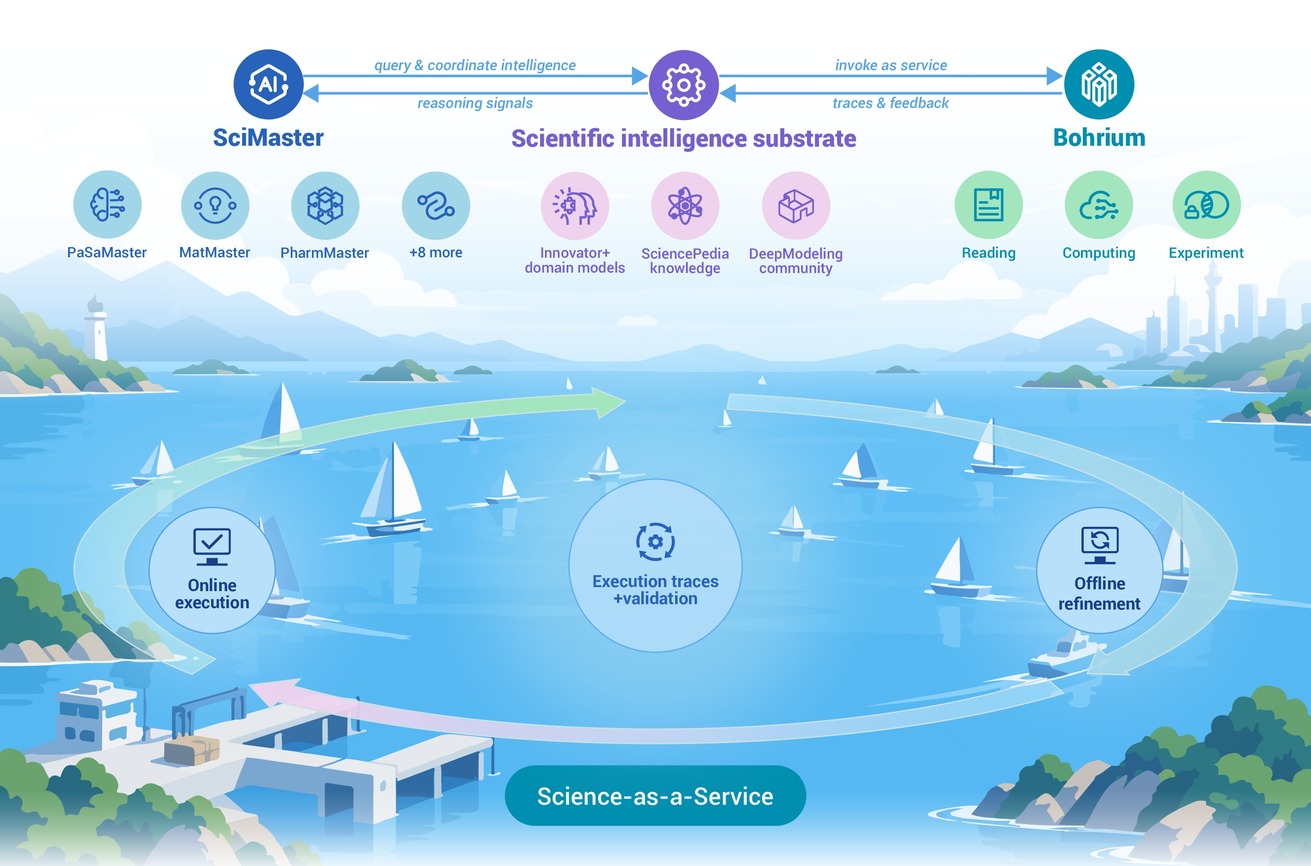
GRAPHICAL ABSTRACT
 DownLoad:
Full size image
DownLoad:
Full size image
-
PUBLIC SUMMARY
-
Bohrium makes scientific assets callable, observable, and governed for agentic workflows.
SciMaster coordinates long-horizon workflows across Reading, Computing, and Experiment.
Eleven master agents report faster cycles in search, simulation, optimization, and design.
The stack points toward Science-as-a-Service with validation and human judgment.
-
-
ABSTRACT
AI agents are emerging as a practical way to run multi-step scientific workflows that interleave reasoning, tool use, and verification. Scaling such agentic science remains difficult because workflows are hard to observe and reproduce, many scientific tools and laboratory systems are not agent-ready, and execution traces are often fragmented. We present Bohrium+SciMaster as an infrastructure-and-ecosystem approach to this problem. Bohrium turns scientific data, software, compute, and laboratory systems into governed, traceable, agent-ready capabilities, while SciMaster orchestrates these capabilities into long-horizon scientific workflows. Between them, a scientific intelligence substrate organizes reusable models, knowledge, and components into executable building blocks for workflow reasoning and action. Across eleven representative master agents spanning literature analysis, simulation, optimization, materials design, and experiment-facing workflows, we report deployment-observed reductions in end-to-end scientific cycle time, together with execution-grounded signals from real workloads at multi-million scale. Together, these results point toward Science-as-a-Service: scientific workflows become increasingly executable, observable, and continuously improvable while remaining anchored in traceable validation and human judgment. -

-
REFERENCES
[1] Jumper J., Evans R., Pritzel A. et al. (2021). Highly accurate protein structure prediction with AlphaFold. Nature 596:583−589. DOI:10.1038/s41586-021-03819-2 [2] Merchant A., Batzner S., Schoenholz S. S. et al. (2023). Scaling deep learning for materials discovery. Nature 624:80−85. DOI:10.1038/s41586-023-06735-9 [3] Zhang L., Han J., Wang H. et al. (2018). Deep potential molecular dynamics: A scalable model with the accuracy of quantum mechanics. Phys. Rev. Lett. 120:143001. DOI:10.1103/PhysRevLett.120.143001 [4] Mitchener L., Yiu A., Chang B. et al. (2025). Kosmos: An AI scientist for autonomous discovery. arXiv:2511.02824. [5] Ghareeb A. E., Chang B., Mitchener L. et al. (2026). A multi-agent system for automating scientific discovery. Nature 655:497−505. DOI:10.1038/s41586-026-10652-y [6] Gottweis J., Weng W.-H., Daryin A. et al. (2026). Accelerating scientific discovery with Co-Scientist. Nature 655:487−496. DOI:10.1038/s41586-026-10644-y [7] Wu M., Wang Y., Ming Y. et al. (2025). CheMatAgent: Enhancing LLMs for chemistry and materials science through tree-search based tool learning. arXiv:2506.07551. [8] Ramos M. C., Collison C. J. and White A. D. (2025). A review of large language models and autonomous agents in chemistry. Chem. Sci. 16:2514−2572. DOI:10.1039/D4SC03921A [9] Chai J., Tang S., Ye R. et al. (2025). SciMaster: Towards general-purpose scientific AI agents, Part I. X-Master as foundation: Can we lead on humanity's last exam? arXiv:2507.05241. [10] Sim M., Vakili M. G., Strieth-Kalthoff F. et al. (2024). ChemOS 2.0: An orchestration architecture for chemical self-driving laboratories. Matter 7:2959−2977. DOI:10.1016/j.matt.2024.04.022 [11] Gao J., Chang J., Que H. et al. (2025). UniLabOS: An AI-native operating system for autonomous laboratories. arXiv:2512.21766. [12] Li Y., Huang Y., Wang T. et al. (2025). Inverse knowledge search over verifiable reasoning: Synthesizing a scientific encyclopedia from a long chains-of-thought knowledge base. arXiv:2510.26854. [13] Zhang D., Peng A., Cai C. et al. (2026). A graph neural network for the era of large atomistic models. npj Comput. Mater. 12:276. DOI:10.1038/s41524-026-02146-2 [14] Zhou G., Gao Z., Ding Q. et al. (2023). Uni-Mol: A universal 3D molecular representation learning framework. In: The Eleventh International Conference on Learning Representations (ICLR). [15] Wang X., Gu R., Chen Z. et al. (2023). UNI-RNA: Universal pre-trained models revolutionize RNA research. bioRxiv. DOI: 10.1101/2023.07.11.548588 [16] Fang X., Hong Y., Wang N. et al. (2025). MolParser: End-to-end visual recognition of molecule structures in the wild. In: Proceedings of the IEEE/CVF International Conference on Computer Vision (ICCV), pp. 24528–24538. DOI: 10.1109/ICCV51701.2025.02274 [17] Gao Z., Ji X., Zhao G. et al. (2023). Uni-QSAR: An auto-ML tool for molecular property prediction. arXiv:2304.12239. [18] Hong Y., Wang N., Xia Z. et al. (2025). Uni-AIMS: AI-powered microscopy image analysis. arXiv:2505.06918. [19] Wen Z., Yang B., Chen S. et al. (2026). Innovator-VL: A multimodal large language model for scientific discovery. arXiv:2601.19325. [20] Wang H., Zhang L., Han J. et al. (2018). DeePMD-kit: A deep learning package for many-body potential energy representation and molecular dynamics. Comput. Phys. Commun. 228:178−184. DOI:10.1016/j.cpc.2018.03.016 [21] Zhou W., Zheng D., Liu Q. et al. (2025). ABACUS: An electronic structure analysis package for the AI era. J. Chem. Phys. 163:192501. DOI:10.1063/5.0297563 [22] Gu Q., Zhouyin Z., Pandey S. K. et al. (2024). Deep learning tight-binding approach for large-scale electronic simulations at finite temperatures with ab initio accuracy. Nat. Commun. 15:6772. DOI:10.1038/s41467-024-51006-4 [23] Zhouyin Z., Gan Z., Pandey S. K. et al. (2025). Learning local equivariant representations for quantum operators. In: The Thirteenth International Conference on Learning Representations (ICLR). [24] Zou J., Zhouyin Z., Lin D. et al. (2025). Deep learning accelerated quantum transport simulations in nanoelectronics: From break junctions to field-effect transistors. npj Comput. Mater. 11:375. DOI:10.1038/s41524-025-01853-6 [25] Mao R., Lin M., Zhang Y. et al. (2023). DeepFlame: A deep learning empowered open-source platform for reacting flow simulations. Comput. Phys. Commun. 291:108842. DOI:10.1016/j.cpc.2023.108842 [26] Xue T., Liao S., Gan Z. et al. (2023). JAX-FEM: A differentiable GPU-accelerated 3D finite element solver for automatic inverse design and mechanistic data science. Comput. Phys. Commun. 291:108802. DOI:10.1016/j.cpc.2023.108802 [27] Zhang Y., Wang H., Chen W. et al. (2020). DP-GEN: A concurrent learning platform for the generation of reliable deep learning based potential energy models. Comput. Phys. Commun. 253:107206. DOI:10.1016/j.cpc.2020.107206 [28] Liu X., Han Y., Li Z. et al. (2024). Dflow: A Python framework for constructing cloud-native AI-for-Science workflows. arXiv:2404.18392. [29] Yuan F., Ding Z., Liu Y.-P. et al. (2025). DPDispatcher: Scalable HPC task scheduling for AI-driven science. J. Chem. Inf. Model. 65:12155−12160. DOI:10.1021/acs.jcim.5c02081 [30] Zeng J., Peng X., Zhuang Y.-B. et al. (2025). dpdata: A scalable Python toolkit for atomistic machine learning data sets. J. Chem. Inf. Model. 65:11497−11504. DOI:10.1021/acs.jcim.5c01767 [31] Li Z., Wen T., Zhang Y. et al. (2025). APEX: An automated cloud-native material property explorer. npj Comput. Mater. 11:88. DOI:10.1038/s41524-025-01580-y [32] Taniai T., Igarashi R., Suzuki Y. et al. (2024). Crystalformer: Infinitely connected attention for periodic structure encoding. In: The Twelfth International Conference on Learning Representations (ICLR). [33] Liu Z., Cai Y., Zhu X. et al. (2025). ML-Master: Towards AI-for-AI via integration of exploration and reasoning. arXiv:2506.16499. [34] Fan E., Hu K., Wu Z. et al. (2026). ChatCFD: A large language model-driven agent for end-to-end computational fluid dynamics automation with structured knowledge and reasoning. Adv. Intell. Discovery 2:e202500174. DOI:10.1002/aidi.202500174 -
ABOUT THIS ARTICLE
Cite this article:
Zhang L., Chen S., Cai Y., et al. (2026). Bohrium + SciMaster: Building the infrastructure and ecosystem for agentic science at scale. AI Plus 1:100005. https://doi.org/10.59717/ipj.aiplus.2026.100005
Welcome!
To request copyright permission to republish or share portions of our works, please visit Copyright Clearance Center's (CCC) Marketplace website at marketplace.copyright.com.
Export File
Citation
Zhang L., Chen S., Cai Y., et al. (2026). Bohrium + SciMaster: Building the infrastructure and ecosystem for agentic science at scale. AI Plus 1:100005. https://doi.org/10.59717/ipj.aiplus.2026.100005

Format
Content
-
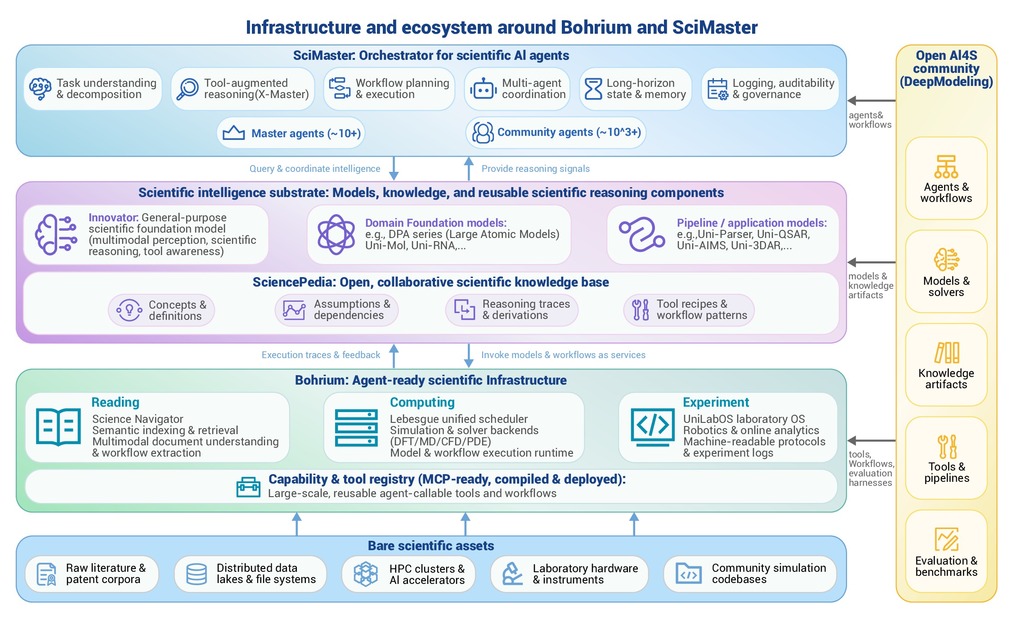
Figure 1.
Infrastructure and ecosystem around Bohrium+SciMaster
-
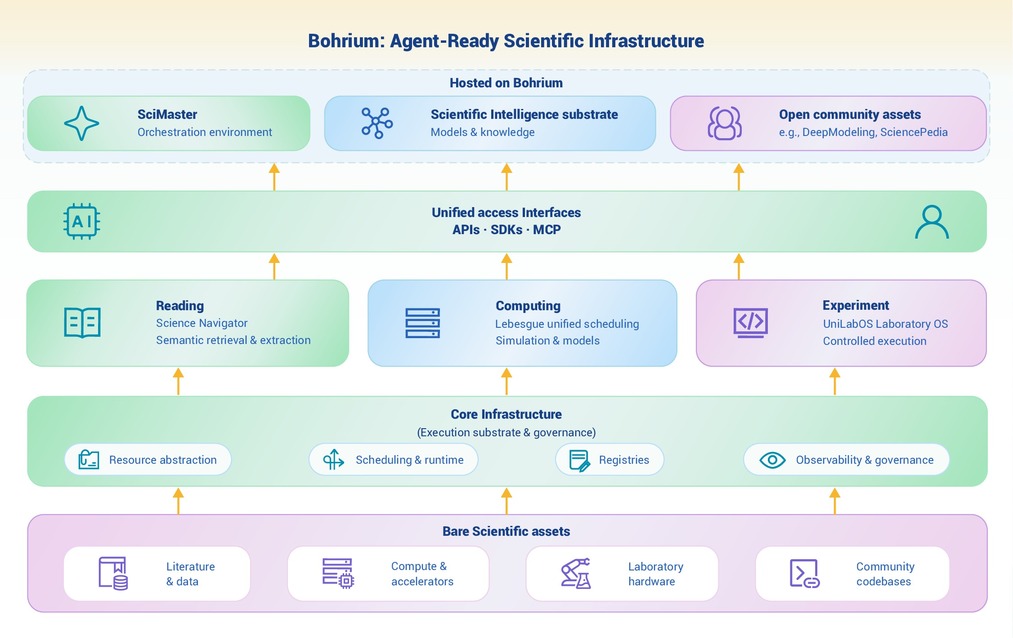
Figure 2.
Bohrium as agent-ready scientific infrastructure.
-
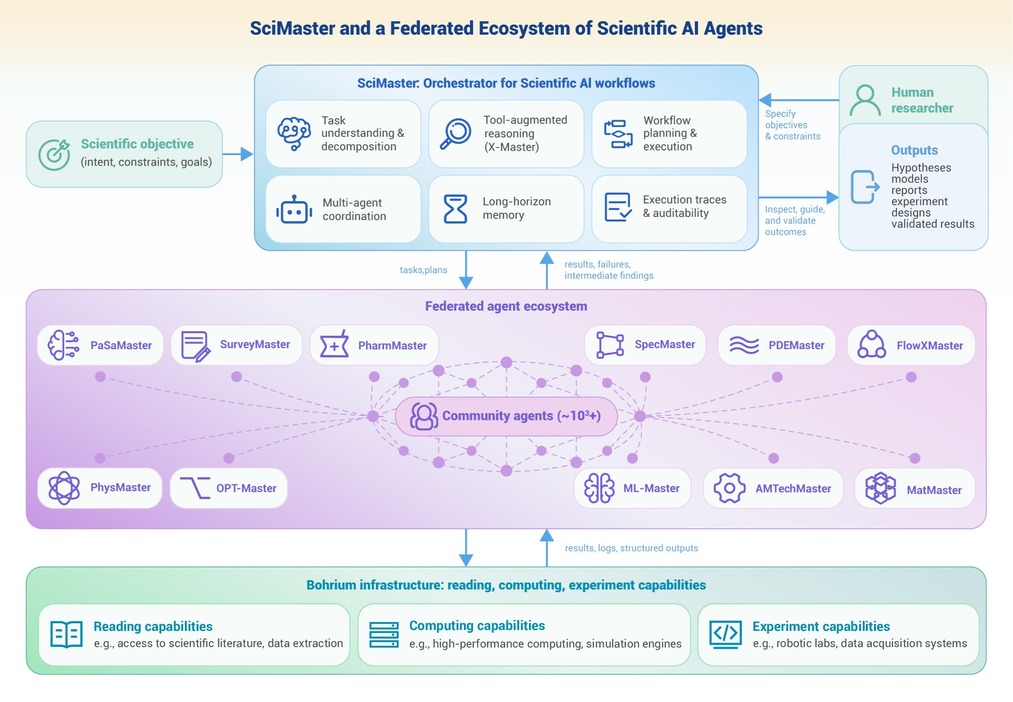
Figure 3.
Workflow-oriented operation of SciMaster
-
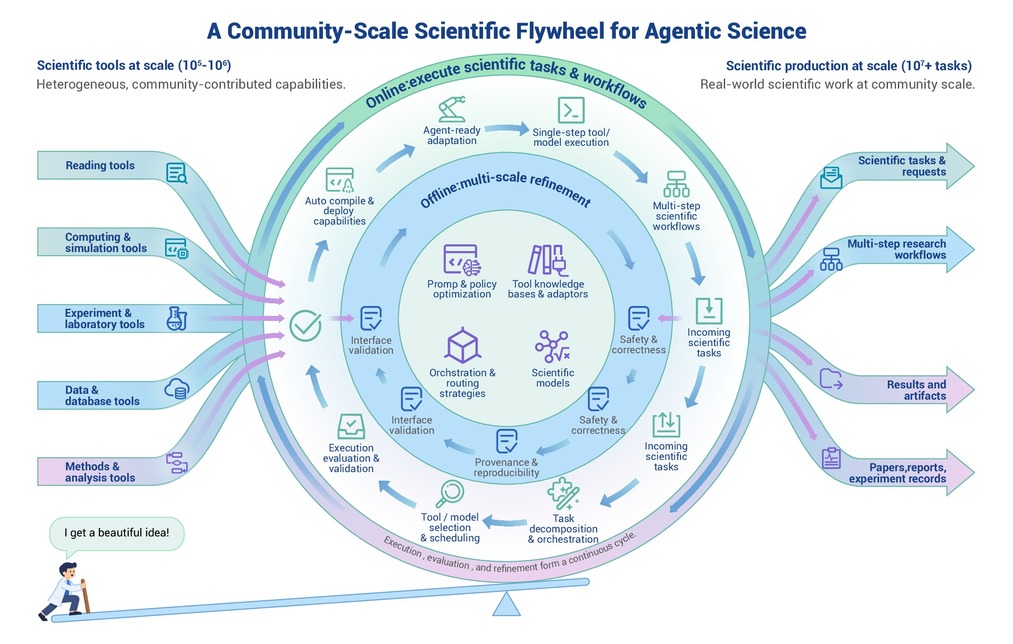
Figure 4.
The emergence of a community-scale scientific flywheel