
GTC: architecture exploration for generation-in-time computing paradigm
-
GRAPHICAL ABSTRACT
 DownLoad:
Full size image
DownLoad:
Full size image
-
PUBLIC SUMMARY
-
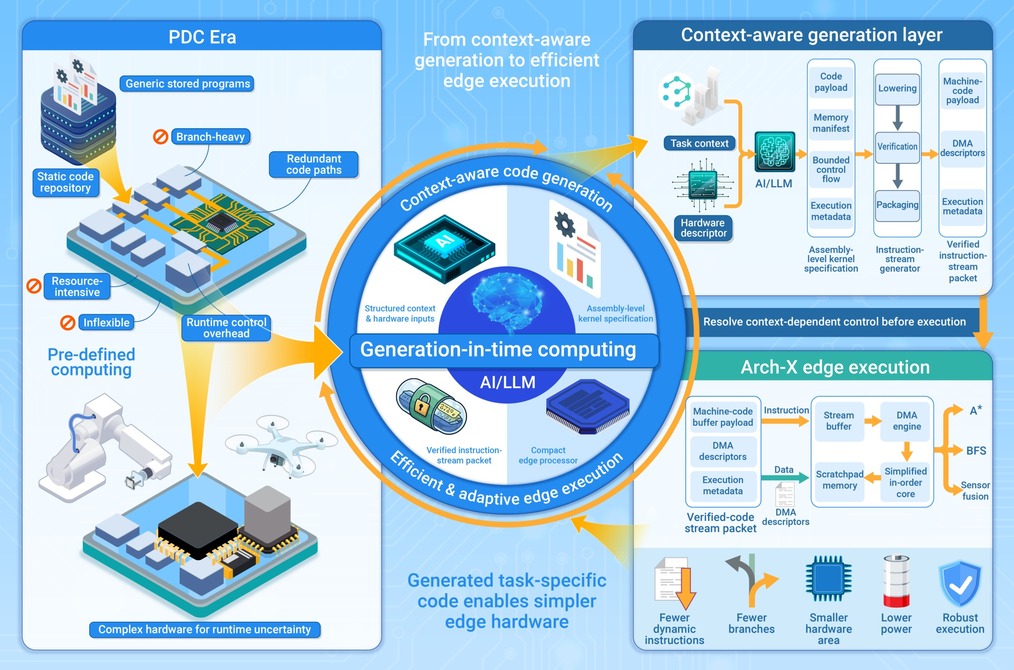
Devices often store many predefined programs even when only one task is active at a time.
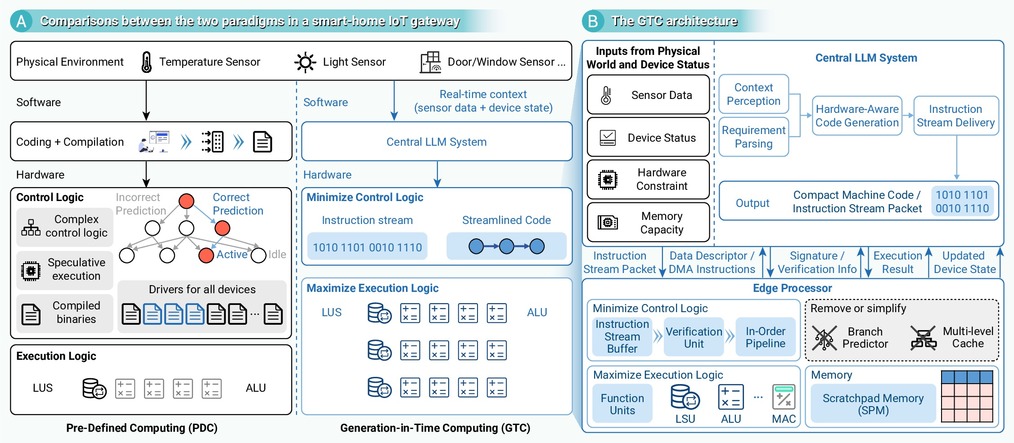
Generation-in-Time Computing (GTC) builds context-specific machine-code streams before edge execution.
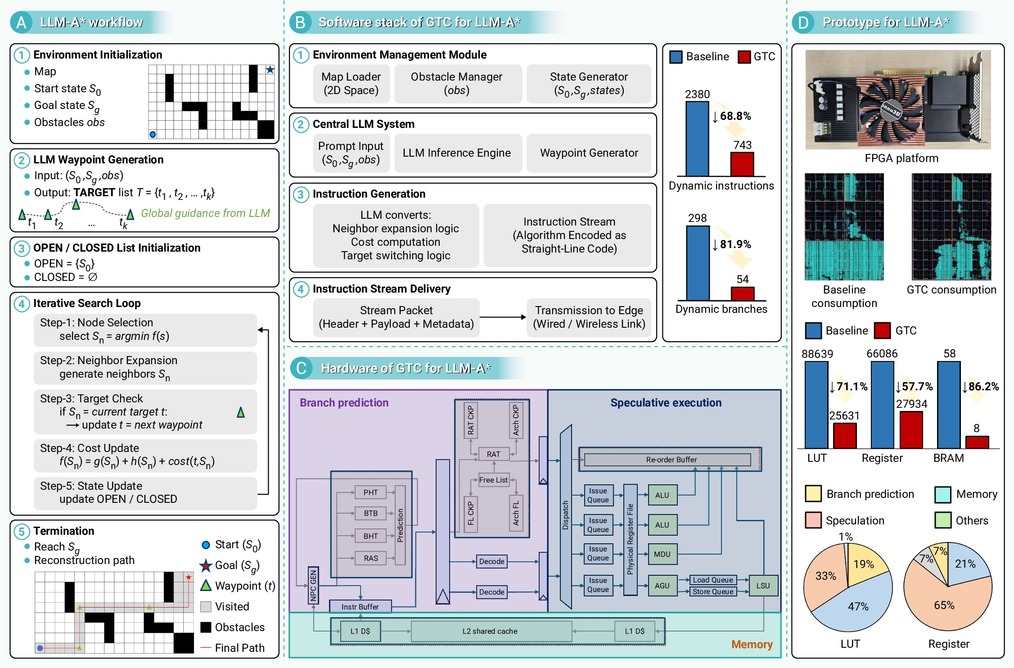
GTC cuts dynamic instructions by 68.8% and FPGA logic power by 52.7% in a path-planning case study.
GTC is especially promising for robots, sensors, and IoT systems that must adapt quickly to changing contexts.
-
-
ABSTRACT
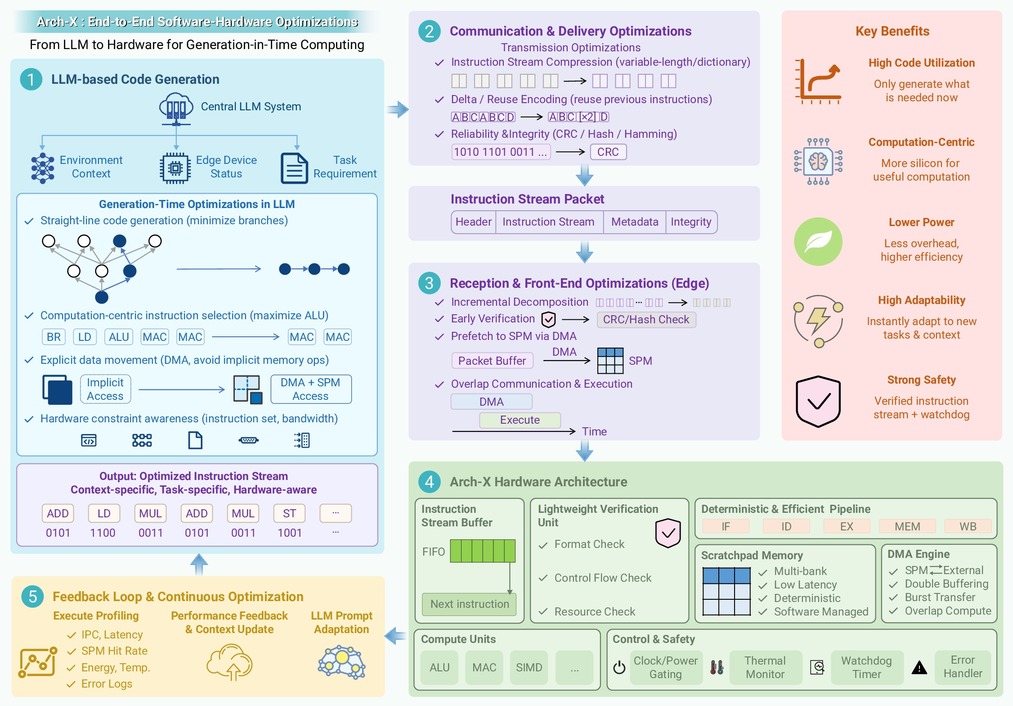
We propose Generation-in-Time Computing (GTC), a software-hardware co-design paradigm in which a centralized, large language model-based generation system translates real-time physical context and target hardware constraints into task-specific executable instruction streams. To realize this paradigm, we present Arch-X, a computation-centric edge architecture that exploits these specialized streams by eliminating or simplifying complex microarchitectural structures commonly used in high-performance processors. We evaluate GTC on three workloads: LLM-guided A* path planning, breadth-first search (BFS), and TinyEKF sensor fusion. For LLM-guided A*, GTC reduces the number of dynamic instructions by 68.8% and branch instructions by 81.9% relative to a predefined-computing baseline. Across all three workloads, GTC improves performance on both in-order and out-of-order processors. An FPGA implementation further shows that Arch-X reduces lookup-table (LUT) and block-RAM (BRAM) usage by 71.1% and 86.2%, respectively, relative to a dual-issue out-of-order reference core, while retaining the arithmetic datapath required by the evaluated workloads. Together, these results provide preliminary evidence that resolving context-dependent control through centralized generation can reduce software overhead and enable simpler edge hardware for efficient, adaptive computation.-
Keywords:
- large language model /
- computing system /
- processor
-

-
REFERENCES
[1] Smith J.E. (1998). A study of branch prediction strategies. 25 Years of the international symposia on Computer architecture (selected papers) (Association for Computing Machinery), pp: 202–215. DOI: 10.1145/285930.285980 [2] Tomasulo R.M. (1967). An efficient algorithm for exploiting multiple arithmetic units. IBM J. Res. Dev. 11:25−33. DOI:10.1147/rd.111.0025 [3] Smith J.E. and Pleszkun A.R. (1988). Implementing precise interrupts in pipelined processors. IEEE Trans. Comput. 37:562−573. DOI:10.1109/12.4607 [4] Pettis K. and Hansen R.C. (1990). Profile guided code positioning. SIGPLAN Not. 25:16−27. DOI:10.1145/93548.93550 [5] Kessler R.E. (1999). The Alpha 21264 microprocessor. IEEE Micro 19:24−36. DOI:10.1109/40.755465 [6] Yeager K.C. (1996). The Mips R10000 superscalar microprocessor. IEEE Micro 16:28−41. DOI:10.1109/40.491460 [7] McFarling S. (1993). Combining branch predictors. (Digital Western Research Laboratory). [8] Smith A.J. and Goodman J.R. (1985). Instruction cache replacement policies and organizations. IEEE Trans. Comput. C–34:234−241. DOI:10.1109/tc.1985.1676566 [9] Smith A.J. (1978). Sequential program prefetching in memory hierarchies. Computer 11:7−21. DOI:10.1109/c-m.1978.218016 [10] Meng S., Wang Y., Yang C.F. et al. (2024). LLM-A*: large language model enhanced incremental heuristic search on path planning. Findings of the Association for Computational Linguistics: EMNLP 2024, pp: 1087–1102. DOI: 10.18653/v1/2024.findings-emnlp.60 [11] Hart P.E., Nilsson N.J. and Raphael B. (1968). A formal basis for the heuristic determination of minimum cost paths. IEEE Trans. Syst. Sci. Cybern. 4:100−107. DOI:10.1109/tssc.1968.300136 [12] Jiang J., Wang F., Shen J. et al. (2026). A survey on large language models for code generation. ACM Trans. Softw. Eng. Methodol. 35:1−72. DOI:10.1145/3747588 [13] Zhang S., Zhao J., Yu Q. et al. (2026). The new compiler stack: A survey on the synergy of LLMs and compilers. CCF Trans. High Perform. Comput. 8:148−179. DOI:10.1007/s42514-025-00270-x [14] Huynh N. and Lin B. (2025). Large language models for code generation: A comprehensive survey of challenges, techniques, evaluation, and applications. arXiv preprint. DOI: 10.48550/arXiv.2503.01245 [15] Dakhel A.M., Majdinasab V., Nikanjam A. et al. (2023). GitHub Copilot AI pair programmer: Asset or Liability?. J. Syst. Softw. 203:111734. DOI:10.1016/j.jss.2023.111734 [16] Yang J., Liu X., Lv W. et al. (2025). From code foundation models to agents and applications: A comprehensive survey and practical guide to code intelligence. arXiv preprint. DOI: 10.48550/arXiv.2511.18538 [17] Gong J., Voskanyan V., Brookes P. et al. (2025). Language models for code optimization: Survey, challenges and future directions. arXiv preprint. DOI: 10.48550/arXiv.2501.01277 [18] Romero Rosas M.R., Torres Sanchez M.A., and Eigenmann R. (2025). Should AI optimize your code? A comparative study of classical optimizing compilers versus current large language models. Proceedings of the 2025 Supercomputing Asia Conference (ACM), pp: 22-29. DOI: 10.1145/3718350.3718357 [19] Anand V., Garg D. and Kaufmann A. (2025). Iridescent: A framework enabling online system implementation specialization. arXiv preprint. DOI: 10.48550/arXiv.2508.16690 [20] Jones N.D., Gomard C.K. and Sestoft P. (1993). Partial evaluation and automatic program generation. (Peter Sestoft). [21] de Assis Costa I.R., Santos H.N., Alves P.R. et al. (2014). Just-in-time value specialization. Comput. Lang. Syst. Struct. 40:37−52. DOI:10.1016/j.cl.2013.11.001 [22] Aycock J. (2003). A brief history of just-in-time. ACM Comput. Surv. 35:97−113. DOI:10.1145/857076.857077 [23] Kobaladze Z., Arnania A. and Sanikidze T. (2025). From provable correctness to probabilistic generation: A comparative review of program synthesis paradigms. arXiv preprint. DOI: 10.48550/arXiv.2508.00013 [24] Mittal S. (2018). A survey of techniques for dynamic branch prediction. Concurr. Comput. Pract. Exp. 31:e4666. DOI:10.1002/cpe.4666 [25] Banakar R., Steinke S., Lee B.S. et al. (2002). Scratchpad memory: design alternative for cache on-chip memory in embedded systems. Proceedings of the tenth international symposium on Hardware/software codesign (Association for Computing Machinery), pp: 73–78. DOI: 10.1145/774789.774805 [26] Guan W., Hu Q., Li A. et al. (2025). Efficient vision-language-action models for embodied manipulation: A systematic survey. arXiv preprint. DOI: 10.48550/arXiv.2510.17111 [27] Li X., He X., Zhang L. et al. (2025). A comprehensive survey on world models for embodied AI. arXiv preprint. DOI: 10.48550/arXiv.2510.16732 [28] Liu F., Tang G., Li Y. et al. (2019). A survey on edge computing systems and tools. Proc. IEEE 107:1537−1562. DOI:10.1109/JPROC.2019.2920341 [29] Wen X., Zhao Y., Xu X. et al. (2026). From craft to kernel: A governance-first execution architecture and semantic ISA for agentic computers. arXiv preprint. DOI: 10.48550/arXiv.2604.18652 [30] McCann A.L. (2026). Governed metaprogramming for intelligent systems: Reclassifying eval as a governed effect. arXiv preprint. DOI: 10.48550/arXiv.2605.05248 [31] Liu Z., Chen X., Wu H. et al. (2025). Integrated sensing and edge AI: Realizing intelligent perception in 6G. IEEE Commun. Surv. Tutor. 28:2725−2770. DOI:10.1109/COMST.2025.3592989 [32] Nie J., Wu H., Lai Y. et al. (2026). KernelCraft: Benchmarking for agentic close-to-metal kernel generation on emerging hardware. arXiv preprint. DOI: 10.48550/arXiv.2603.08721 [33] Dehury C.K., Kushwaha S.S., Zhang Q. et al. (2026). LLM-assisted Agentic Edge Intelligence Framework. arXiv preprint. DOI: 10.48550/arXiv.2604.09607 [34] Wehmeyer L. and Marwedel P. (2005). Influence of memory hierarchies on predictability for time constrained embedded software. Design, Automation and Test in Europe (IEEE), pp: 600–605. DOI: 10.1109/DATE.2005.183 [35] Horro M., Rodríguez G., Touriño J. et al. (2018). Architectural exploration of heterogeneous memory systems. arXiv preprint. DOI: 10.48550/arXiv.1810.12573 [36] Zhang Y., Malawade A.V., Zhang X. et al. (2023). CARMA: Context-aware runtime reconfiguration for energy-efficient sensor fusion. 2023 IEEE/ACM International Symposium on Low Power Electronics and Design (ISLPED) (IEEE), pp: 1-6. DOI: 10.1109/ISLPED58423.2023.10244517 [37] Jain D., Pardeshi A., Frigo M. et al. (2025). ACT: Automatically generating compiler backends from tensor accelerator ISA descriptions. arXiv preprint. DOI: 10.48550/arXiv.2510.09932 [38] Kan S. and Ertel S. (2026). Interaction tree semantics for RISC-V: Bridging compiler and hardware verification. arXiv preprint. DOI: 10.48550/arXiv.2605.04933 [39] Li L., Rahili S. and Zhao Y. (2025). Correctness-guaranteed code generation via constrained decoding. arXiv preprint. DOI: 10.48550/arXiv.2508.15866 [40] Mündler N., He J., Wang H. et al. (2025). Type-constrained code generation with language models. Proc. ACM Program. Lang. 9:601−626. DOI:10.1145/3729274 [41] Liao G., Qin H., Wang Y. et al. (2025). KernelEvolve: Scaling agentic kernel coding for heterogeneous AI accelerators at meta. arXiv preprint. DOI: 10.48550/arXiv.2512.23236 [42] Mukherjee P., Lu M. and Delaware B. (2025). LLM-assisted synthesis of high-assurance c programs. 2025 40th IEEE/ACM International Conference on Automated Software Engineering (ASE), pp: 3108–3108. DOI: 10.1109/ase63991.2025.00255 [43] Du W., Zhuo J., Dong Y. et al. (2026). AdaExplore: Failure-driven adaptation and diversity-preserving search for efficient kernel generation. arXiv preprint. DOI: 10.48550/arXiv.2604.16625 [44] Zhang R., Liu G., Liu Y. et al. (2026). Toward edge general intelligence with agentic AI and agentification: Concepts, technologies, and future directions. IEEE Commun. Surv. Tutor. 28:4285−4318. DOI:10.1109/COMST.2026.3651702 [45] Qu G., Chen Q., Wei W. et al. (2025). Mobile edge intelligence for large language models: A contemporary survey. IEEE Commun. Surv. Tutor. 27:3820−3860. DOI:10.1109/COMST.2025.3527641 [46] Cao S., Mao Z., Gonzalez J.E. et al. (2026). K-search: LLM kernel generation via coevolving intrinsic world model. arXiv preprint. DOI: 10.48550/arXiv.2602.19128 [47] Brooks R.A. (1986). A robust layered control system for a mobile robot. IEEE J. Robot. Autom. 2:14−23. DOI:10.1109/jra.1986.1087032 [48] Zheng Y., Chen Y., Qian B. et al. (2025). A review on edge large language models: Design, execution, and applications. ACM Comput. Surv. 57:1−35. DOI:10.1145/3719664 [49] Yang B., He L., Ling N. et al. (2023). EdgeFM: Leveraging Foundation Model for Open-set Learning on the Edge. Proceedings of the 21st ACM Conference on Embedded Networked Sensor Systems (Association for Computing Machinery), pp: 111–124. DOI: 10.1145/3625687.3625793 [50] Gill S.S., Golec M., Hu J. et al. (2025). Edge AI: A taxonomy, systematic review and future directions. Clust. Comput. 28:18. DOI:10.1007/s10586-024-04686-y [51] Kang Y., Hauswald J., Gao C. et al. (2017). Neurosurgeon: Collaborative intelligence between the cloud and mobile edge. ACM SIGARCH Comput. Arch. News 45:615−629. DOI:10.1145/3093337.3037698 [52] Varghese T.G., Kochuvila S., Kumar N. et al. (2026). Hybrid coordination framework for centralized task allocation and execution in heterogeneous multi-robot systems. IEEE Access 14:61573−61595. DOI:10.1109/ACCESS.2026.3680629 [53] Sun L., Yang Y., Duan Q. et al. (2025). Multi-agent coordination across diverse applications: A survey. arXiv preprint. DOI: 10.48550/arXiv.2502.14743 [54] Alhanahnah M., Boshmaf Y. and Gehani A. (2024). SoK: Software debloating landscape and future directions. Proceedings of the 2024 workshop on forming an ecosystem around software transformation (Association for Computing Machinery), pp: 11–18. DOI: 10.1145/3689937.3695792 [55] Manadhata P.K. and Wing J.M. (2011). A formal model for a system’s attack surface. Moving target defense (Springer), pp: 1–28. DOI: 10.1007/978-1-4614-0977-91 [56] Huang X., Ruan W., Huang W. et al. (2024). A survey of safety and trustworthiness of large language models through the lens of verification and validation. Artif. Intell. Rev. 57:175. DOI:10.1007/s10462-024-10824-0 [57] Nguyen D.C., Ding M., Pathirana P.N. et al. (2021). Federated learning for internet of things: A comprehensive survey. IEEE Commun. Surv. Tutor. 23:1622−1658. DOI:10.1109/COMST.2021.3075439 [58] Wu J., Liu J., Liu Y. et al. (2025). A survey on cloud-edge-terminal collaborative intelligence in AIoT networks. arXiv preprint. DOI: 10.48550/arXiv.2508.18803 [59] Levy S.D. (2025). TinyEKF: Lightweight C/C++ Extended Kalman Filter with Python for prototyping. GitHub. Available at: https://github.com/simondlevy/TinyEKF (accessed July 5, 2026). -
ABOUT THIS ARTICLE
Cite this article:
Ren P., Fu G., Liu S., et al. (2026). GTC: architecture exploration for generation-in-time computing paradigm. AI Plus 1:100007. https://doi.org/10.59717/ipj.aiplus.2026.100007
Welcome!
To request copyright permission to republish or share portions of our works, please visit Copyright Clearance Center's (CCC) Marketplace website at marketplace.copyright.com.
Export File
Citation
Ren P., Fu G., Liu S., et al. (2026). GTC: architecture exploration for generation-in-time computing paradigm. AI Plus 1:100007. https://doi.org/10.59717/ipj.aiplus.2026.100007

Format
Content
-
Figure 1.
From Predefined Computing to Generation-in-Time Computing
-
Figure 2.
Cross-stack workflow of GTC
-
Figure 3.
Mapping LLM-A* onto Arch-X
-
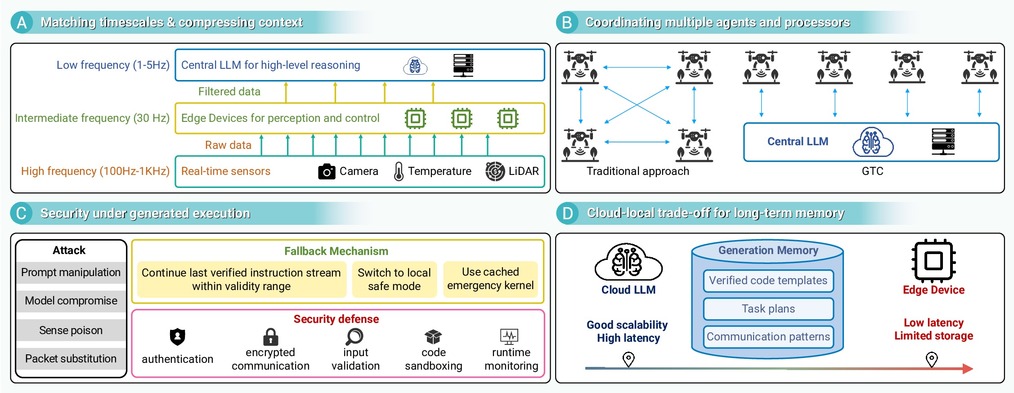
Figure 4.
System-level design considerations for GTC