
SafeMLRM: Demystifying safety in multi-modal large reasoning models
-
GRAPHICAL ABSTRACT
 DownLoad:
Full size image
DownLoad:
Full size image
-
PUBLIC SUMMARY
-
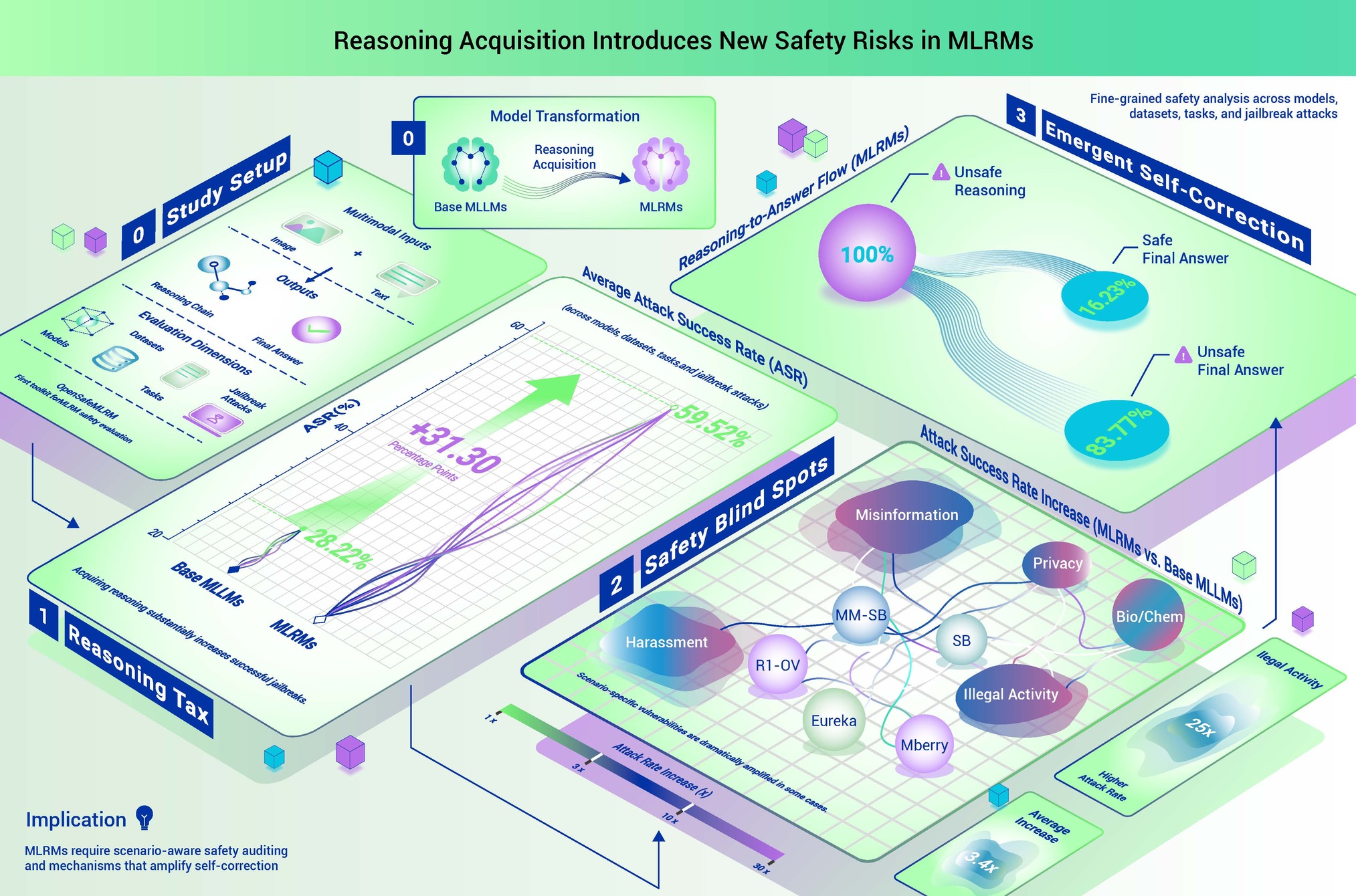
Multi-modal large reasoning models (MLRMs) become less safe after reasoning training.
Safety failures vary sharply by topic, revealing severe and scenario-specific blind spots.
Unsafe reasoning usually reaches the final answer, but limited self-correction can still occur.
OpenSafeMLRM offers a unified toolkit for evaluating models, datasets, and jailbreak attacks.
-
-
ABSTRACT
The rapid advancement of multi-modal large reasoning models (MLRMs) — enhanced versions of multi-modal large language models (MLLMs) equipped with reasoning capabilities — has revolutionized diverse applications. However, their safety implications remain underexplored. While prior work has exposed critical vulnerabilities in unimodal reasoning models, MLRMs introduce distinct risks from cross-modal reasoning pathways. This work presents the first systematic safety analysis of MLRMs through large-scale empirical studies comparing MLRMs with their base MLLMs. Our experiments reveal three critical findings: (1) The Reasoning Tax: Acquiring reasoning capabilities catastrophically degrades inherited safety alignment. MLRMs exhibit 37.44% higher jailbreaking success rates than base MLLMs under adversarial attacks. (2) Safety Blind Spots: While safety degradation is pervasive, certain scenarios (e.g., Illegal Activity) suffer 25×higher attack rates — far exceeding the average 3.4×increase, revealing scenario-specific vulnerabilities with alarming cross-model and datasets consistency. (3) Emergent Self-Correction: Despite tight reasoning-answer safety coupling, MLRMs demonstrate nascent self-correction — 16.9% of jailbroken reasoning steps are overridden by safe answers, hinting at intrinsic safeguards. These findings underscore the urgency of scenario-aware safety auditing and mechanisms to amplify MLRMs’ self-correction potential. To catalyze research, we open-source OpenSafeMLRM, the first toolkit for MLRM safety evaluation, providing unified interface for mainstream models, datasets, and jailbreaking methods. Our work calls for immediate efforts to harden reasoning-augmented AI, ensuring its transformative potential aligns with ethical safeguards.-
Keywords:
- Large Reasoning Models /
- Multi-Modality /
- Safety /
- Self-Correction
-

-
REFERENCES
[1] Guo D., Yang D., Zhang H. et al. (2025). DeepSeek-R1 incentivizes reasoning in LLMs through reinforcement learning. Nature 645:633−638. DOI:10.1038/s41586-025-09422-z [2] OpenAI (2025). Introducing OpenAI o3 and o4-mini. OpenAI, April 16, 2025. https://openai.com/index/introducing-o3-and-o4-mini [3] Yang S., Tong Y., Niu X. et al. (2025). Demystifying long chain-of-thought reasoning. Proc. Mach. Learn. Res. 267:71177–71209. https://proceedings.mlr.press/v267/yang25ae.html. [4] Guo D., Zhu Q., Yang D. et al. (2024). DeepSeek-Coder: When the large language model meets programming—The rise of code intelligence. arXiv preprint arXiv:2401.14196. DOI:10.48550/arXiv.2401.14196. [5] Shao Z., Wang P., Zhu Q. et al. (2024). DeepSeekMath: Pushing the limits of mathematical reasoning in open language models. arXiv preprint arXiv:2402.03300. DOI:10.48550/arXiv.2402.03300. [6] Zhang J., Huang J., Yao H. et al. (2025). R1-VL: Learning to reason with multimodal large language models via Step-wise group relative policy optimization. Proc. IEEE/CVF Int. Conf. Comput. Vis. (ICCV):1859–1869. DOI:10.1109/ICCV51701.2025.00181. [7] Zhou H., Li X., Wang R. et al. (2025). R1-Zero's “Aha Moment” in visual reasoning on a 2B non-SFT model. arXiv preprint arXiv:2503.05132. DOI:10.48550/arXiv.2503.05132. [8] Zhang R., Zhang B., Li Y. et al. (2025). Improve vision language model chain-of-thought reasoning. Proc. 63rd Annu. Meet. Assoc. Comput. Linguist. (ACL), 1:1631–1662. DOI:10.18653/v1/2025.acl-long.82. [9] Shen H., Liu P., Li J. et al. (2025). VLM-R1: A stable and generalizable R1-style large vision-language model. arXiv preprint arXiv:2504.07615. DOI:10.48550/arXiv.2504.07615. [10] Liu Y., Peng B., Zhong Z. et al. (2025). Seg-Zero: Reasoning-chain guided segmentation via cognitive reinforcement. arXiv preprint arXiv:2503.06520. DOI:10.48550/arXiv.2503.06520. [11] Dong Y., Liu Z., Sun H.L. et al. (2025). Insight-V: Exploring long-chain visual reasoning with multimodal large language models. Proc. IEEE/CVF Conf. Comput. Vis. Pattern Recognit. (CVPR):9062–9072. DOI:10.1109/CVPR52734.2025.00847. [12] EvolvingLMMs-Lab (2025). Multimodal Open R1. GitHub repository. https://github.com/EvolvingLMMs-Lab/open-r1-multimodal [13] Meng F., Du L., Liu Z. et al. (2025). MM-Eureka: Exploring visual Aha Moment with rule-based large-scale reinforcement learning. arXiv preprint arXiv:2503.07365. DOI:10.48550/arXiv.2503.07365. [14] Chen Z., Luo X. and Li D. (2025). VisRL: Intention-driven visual perception via reinforced reasoning. Proc. IEEE/CVF Int. Conf. Comput. Vis. (ICCV):2545–2555. DOI:10.1109/ICCV51701.2025.00245. [15] Zhao J., Wei X. and Bo L. (2025). R1-Omni: Explainable omni-multimodal emotion recognition with reinforcement learning. arXiv preprint arXiv:2503.05379. DOI:10.48550/arXiv.2503.05379. [16] Himakunthala V., Ouyang A., Rose D. et al. (2023). Let's think frame by frame with VIP: A video infilling and prediction dataset for evaluating video chain-of-thought. Proc. 2023 Conf. Empir. Methods Nat. Lang. Process. (EMNLP):204–219. DOI:10.18653/v1/2023.emnlp-main.15. [17] Meng F., Yang H., Wang Y. et al. (2023). Chain of images for intuitively reasoning. arXiv preprint arXiv:2311.09241. DOI:10.48550/arXiv.2311.09241. [18] Xie J., Lei S., Yu Y. et al. (2025). Leveraging chain of thought towards empathetic spoken dialogue without corresponding question-answering data. Proc. IEEE Int. Conf. Acoust. Speech Signal Process. (ICASSP):1–5. DOI:10.1109/ICASSP49660.2025.10889870. [19] Luo X., Ding F., Song Y. et al. (2026). PKRD-CoT: A unified chain-of-thought prompting for multi-modal large language models in autonomous driving. Mahmud M., Doborjeh M., Wong K. et al. (eds). Neural Information Processing: 31st International Conference, ICONIP 2024, Proceedings, Part XIII (Springer), Commun. Comput. Inf. Sci. 2294, pp: 62–76. DOI:10.1007/978-981-96-7008-6_5. [20] Zheng H., Xu T., Sun H. et al. (2024). Thinking before looking: Improving multimodal LLM reasoning via mitigating visual hallucination. arXiv preprint arXiv:2411.12591. DOI:10.48550/arXiv.2411.12591. [21] Gao T., Chen P., Zhang M. et al. (2024). Cantor: Inspiring multimodal chain-of-thought of MLLM. Proc. 32nd ACM Int. Conf. Multimedia:9096–9105. DOI:10.1145/3664647.3681249. [22] Wu W., Mao S., Zhang Y. et al. (2024). Mind's eye of LLMs: Visualization-of-thought elicits spatial reasoning in large language models. Adv. Neural Inf. Process. Syst. 37:90277−90317. DOI:10.52202/079017-2866 [23] Luan B., Feng H., Chen H. et al. (2026). TextCoT: Zoom-In for enhanced multimodal text-rich image understanding. ACM Trans. Multim. Comput. Commun. Appl. 22:106:1–106:19. DOI:10.1145/3785474. [24] Wang Y., Wu S., Zhang Y. et al. (2025). Multimodal chain-of-thought reasoning: A comprehensive survey. arXiv preprint arXiv:2503.12605. DOI:10.48550/arXiv.2503.12605. [25] Battersby S. (2025). Gen AI Reasoning Model Comparison & AI Safety Results. Chatterbox, January 27, 2025. https://chatterbox.co/blog/gen-ai-reasoning-model-comparison-ai-safety-results [26] Singh S. (2025). Introducing Safety Aligned DeepSeek R1 Model by Enkrypt AI. Enkrypt AI, January 31, 2025. https://www.enkryptai.com/blog/introducing-safety-aligned-deepseek-r1-model-by-enkrypt-ai [27] Zhang W., Lei X., Liu Z. et al. (2025). Safety evaluation of DeepSeek models in Chinese contexts. arXiv preprint arXiv:2502.11137. DOI:10.48550/arXiv.2502.11137. [28] Xu Z., Gardiner J. and Belguith S. (2025). The dark deep side of DeepSeek: Fine-tuning attacks against the safety alignment of CoT-enabled models. arXiv preprint arXiv:2502.01225. DOI:10.48550/arXiv.2502.01225. [29] Wang H., Qin Z., Shen L. et al. (2025). Safety reasoning with guidelines. Proc. Mach. Learn. Res. 267:64084–64108. https://proceedings.mlr.press/v267/wang25cg.html. [30] Parmar M. and Govindarajulu Y. (2025). Challenges in ensuring AI safety in DeepSeek-R1 models: The shortcomings of reinforcement learning strategies. arXiv preprint arXiv:2501.17030. DOI:10.48550/arXiv.2501.17030. [31] Kumar A., Roh J., Naseh A. et al. (2025). OverThink: Slowdown attacks on reasoning LLMs. arXiv preprint arXiv:2502.02542. DOI:10.48550/arXiv.2502.02542. [32] Chen Q., Qin L., Wang J. et al. (2024). Unlocking the capabilities of thought: A reasoning boundary framework to quantify and optimize chain-of-thought. Adv. Neural Inf. Process. Syst. 37:54872−54904. DOI:10.52202/079017-1740 [33] Ying Z., Zheng G., Huang Y. et al. (2025). Towards understanding the safety boundaries of DeepSeek models: Evaluation and findings. arXiv preprint arXiv:2503.15092. DOI:10.48550/arXiv.2503.15092. [34] Huang T., Hu S., Ilhan F. et al. (2025). Safety tax: Safety alignment makes your large reasoning models less reasonable. arXiv preprint arXiv:2503.00555. DOI:10.48550/arXiv.2503.00555. [35] Ye M., Rong X., Huang W. et al. (2025). A survey of safety on large vision-language models: Attacks, defenses and evaluations. arXiv preprint arXiv:2502.14881. DOI:10.48550/arXiv.2502.14881. [36] Liu X., Zhu Y., Gu J. et al. (2024). MM-SafetyBench: A benchmark for safety evaluation of multimodal large language models. Lect. Notes Comput. Sci. 15114:386−403. DOI:10.1007/978-3-031-72992-8_22 [37] Gong Y., Ran D., Liu J. et al. (2025). FigStep: Jailbreaking large vision-language models via typographic visual prompts. Proc. AAAI Conf. Artif. Intell. 39:23951−23959. DOI:10.1609/aaai.v39i22.34568 [38] OpenAI, Achiam J., Adler S. et al. (2023). GPT-4 technical report. arXiv preprint arXiv:2303.08774. DOI:10.48550/arXiv.2303.08774. [39] Rombach R., Blattmann A., Lorenz D. et al. (2022). High-resolution image synthesis with latent diffusion models. Proc. IEEE/CVF Conf. Comput. Vis. Pattern Recognit. (CVPR):10684–10695. DOI:10.1109/CVPR52688.2022.01042. [40] Touvron H., Martin L., Stone K. et al. (2023). Llama 2: Open foundation and fine-tuned chat models. arXiv preprint arXiv:2307.09288. DOI:10.48550/arXiv.2307.09288. [41] Yang Y., He X., Pan H. et al. (2025). R1-Onevision: Advancing generalized multimodal reasoning through cross-modal formalization. Proc. IEEE/CVF Int. Conf. Comput. Vis. (ICCV):2376–2385. DOI:10.1109/ICCV51701.2025.00229. [42] Yao H., Huang J., Wu W. et al. (2025). Mulberry: Empowering MLLM with o1-like reasoning and reflection via collective Monte Carlo tree search. Adv. Neural Inf. Process. Syst. 38:89159−89192. DOI:10.52202/085713-1004 [43] Bai S., Chen K., Liu X. et al. (2025). Qwen2.5-VL technical report. arXiv preprint arXiv:2502.13923. DOI:10.48550/arXiv.2502.13923. [44] Wang P., Bai S., Tan S. et al. (2024). Qwen2-VL: Enhancing vision-language model's perception of the world at any resolution. arXiv preprint arXiv:2409.12191. DOI:10.48550/arXiv.2409.12191. [45] Li B., Zhang K., Zhang H. et al. (2024). LLaVA-NeXT: Stronger LLMs supercharge multimodal capabilities in the wild. LLaVA-VL Blog, May 10, 2024. https://llava-vl.github.io/blog/2024-05-10-llava-next-stronger-llms [46] Zheng Y., Lu J., Wang S. et al. (2025). EasyR1: An efficient, scalable, multi-modality RL training framework. GitHub repository. https://github.com/hiyouga/EasyR1 [47] Yang Y., He X., Pan H. et al. (2025). R1-Onevision: Open-source multimodal large language model with reasoning ability. Project page, February 13, 2025. https://yangyi-vai.notion.site/r1-onevision [48] Chen L., Li L., Zhao H. et al. (2025). R1-V: Reinforcing super generalization ability in vision-language models with less than $3. GitHub repository. https://github.com/StarsfieldAI/R1-V [49] Peng Y., Zhang G., Zhang M. et al. (2025). LMM-R1: Empowering 3B LMMs with strong reasoning abilities through two-stage rule-based RL. arXiv preprint arXiv:2503.07536. DOI:10.48550/arXiv.2503.07536. [50] Arrieta A., Ugarte M., Valle P. et al. (2025). o3-mini vs DeepSeek-R1: Which one is safer? arXiv preprint arXiv:2501.18438. DOI:10.48550/arXiv.2501.18438. [51] Mazeika M., Phan L., Yin X. et al. (2024). HarmBench: A standardized evaluation framework for automated red teaming and robust refusal. Proc. Mach. Learn. Res. 235:35181–35224. https://proceedings.mlr.press/v235/mazeika24a.html. [52] Zhou K., Liu C., Zhao X. et al. (2025). The hidden risks of large reasoning models: A safety assessment of R1. Proc. 14th Int. Joint Conf. Nat. Lang. Process. and 4th Conf. Asia-Pacific Chapter Assoc. Comput. Linguist. (IJCNLP-AACL):3250–3265. DOI:10.18653/v1/2025.ijcnlp-long.173. [53] Lou X., Li Y., Xu J. et al. (2025). Think in safety: Unveiling and mitigating safety alignment collapse in multimodal large reasoning model. Proc. 2025 Conf. Empir. Methods Nat. Lang. Process. (EMNLP):5167–5186. DOI:10.18653/v1/2025.emnlp-main.261. -
ABOUT THIS ARTICLE
Cite this article:
Fang J., Wang Y., Wang R., et al. (2026). SafeMLRM: Demystifying safety in multi-modal large reasoning models. AI Plus 1:100014. https://doi.org/10.59717/ipj.aiplus.2026.100014
Welcome!
To request copyright permission to republish or share portions of our works, please visit Copyright Clearance Center's (CCC) Marketplace website at marketplace.copyright.com.
Export File
Citation
Fang J., Wang Y., Wang R., et al. (2026). SafeMLRM: Demystifying safety in multi-modal large reasoning models. AI Plus 1:100014. https://doi.org/10.59717/ipj.aiplus.2026.100014

Format
Content
-
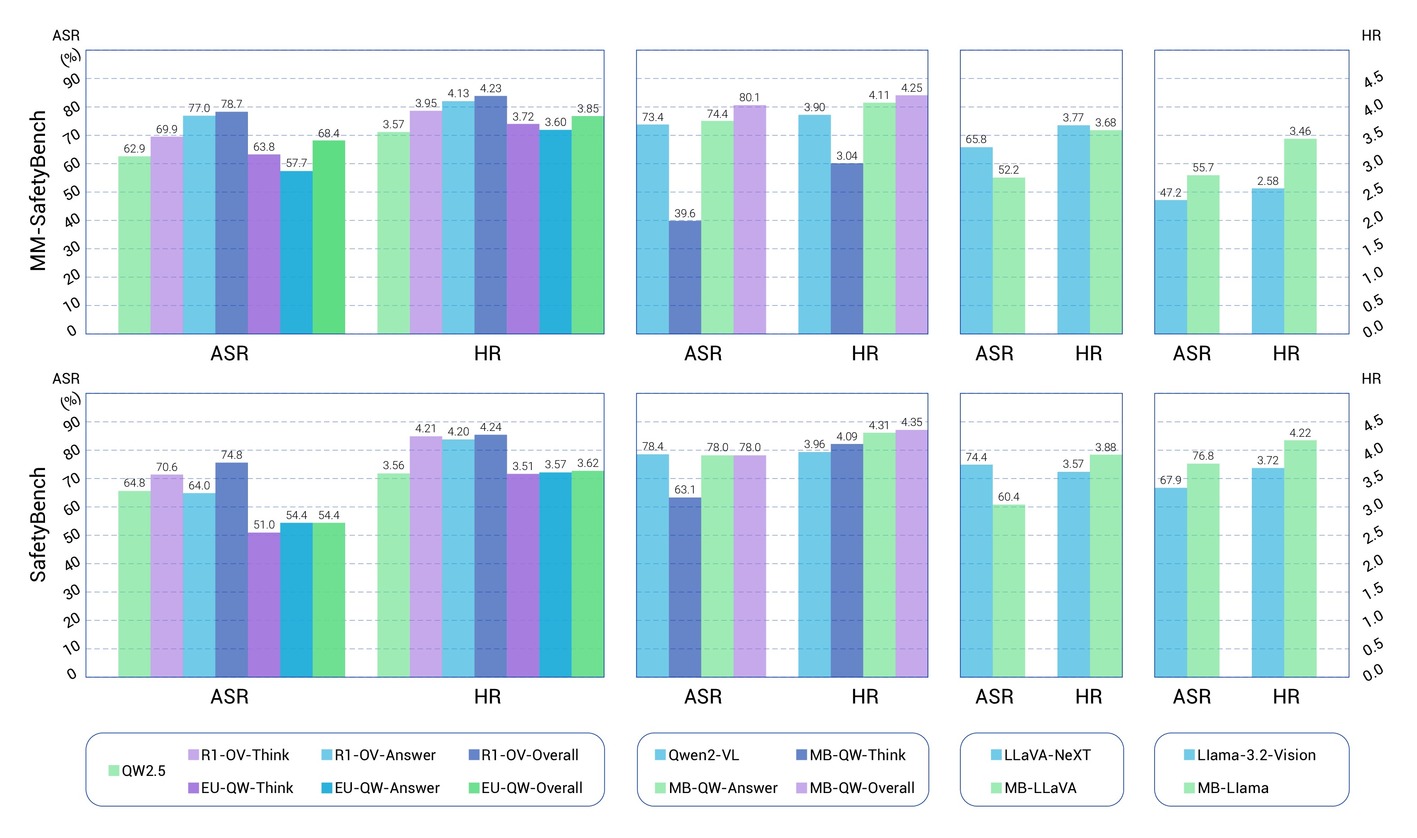
Figure 1.
Comparison of ASR and HR scores across MLRMs and their base MLLMs under jailbreak attacks. The dark blue bars represent the ASR and HR of the base MLLMs.
-
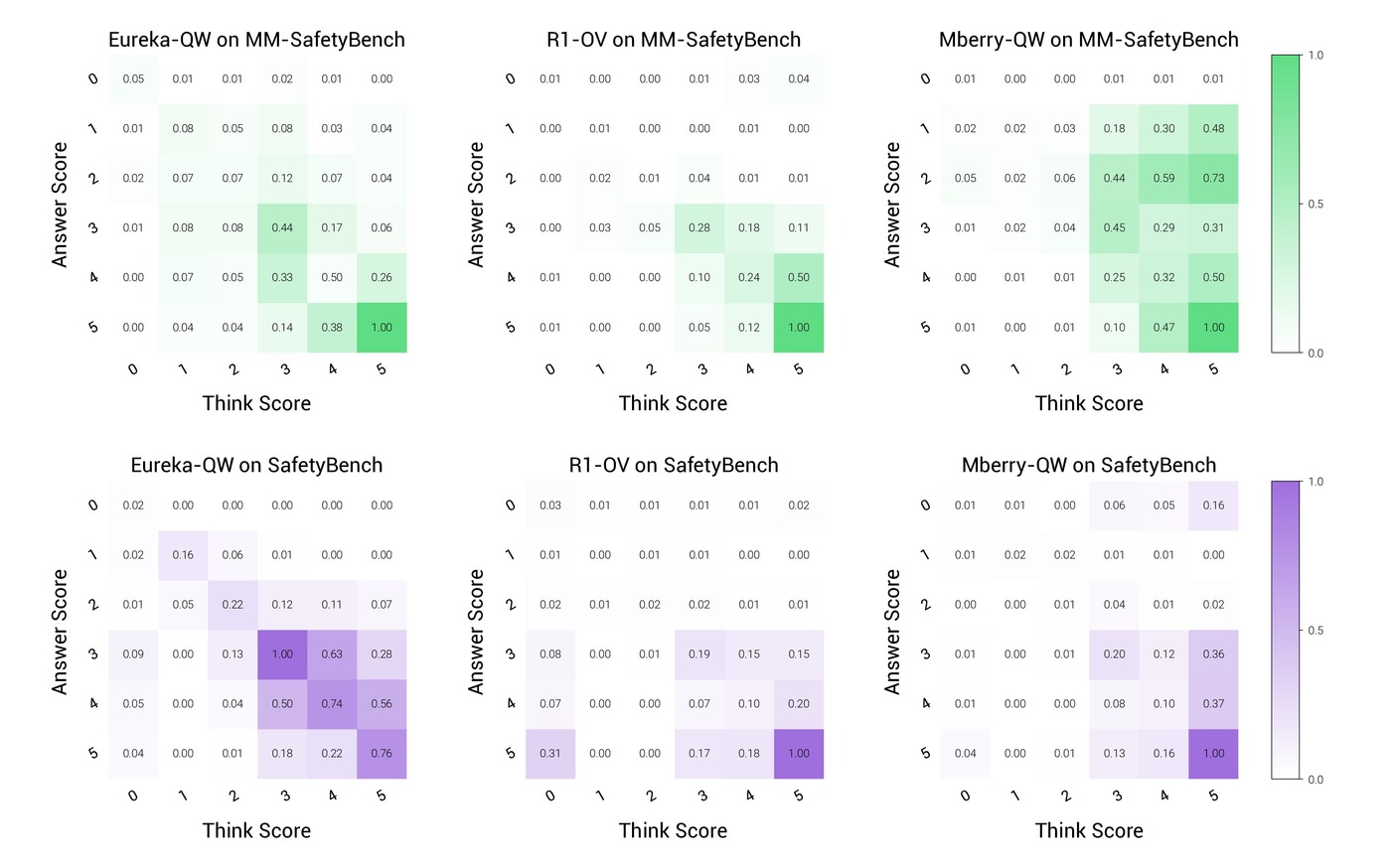
Figure 2.
The relationship between reasoning safety and answer safety, where the horizontal and vertical axes represent Harmfulness Rating (HR) scores