
Assistive robots for Beijing Winter Paralympic torch relay: Accessible technologies to restore human functionality
-

-
REFERENCES
[1] Gao, F., Li, S., Gao, Y., Qi, C., Tian, Q., and Yang, G.Z. (2022). Robots at the Beijing 2022 Winter Olympics. Sci. Robot. 7, eabq0785. [2] Park, H., and Oh, J.H. (2018). Robots for the PyeongChang 2018 Winter Olympic Games. Sci. Robot. 3, eaat5217. [3] Yang, G.Z., Riener, R., and Dario, P. (2017). To integrate and to empower: Robots for rehabilitation and assistance. Sci. Robot. 2, eaan5593. [4] Weber, D., and Matsiko, A. (2023). Assistive robotics should seamlessly integrate humans and robots. Sci. Robot. 8, eadl0014. [5] Rodríguez-Fernández, A., Lobo-Prat, J., and Font-Llagunes, J.M. (2021). Systematic review on wearable lower-limb exoskeletons for gait training in neuromuscular impairments. J. NeuroEng. Rehabil. 18, 22. -
ABOUT THIS ARTICLE
Cite this article:
Bi Zhang, Mei Shuai, Bicheng Han, Shuo Li, Lianqing Liu, Xingang Zhao. Assistive robots for Beijing Winter Paralympic torch relay: Accessible technologies to restore human functionality[J]. The Innovation, 2024, 5(1). https://doi.org/10.1016/j.xinn.2023.100556
Welcome!
To request copyright permission to republish or share portions of our works, please visit Copyright Clearance Center's (CCC) Marketplace website at marketplace.copyright.com.
Export File
Citation
Bi Zhang, Mei Shuai, Bicheng Han, Shuo Li, Lianqing Liu, Xingang Zhao. Assistive robots for Beijing Winter Paralympic torch relay: Accessible technologies to restore human functionality[J]. The Innovation, 2024, 5(1). https://doi.org/10.1016/j.xinn.2023.100556

Format
Content
 DownLoad:
-
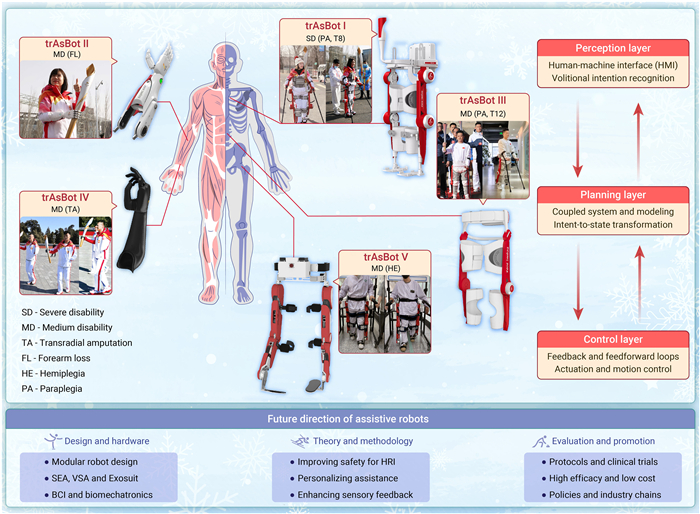
Figure 1.
Assistive robots for torch relay (trAsBots Ⅰ–Ⅴ) at the Beijing 2022 Winter Paralympics
