
Charging Guidance Strategy for Electric Ride-Hailing Vehicles Oriented Towards Building Energy Sharing
-
GRAPHICAL ABSTRACT
 DownLoad:
Full size image
DownLoad:
Full size image
-
ABSTRACT
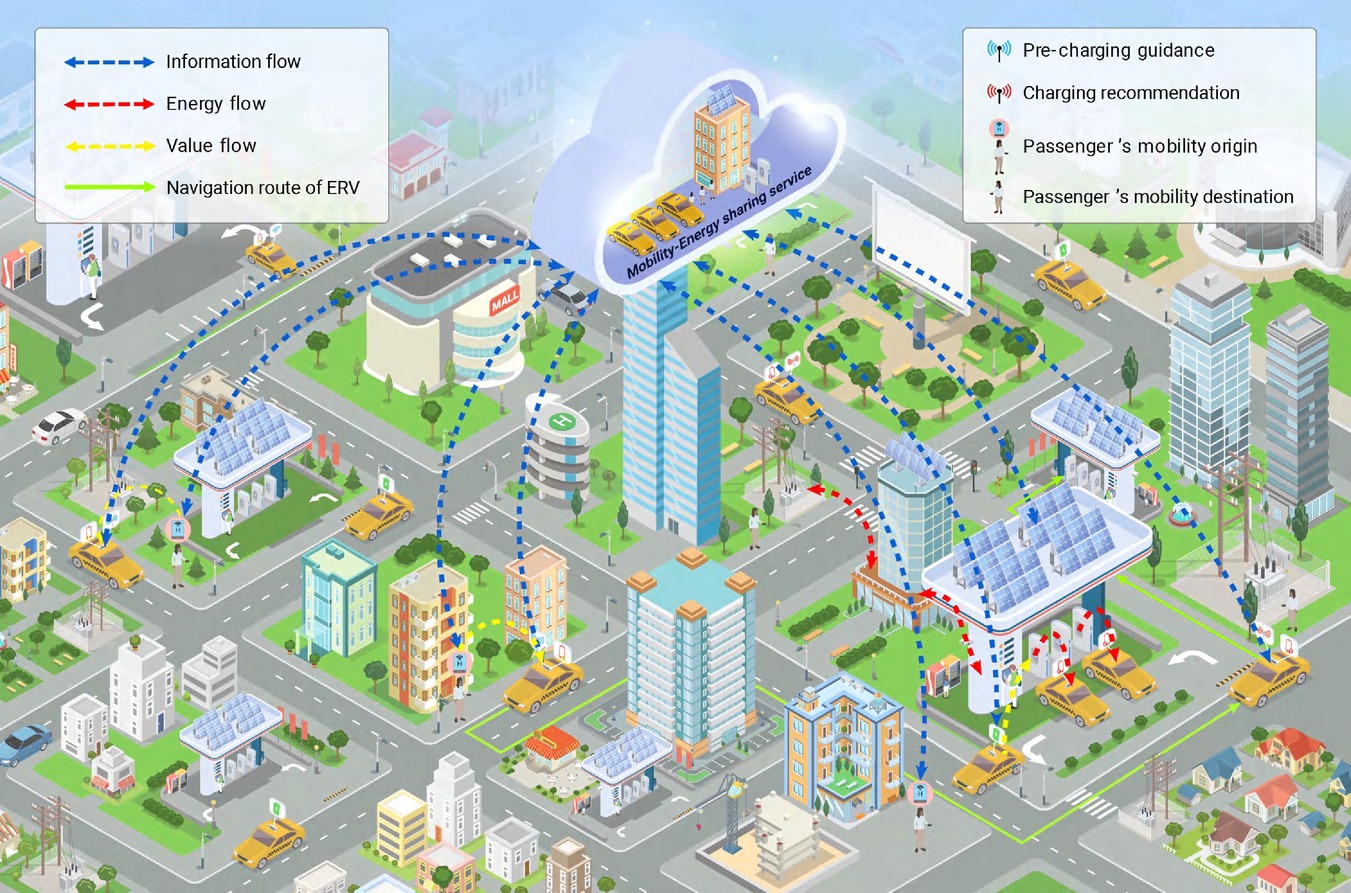
With the characteristics of spatial-temporal flexibility, the charging load of electric vehicles can provide excellent flexibility for the low-carbon and economical operation of buildings, via implementing rational charging guidance strategies. Focusing on the electric ride-hailing vehicle (ERV) group, a charging guidance strategy for ERVs is established oriented towards building energy sharing, accounting for the influence on spatial distribution of charging loads caused by online car-hailing order matching. First, combining ERV mobility sharing with building energy sharing demand together, an urban mobility-energy sharing service framework is constructed and illustrated with the integration of information, energy, and value flows. Then, considering the spatial effect of mobility orders on the following charging behavior, a two-stage guidance strategy of ERVs is proposed. The first stage deals with a pre-charging guidance problem with final car-hailing order matching for ERVs triggered range alerts considering the region of building energy sharing requirement. Subsequently, in the second stage, an optimal charging station recommendation strategy is proposed to meet the refined energy sharing demand of the buildings nearby, considering ERVs’ charging decision-making behavior. Simulation results verify that the proposed method successfully creates a synergistic interaction between ERV charging loads and building energy sharing, with seamlessly improving the charging experience for ERV drivers. -

-
REFERENCES
[1] IEA (2023). Tracking Clean Energy Progress 2023, IEA, Paris. https://www.iea.org/reports/tracking-clean-energy-progress-2023 [2] Chen X. (2024). Green and low-carbon energy-use. Innov. Energy. 1:100003. DOI:10.59717/j.xinn-energy.2024.100003 [3] Chen X., Liu J., Lin B., et al. (2025). Promote the Revolution in Energy Use to Enhance the Impetus for Green Transformation and Development. Energy Use. 1:100001. DOI:10.59717/ipj.energy-use.2025.100001 [4] Chen X. (2025). Energy-use Net: Path to Green and Low-carbon Energy-use. Proceedings of the CSEE, 1-18. https://link.cnki.net/urlid/11.2107.tm.20250909.1416. 003.(in Chinese). [5] Wang Y., Ma M., Zhou N., et al. (2025). Paving the way to carbon neutrality: Evaluating the decarbonization of residential building electrification worldwide. Sustain. Cities Soc. 130:106549. DOI:10.1016/j.scs.2025.106549 [6] Liang Y., Yu C., and Pan W. (2025). Energy efficiency, renewables, and electrification contribute to decarbonising the operation of residential building stock in Hong Kong. Energy Build. 349:116520. DOI:10.1016/j.enbuild.2025.116520 [7] Yu J., Wang Q., Zhang X., et al. (2026). Optimizing photovoltaic energy sharing: A novel framework based on Stackelberg games in distribution networks. Renew. Energy. 256:123870. DOI:10.1016/j.renene.2025.123870 [8] Ivona Š., Mirna G., and Tomislav C. (2025). Energy sharing: Encouraging citizen participation in energy communities and collective self-consumption. Energy. 338:138911. DOI:10.1016/j.energy.2025.138911 [9] Kang J., Wang J., Liu C., et al. (2024). Coordinated optimization of configuration and operation of a photovoltaic integrated building cooling system with electricity and ice storages under source-load uncertainties. Energy Build. 320:114600. DOI:10.1016/j.enbuild.2024.114600 [10] Li G., Xu X., Cheng X., et al. (2025). Robust configuration planning for net zero-energy buildings considering source-load dual uncertainty and hybrid energy storage system. Build. Environ. 282:113239. DOI:10.1016/j.buildenv.2025.113239 [11] Wu Y., Liu Z., Li B., et al. (2025). Optimal storage capacity for building photovoltaic-energy storage systems considering energy flexibility management. Energy Build. 338:115757. DOI:10.1016/j.enbuild.2025.115757 [12] Li S., Chen X., Bu L., et al. (2024). Two-stage optimization for the air conditioning system in public buildings with flexible control of indoor load. Energy Build. 312:114162. DOI:10.1016/j.enbuild.2024.114162 [13] Wang M., Wang M., Wang R., et al. (2024). Optimization scheduling for low-carbon operation of building integrated energy systems considering source-load uncertainty and user comfort. Energy Build. 318:114423. DOI:10.1016/j.enbuild.2024.114423 [14] Yao Z., Ran L., Wang Z., et al. (2024). Integrated management of electric vehicle sharing system operations and Internet of Vehicles energy scheduling. Energy. 309:132498. DOI:10.1016/j.energy.2024.132498 [15] IEA (2025). Global EV Outlook 2025, IEA, Paris. https://www.iea.org/reports/global-ev-outlook-2025 [16] María V., Jose C., Juan G., et al. (2025). Integrating shared mobility into multimodal habits: A comparative analysis across shared micro- and 'macro'-mobility services. Transp. Policy. 174:103840. DOI:10.1016/j.tranpol.2025.103840 [17] Gao F., Sylvia Y., Han C., et al. (2024). The impact of shared mobility on metro ridership: The non-linear effects of bike-sharing and ride-hailing services. Travel Behav. Soc. 37:100842. DOI:10.1016/j.tbs.2024.100842 [18] Morteza T., Samuel S., and Xu M. (2022). Widespread range suitability and cost competitiveness of electric vehicles for ride-hailing drivers. Appl. Energy. 319:119246. DOI:10.1016/j.apenergy.2022.119246 [19] Tang W., Chen X. (Michael), and Lee D-H. (2025). Toward mobility incentive: Integrating green service and carbon inclusion scheme into the ride-hailing market. Transp. Res. B Methodol. 201:103320. DOI:10.1016/j.trb.2025.103320 [20] Zhang Z., Yu Q., Gao K., et al. (2025). Carbon emission reduction benefits of ride-hailing vehicle electrification considering energy structure. Appl. Energy. 377:124548. DOI:10.1016/j.apenergy.2024.124548 [21] Li J., Xu X., Hamid R., et al. (2025). Optimization of electric vehicle charging strategies in residential integrated energy systems: A SARIMA model approach for dynamic electricity prices. Energy. 330:136600. DOI:10.1016/j.energy.2025.136600 [22] Wu H., Lan X., He Y., et al. (2025). Orderly charging of electric vehicles: A two-stage spatial-temporal scheduling method based on user-personalized navigation. Appl. Energy. 378:124800. DOI:10.1016/j.apenergy.2024.124800 [23] Liu G., Wang B., Li T., et al. (2025). Multi-objective electric-carbon synergy optimisation for electric vehicle charging: Integrating uncertainty and bounded rational behaviour models. Appl. Energy. 389:125790. DOI:10.1016/j.apenergy.2025.125790 [24] Chen X. (2025). Urban Energy Use and Its Friendly Interaction with Power Grid. Energy Use. 1:100011. DOI:10.59717/ipj.energy-use.2025.100011 [25] Abdalla M. A. A., Min W., Bing W., et al. (2023). Double-layer home energy management strategy for increasing PV self-consumption and cost reduction through appliances scheduling, EV, and storage. Energy Rep. 10:3494-3518. DOI:10.1016/j.egyr.2023.10.019 [26] Michele D., Tohid H., Anna R., et al. (2025). Enhancing voltage optimization in distribution networks through flexible operation of EV parking lots. Sustain. Energy Grids Netw. 41:101601. DOI:10.1016/j.segan.2024.101601 [27] Yan Q., Wang J., Lin T., et al. (2025). Peak-Valley difference based pricing strategy and optimization for PV-storage electric vehicle charging stations through ggregators. Int. J. Electr. Power Energy Syst. 169:110812. DOI:10.1016/j.ijepes.2025.110812 [28] Xiang Y., Yang J., Li X., et al. (2022). Routing optimization of electric vehicles for charging with event-driven pricing strategy. IEEE Trans. Autom. Sci. Eng. 19:7−20. DOI:10.1109/tase.2021.3102997 [29] Su S., Li Y., Yamashita K., et al. (2024). Electric vehicle charging guidance strategy considering “traffic network-charging station-driver” modeling: a multiagent deep reinforcement learning-based approach. IEEE Trans. Transp. Electrific. 10:4653−4666. DOI:10.1109/tte.2023.3322685 [30] Tao Y., Qiu J., Lai S., et al. (2024). Distributed electric vehicle assignment and charging navigation in cyber-physical systems. IEEE Trans. Smart Grid. 15:1861−1875. DOI:10.1109/tsg.2023.3293251 [31] Sun X., and Qiu J. (2021). Hierarchical voltage control strategy in distribution networks considering customized charging navigation of electric vehicles. IEEE Trans. Smart Grid. 12:4752−4764. DOI:10.1109/tsg.2021.3094891 [32] Habbal A., and Alrifaie M. F. (2024). A user-preference-based charging station recommendation for electric vehicles. IEEE Trans. Intell. Transp. Syst. 25:11617−11634. DOI:10.1109/tits.2024.3379469 [33] Yi Z., and Smart J. (2021). A framework for integrated dispatching and charging management of an autonomous electric vehicle ride-hailing fleet. Transp. Res., Part D: Transp. Environ. 95:102822. DOI:10.1016/j.trd.2021.102822 [34] Wang J., Cai H., Sun L., et al. (2025). MERCI: multi-agent reinforcement learning for enhancing on-demand electric taxi operation in terms of rebalancing, charging, and informing orders. Comput. Ind. Eng. 200:110711. DOI:10.1016/j.cie.2024.110711 [35] Li D., Hu C., Yang Q., et al. (2025). Charge or pick up. Optimizing E-taxi management: a dual-stage heuristic coordinated reinforcement learning approach. IEEE Trans. Autom. Sci. Eng. 22:8533−8553. DOI:10.1109/tase.2024.3486342 [36] Li X., Normandin-Taillon H., Wang C., et al. (2024). BM-RCWTSG: an integrated matching framework for electric vehicle ride-hailing services under stochastic guidance. Sustain. Cities Soc. 108:105485. DOI:10.1016/j.scs.2024.105485 [37] Zhong J., Liu J., and Zhang X. (2023). Charging navigation strategy for electric vehicles considering empty-loading ratio and dynamic electricity price. Sustain. Energy Grids Netw. 34:100987. DOI:10.1016/j.segan.2022.100987 [38] Ni W., Cheng P., Chen L., et al. (2024). Task assignment framework for online car-hailing systems with electric vehicles. IEEE Trans. Knowl. Data Eng. 36:9361−9373. DOI:10.1109/tkde.2024.3434567 [39] Patankar P. P., Hussain Rather Z., Liebman A., et al. (2025). Machine Learning-Based EV Charging Management System for Vehicle-to-Home and Vehicle-to-Building. IEEE Trans. Transp. Electrific. 11:11100−11111. DOI:10.1109/tte.2025.3571793 [40] Dai Y., Liu X., Li H., et al. (2025). Building-related electric vehicle charging behaviors and energy consumption patterns: An urban-scale analysis. Transp. Res., Part D: Transp. Environ. 141:104663. DOI:10.1016/j.trd.2025.104663 -
ABOUT THIS ARTICLE
Cite this article:
Gan L., Jia Z., Bu L., et al. (2025). Charging Guidance Strategy for Electric Ride-Hailing Vehicles Oriented Towards Building Energy Sharing. Energy Use 1:100027. https://doi.org/10.59717/ipj.energy-use.2025.100027
Welcome!
To request copyright permission to republish or share portions of our works, please visit Copyright Clearance Center's (CCC) Marketplace website at marketplace.copyright.com.
Figures(5)
Tables(1)
Article Metrics
Relative Articles
Cited by
Export File
Citation
Gan L., Jia Z., Bu L., et al. (2025). Charging Guidance Strategy for Electric Ride-Hailing Vehicles Oriented Towards Building Energy Sharing. Energy Use 1:100027. https://doi.org/10.59717/ipj.energy-use.2025.100027

Format
Content
-
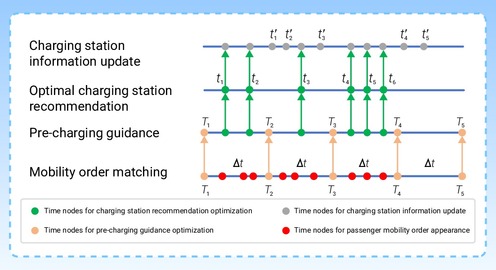
Figure 1.
Module operation sequence of mobility-energy sharing service
-
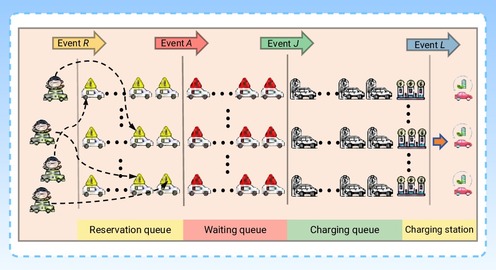
Figure 2.
Three-layer dynamic queue model of CS
-
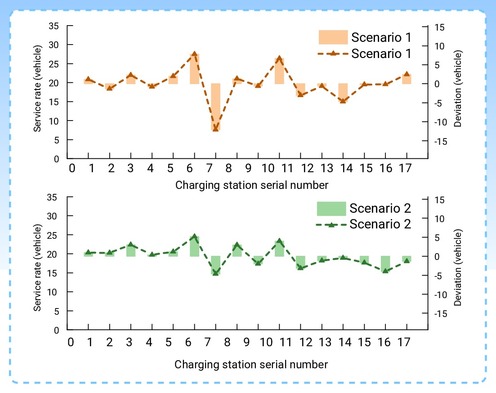
Figure 3.
CS service rates and their deviations across two Scenarios
-
Figure 4.
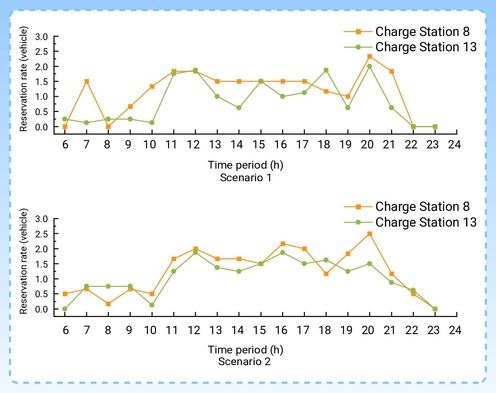
Comparison of reservation rates between central-area CS 8 and remote-area CS 13 in operation time period under two Scenarios
-
Figure 5.
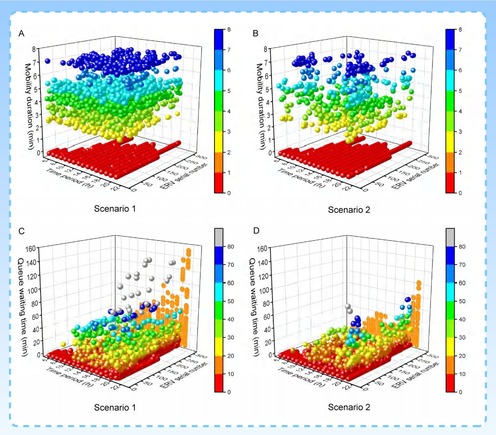
Mobility duration and queue waiting time of electric ride-hailing vehicles across two Scenarios. (A-B) Mobility duration distribution. (C-D) Queue waiting time distribution.