
Powering Humanoid Robots: The Central Role of Battery Technology
-
ABSTRACT
Recent advancements in artificial intelligence (AI), sensing, and mechanical systems have substantially expanded the functional capabilities of humanoid robots. However, their transition from laboratory demonstrations to sustained real-world operation remains fundamentally limited by onboard energy storage. Battery technology now represents a primary system-level constraint, shaping achievable runtime, mobility, and operational reliability. Humanoid robots place unusually demanding requirements on batteries, combining high energy density, robust power output, and stringent safety within severe mass and volume constraints. Current lithium-ion batteries (LIBs) struggle to satisfy these competing demands, leading to restricted endurance, thermal management challenges, and conservative operating envelopes. In this perspective, we identify battery systems as a central bottleneck in humanoid robotics and contend that meaningful progress will require coordinated innovation across materials, power-system architectures, and battery management. Emerging approaches, including high-energy-density cells, higher-voltage platforms, distributed and hybrid power architectures, and AI-driven battery management systems (BMS), offer pathways to extend operational duration while improving mobility and robustness. Advances in battery technology will therefore play a decisive role in enabling scalable, reliable humanoid robots for industrial and societal applications. -

-
REFERENCES
[1] Cao L. (2025). Humanoid Robots and Humanoid AI: Review, Perspectives and Directions. ACM Comput. Surv. 58:1−37. DOI:10.1145/3770574 [2] Li W., Wu J., Yang G., et al. (2025). Humanoid robots: progress, challenges, and future research directions. Sci. China Inf. Sci. 68:216201. DOI:10.1007/s11432-025-4532-0 [3] Tong Y. C., Liu H. T. and Zhang Z. T. (2024). Advancements in Humanoid Robots: A Comprehensive Review and Future Prospects. IEEE-CAA J. Autom. Sin. 11:301−328. DOI:10.1109/Jas.2023.124140 [4] Geng Y., Tang H., Ji W., et al. (2025). Mobile Energy Storage (MES): A Grid-Edge Technology for Power Redistribution and Resilience Enhancement. Energy Use 1:100022. DOI:10.59717/ipj.energy-use.2025.100022 [5] Ngoy K. R., Lukong V. T., Yoro K. O., et al. (2025). Lithium-ion batteries and the future of sustainable energy: A comprehensive review. Renew. Sust. Energ. Rev. 223:115971. DOI:10.1016/j.rser.2025.115971 [6] Deng J., Yu X., Pang D., et al. (2025). Cutting-edge gas sensor design for monitoring thermal runaway in lithium-ion batteries: A critical review. J. Energy Chem. 109:769−785. DOI:10.1016/j.jechem.2025.06.025 [7] Sheng Q., Zhou Z., Li J., et al. (2025). A Comprehensive Review of Humanoid Robots. SmartBot 1:e12008. DOI:10.1002/smb2.12008 [8] Khan A., Al Rashid H., Roy P. K., et al. (2025). Challenges and the Way to Improve Lithium-Ion Battery Technology for Next-Generation Energy Storage. Energy Environ. Mater. 8:e70088. DOI:10.1002/eem2.70088 [9] Li C., Li Y., Su T., et al. (2025). Wide-Temperature, High-Voltage, Flame-Retardant Electrolyte for 4.8V Li||NCM94 Batteries. Angew. Chem. Int. Ed. 64:e202509744. DOI:10.1002/anie.202509744 [10] Mukherjee R., Ganguly P. and Dahiya R. (2023). Bioinspired Distributed Energy in Robotics and Enabling Technologies. Adv. Intell. Syst. 5:2100036. DOI:10.1002/aisy.202100036 -
ABOUT THIS ARTICLE
Cite this article:
Deng J., Chen J. and Mo J. (2026). Powering Humanoid Robots: The Central Role of Battery Technology. Energy Use 2:100032. https://doi.org/10.59717/ipj.energy-use.2026.100032
Welcome!
To request copyright permission to republish or share portions of our works, please visit Copyright Clearance Center's (CCC) Marketplace website at marketplace.copyright.com.
Export File
Citation
Deng J., Chen J. and Mo J. (2026). Powering Humanoid Robots: The Central Role of Battery Technology. Energy Use 2:100032. https://doi.org/10.59717/ipj.energy-use.2026.100032

Format
Content
 DownLoad:
-
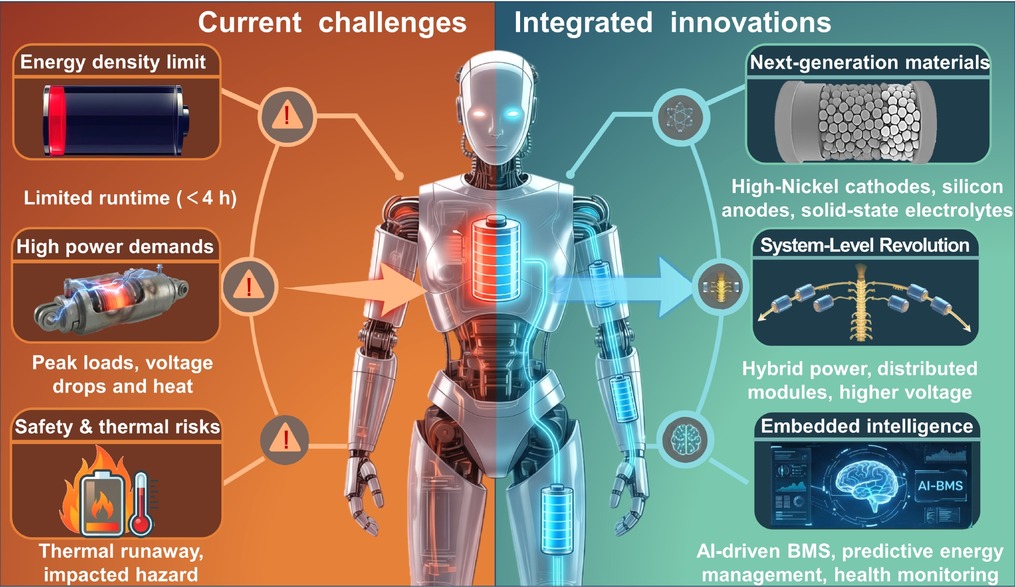
Figure 1.
Current challenges and integrated innovations for battery techniques in humanoid robots