
Thermal Environment Management of eVTOL Cabin for Future Urban Air Mobility: From Multi-dimensional Sensing to Intelligent Regulation
-

-
REFERENCES
[1] NASA. (2021). NASA Electric Vertical Takeoff and Landing (eVTOL) Aircraft Technology for Public Services. [2] Li, Z., Xie, P., Lin, C., and Liu, G. (2025). A state-of-the-art review on eVTOL thermal management: system architectures, key components and emerging technologies. eTransportation 26. DOI:10.1016/j.etran.2025.100480 [3] Hubert, R., Weber, T.A., Linnemann, L., et al. (2025). Tailored composites and digital optimization for efficient eVTOL propellers. CEAS Aeronautical Journal. DOI:10.1007/s13272-025-00880-9 [4] Chen, B., Lian, Y., Xu, L., et al. (2024). State-of-the-art thermal comfort models for car cabin Environment. Building and Environment 262. DOI:10.1016/j.buildenv.2024.111825 [5] Liu, S., Li, W., Li, H., and Li, S. (2025). Reinforcement learning based multi-perspective motion planning of manned electric vertical take-off and landing vehicle in urban environment with wind fields. Engineering Applications of Artificial Intelligence 149. DOI:10.1016/j.engappai.2025.110392 -
ABOUT THIS ARTICLE
Cite this article:
Zhao J. and Cao B. (2026). Thermal Environment Management of eVTOL Cabin for Future Urban Air Mobility: From Multi-dimensional Sensing to Intelligent Regulation. Energy Use 2:100034. https://doi.org/10.59717/ipj.energy-use.2026.100034
Welcome!
To request copyright permission to republish or share portions of our works, please visit Copyright Clearance Center's (CCC) Marketplace website at marketplace.copyright.com.
Export File
Citation
Zhao J. and Cao B. (2026). Thermal Environment Management of eVTOL Cabin for Future Urban Air Mobility: From Multi-dimensional Sensing to Intelligent Regulation. Energy Use 2:100034. https://doi.org/10.59717/ipj.energy-use.2026.100034

Format
Content
 DownLoad:
-
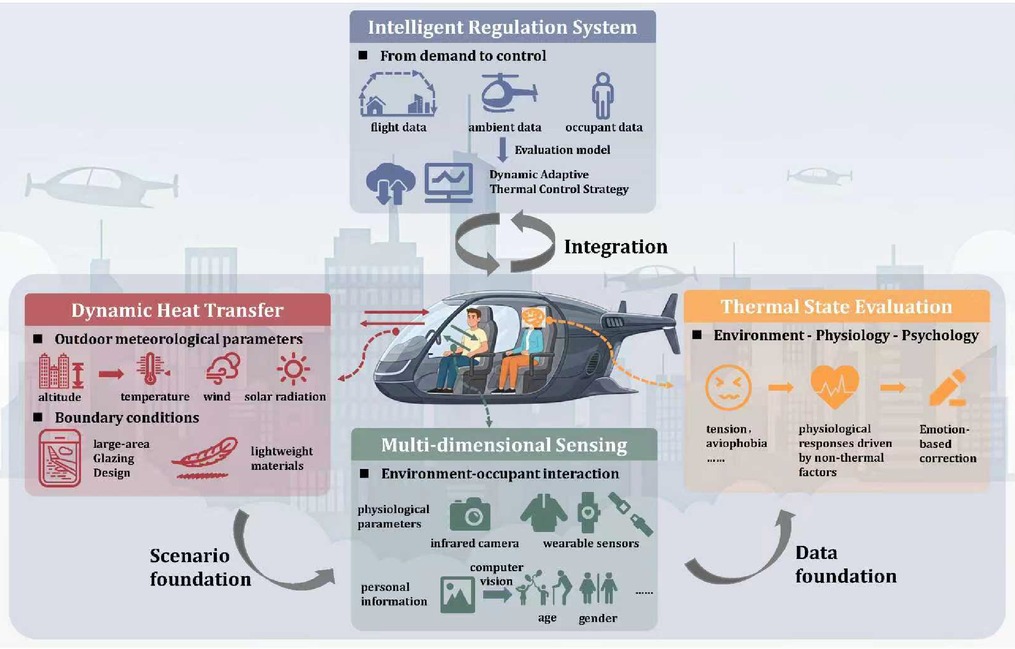
Figure 1.
Integrated framework of intelligent cabin thermal environment regulation for eVTOL