
Low-Temperature Desorption: The Next Generation in Amine-based CO2 Capture Technology
-
-
Keywords:
- CO2 capture /
- Low-temperature desorption /
- Amine scrubbing
-

-
REFERENCES
[1] Wang Z., He S., Li Y., et al. (2026). Carbon capture using chemical absorption: Absorbent intergenerational evolution, process innovation, and large-scale application. The Innovation 7:101250. DOI:10.1016/j.xinn.2025.101250 [2] Gautam A. and Mondal M. K. (2023). Review of recent trends and various techniques for CO2 capture: Special emphasis on biphasic amine solvents. Fuel 334:126616. DOI:10.1016/j.fuel.2022.126616 Copy to clipboard. DOI:10.1016/j.fuel.2022.126616Copytoclipboard [3] Guo Y. and Hatton T. A. (2026). Enhancing continuous-flow CO2 capture and release from aqueous carbonates via thermal pH regulation. Nat. Chem. Eng. 3:70−78. DOI:10.1038/s44286-025-00313-8 [4] . Li S., Wang Z., Zhang Z., et al. (2026). Mutual-extraction-enhanced desorption achieves low-temperature gas separation. Cell Rep. Phy. Sci. 7. DOI:10.1016/j.xcrp.2026.103302 -
ABOUT THIS ARTICLE
Cite this article:
He S., Li S. and Wang Z. (2026). Low-Temperature Desorption: The Next Generation in Amine-based CO2 Capture Technology. Energy Use 2:100052. https://doi.org/10.59717/ipj.energy-use.2026.100052
Welcome!
To request copyright permission to republish or share portions of our works, please visit Copyright Clearance Center's (CCC) Marketplace website at marketplace.copyright.com.
Export File
Citation
He S., Li S. and Wang Z. (2026). Low-Temperature Desorption: The Next Generation in Amine-based CO2 Capture Technology. Energy Use 2:100052. https://doi.org/10.59717/ipj.energy-use.2026.100052

Format
Content
 DownLoad:
-
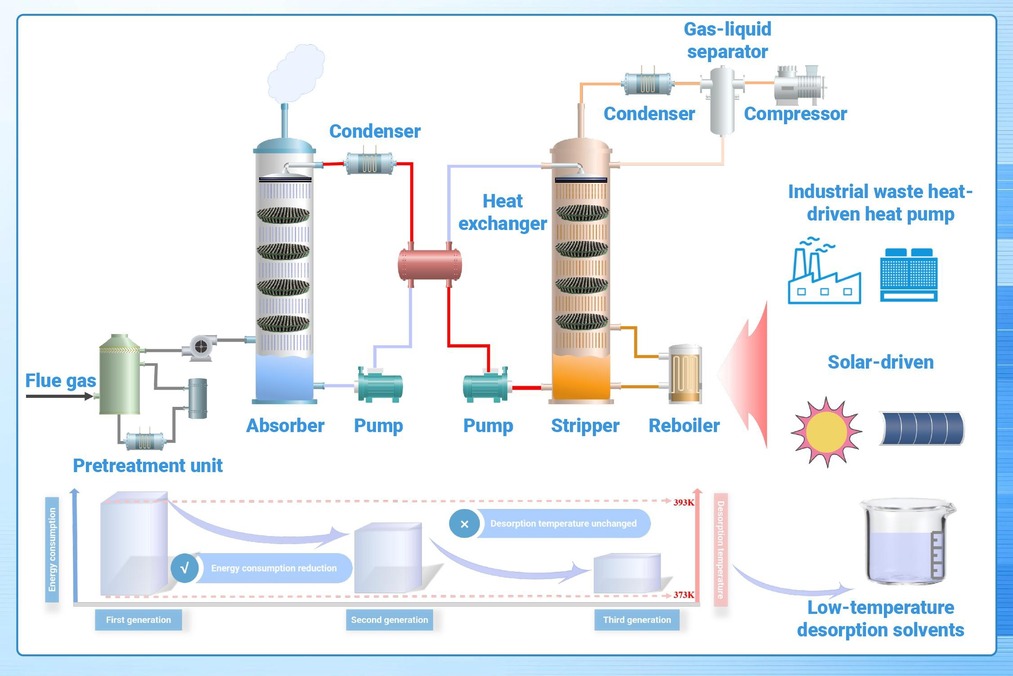
Figure 1.
Iterations of absorbents and prospects