
AI Computing Loads Reshape Power Systems: Shenzhen Launches the Greater Bay Area Computing–Electricity Coordination Innovation Consortium
-

-
REFERENCES
[1] International Energy Agency. (2025). Energy and AI. IEA. [2] Guo C., Luo F., Cai Z., Dong Z.Y. (2021). Integrated energy systems of data centers and smart grids: State-of-the-art and future opportunities. Appl. Energy 301:117474. DOI:10.1016/j.apenergy.2021.117474 [3] Radovanović A., Koningstein R., Schneider I., et al. (2023). Carbon-Aware Computing for Datacenters. IEEE TPS 38:1270−1280. DOI:10.1109/TPWRS.2022.3173250 [4] Riepin I., Brown T. and Zavala V.M. (2025). Spatio-temporal load shifting for truly clean computing. Adv. Appl. Energy 17:100202. DOI:10.1016/j.adapen.2024.100202 [5] Hasan M.M., Razmi D., Babayomi O., et al. (2025). Advanced control and protection strategies for grid-forming inverters in microgrids—A review. Int. J. Electr. Power Energy Syst. 172:111297. DOI:10.1016/j.ijepes.2025.111297 -
ABOUT THIS ARTICLE
Cite this article:
Deng Y., Shen J., Tian R., et al. (2026). AI Computing Loads Reshape Power Systems: Shenzhen Launches the Greater Bay Area Computing–Electricity Coordination Innovation Consortium. Energy Use 2:100075. https://doi.org/10.59717/ipj.energy-use.2026.100075
Welcome!
To request copyright permission to republish or share portions of our works, please visit Copyright Clearance Center's (CCC) Marketplace website at marketplace.copyright.com.
Export File
Citation
Deng Y., Shen J., Tian R., et al. (2026). AI Computing Loads Reshape Power Systems: Shenzhen Launches the Greater Bay Area Computing–Electricity Coordination Innovation Consortium. Energy Use 2:100075. https://doi.org/10.59717/ipj.energy-use.2026.100075

Format
Content
 DownLoad:
-
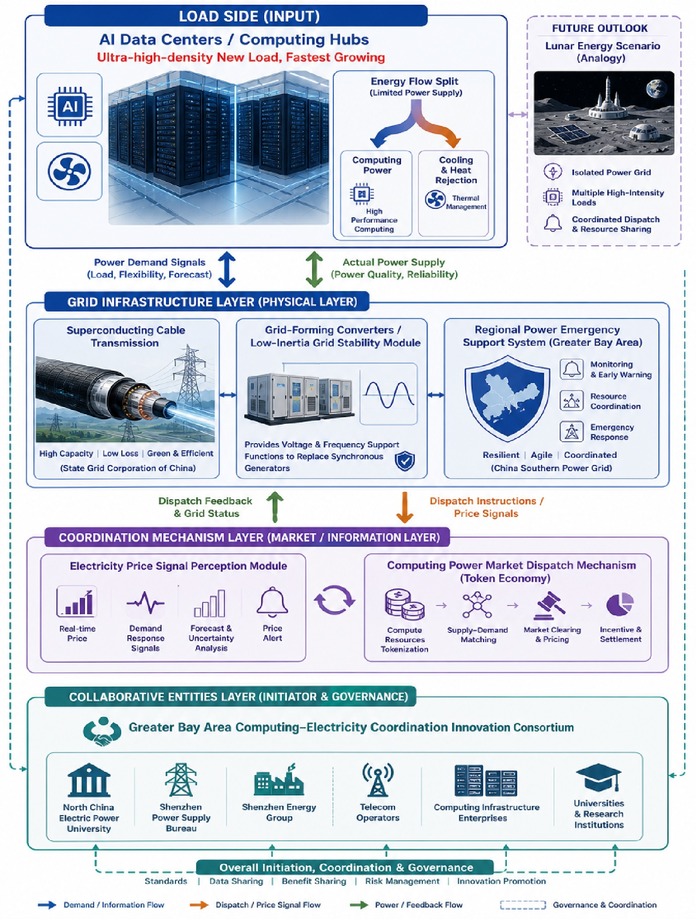
Figure 1.
Conceptual computing–power–electricity coordination architecture for high-density AI loads.