
-
GRAPHICAL ABSTRACT
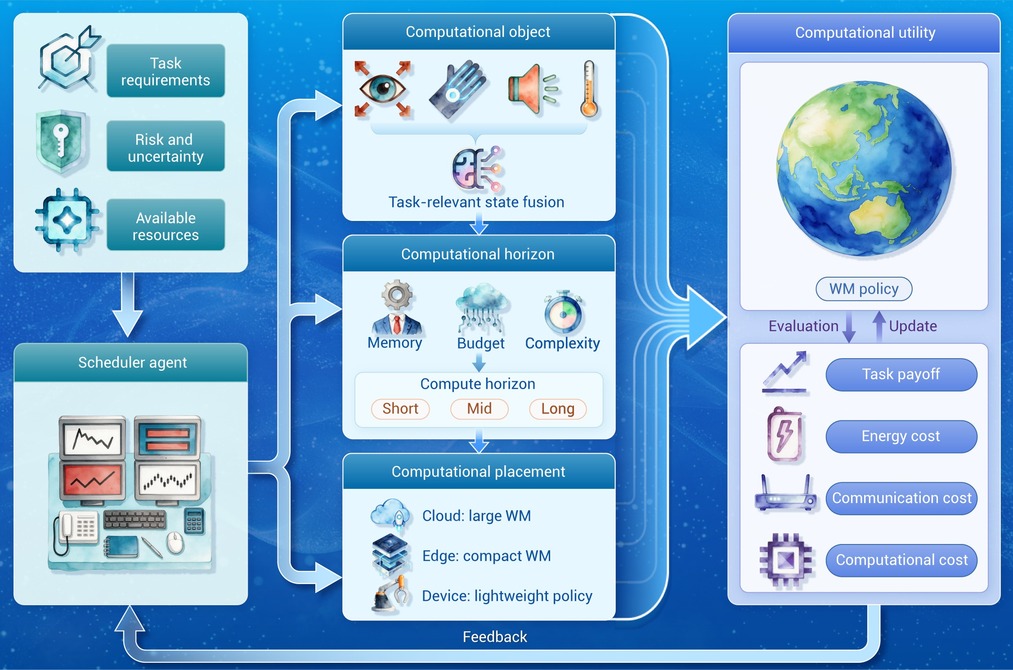
 DownLoad:
Full size image
-
PUBLIC SUMMARY
-
Computational usability asks what to compute, how far to simulate, where to run it, and what value it adds.
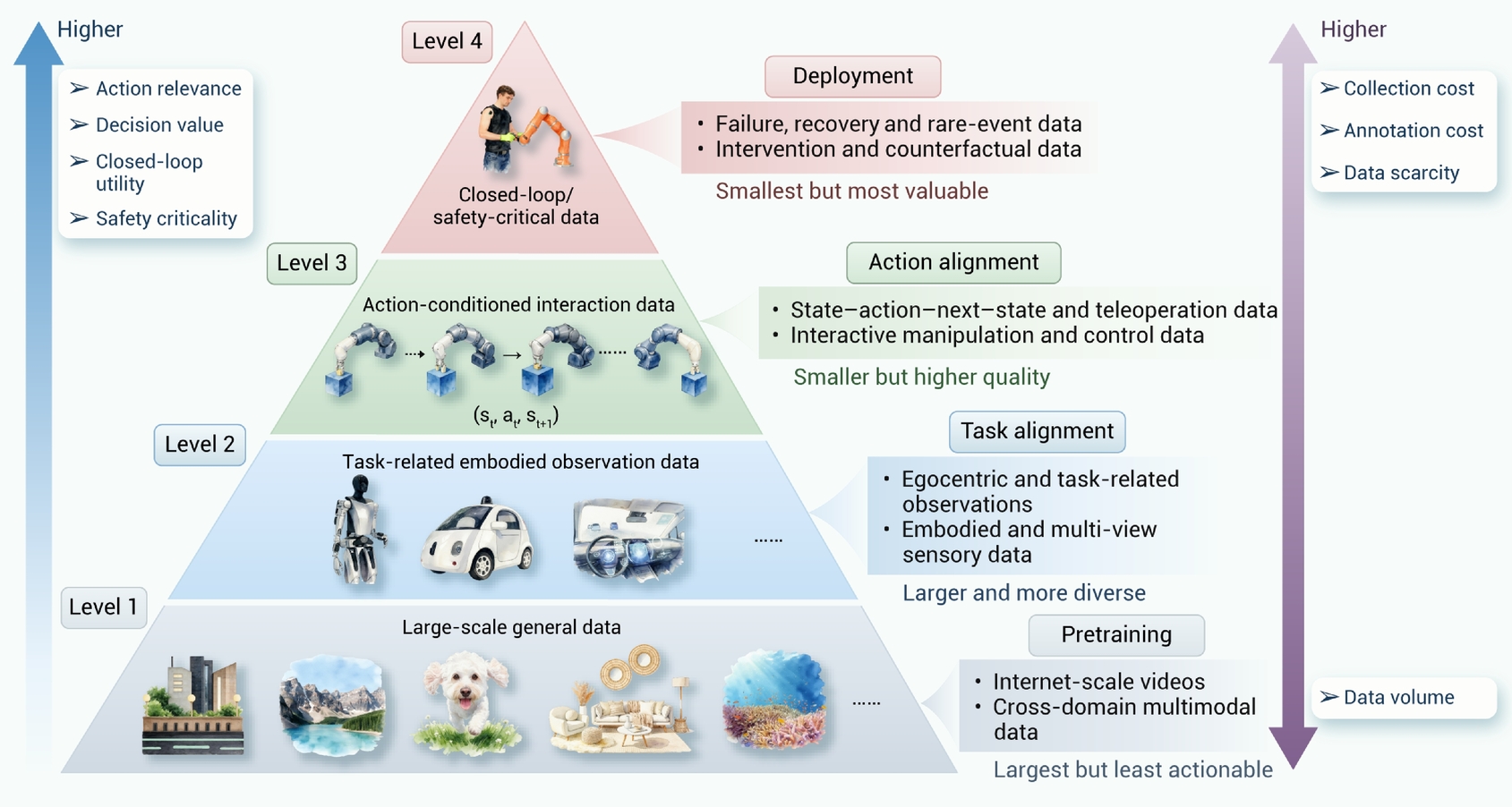
Action-oriented data help models prioritize the states that matter for decisions and safety.
Risk-adaptive rollouts and device-edge-cloud computing may make world models more deployable.
Action gain per computational cost measures improvements in decision-making relative to computing and resource costs.
-
-
ABSTRACT
World models are evolving from latent dynamics modules in model-based reinforcement learning into critical infrastructure for embodied intelligence, autonomous driving, robot learning, and physical AI. However, current discussions often equate world models with larger-scale video generation or more realistic interactive simulation, overlooking a fundamental constraint: embodied systems must act under constraints on limited data, computation, and communication under real-time safety requirements. This paper frames this challenge as the “computational usability gap.” An actionable world model must not only predict the future, but also determine what to compute, how far to roll out, where to compute, and whether the computation delivers sufficient action value. We review recent progress in representation, training and rollout, deployment, and evaluation, and argue that the focus is shifting from visual fidelity to action utility per unit of computation.-
Keywords:
- Computationally usability /
- embodied intelligence /
- physical AI /
- world models
-

-
REFERENCES
[1] Ha D. and Schmidhuber J. (2018). Recurrent world models facilitate policy evolution. Adv. Neural Inf. Process. Syst. 31:2451−2463. DOI:10.48550/arXiv.1809.01999 [2] Hafner D., Lillicrap T., Fischer I., et al. (2019). Learning latent dynamics for planning from pixels. Proc. Mach. Learn. Res. 97:2555−2565. DOI:10.48550/arXiv.1811.04551 [3] Hafner D., Lillicrap T., Ba J., et al. (2020). Dream to control: Learning behaviors by latent imagination. International Conference on Learning Representations. DOI: 10.48550/arXiv.1912.01603 [4] Hafner D., Pasukonis J., Ba J., et al. (2025). Mastering diverse control tasks through world models. Nature 640:647−653. DOI:10.1038/s41586-025-08744-2 [5] Brooks T., Peebles B., Holmes C., et al. (2024). Video generation models as world simulators. OpenAI Technical Report [6] Assran M., Bardes A., Fan D., et al. (2025). V-JEPA 2: Self-supervised video models enable understanding, prediction and planning. Preprint at arXiv:2506.09985. DOI: 10.48550/arXiv.2506.09985 [7] World Labs. (2025). Marble: A multimodal world model. World Labs Research Release [8] World Labs. (2025). RTFM: A real-time frame model. Research preview [9] Parker-Holder J., Ball P., Bruce J., et al. (2024). Genie 2: A large-scale foundation world model. Google DeepMind Research Report [10] Parker-Holder J. and Fruchter S. (2025). Genie 3: A new frontier for world models. Google DeepMind Research Report [11] NVIDIA. (2025). Cosmos world foundation model platform for physical AI. NVIDIA Technical Report DOI: 10.48550/arXiv.2501.03575 [12] Bordes F., Garrido Q., Kao J.T., et al. (2025). IntPhys 2: Benchmarking intuitive physics understanding in complex synthetic environments. Preprint at arXiv:2506.09849. DOI: 10.48550/arXiv.2506.09849 [13] Jiang F., Chen Y., Xu K., et al. (2026). RoboWM-Bench: A benchmark for evaluating world models in robotic manipulation. Proc. IEEE/CVF Conf. Comput. Vis. Pattern Recogn Workshops: 4455–4460. DOI: 10.48550/arXiv.2604.19092 [14] Unterthiner T., van Steenkiste S., Kurach K., et al. (2019). Towards accurate generative models of video: A new metric & challenges. arXiv preprint arXiv:1812.01717. DOI: 10.48550/arXiv.1812.01717 [15] Assran M., Duval Q., Misra I., et al. (2023). Self-supervised learning from images with a joint-embedding predictive architecture. Proc. IEEE/CVF Conf. Comput. Vis. Pattern Recogn.: 15619–15629. DOI: 10.1109/CVPR52729.2023.01499 [16] Bardes A., Garrido Q., Ponce J., et al. (2024). Revisiting feature prediction for learning visual representations from video. Trans. Mach. Learn. Res. DOI: 10.48550/arXiv.2404.08471 [17] Zhang Z., Wang J., Lin C., et al. (2026). TWM: Multimodal data generation engine via traffic world model. Communications in Transportation Research 6(3):9640045. DOI:10.26599/COMMTR.2026.9640045 [18] Tian S., Zheng Y., Zheng Y., et al. (2026). VT-WAM: Visual-tactile world action model for contact-rich manipulation. Preprint at arXiv:2607.02503. DOI: 10.48550/arXiv.2607.02503 [19] Higuera C., Arnaud S., Boots B., et al. (2026). Visuo-tactile world models. Preprint at arXiv:2602.06001. DOI: 10.48550/arXiv.2602.06001 [20] Zheng Y., Gu S., Li W., et al. (2026). OmniVTA: Visuo-tactile world modeling for contact-rich robotic manipulation. Preprint at arXiv:2603.19201. DOI: 10.48550/arXiv.2603.19201 [21] Zhang Z., Zhou P., Zhang K., et al. (2026). ContactWorld: What matters in vision-tactile world models for contact-rich manipulation. Preprint at arXiv:2606.13877. DOI: 10.48550/arXiv.2606.13877 [22] Wang S., Shi J., Fu Z., et al. (2026). World action models: The next frontier in embodied AI. Preprint at arXiv:2605.12090. DOI: 10.48550/arXiv.2605.12090 [23] Cen J., Yu C., Yuan H., et al. (2025). WorldVLA: Towards autoregressive action world model. Adv. Neural Inf. Process. Syst (NeurIPS) 2026 DOI: 10.48550/arXiv.2506.21539 [24] Yang Y., Liu Z., Kou S., et al. (2026). World-language-action model for unified world modeling, language reasoning, and action synthesis. Conference on Robot Learning (CoRL) 2026 DOI: 10.48550/arXiv.2606.05979 [25] Russell L., Hu A., Bertoni L., et al. (2025). GAIA-2: A controllable multi-view generative world model for autonomous driving. Preprint at arXiv:2503.20523. DOI: 10.48550/arXiv.2503.20523 [26] Ren X., Lu Y., Cao T., et al. (2025). Cosmos-Drive-Dreams: Scalable synthetic driving data generation with world foundation models. Preprint at arXiv:2506.09042. DOI: 10.48550/arXiv.2506.09042 [27] NVIDIA. (2026). NVIDIA OmniDreams: Real-time generative world model for closed-loop autonomous vehicle simulation. Preprint at arXiv:2606.03159. DOI: 10.48550/arXiv.2606.03159 [28] Zhao P., Lin J., Rupprecht T., et al. (2026). PhyWorld: Physics-faithful world model for video generation. Preprint at arXiv:2605.19242. DOI: 10.48550/arXiv.2605.19242 [29] Oh Y. and Yun S. (2026). Reference-free assessment of physical consistency in world model-based video generation. Preprint at arXiv:2606.22363. DOI: 10.48550/arXiv.2606.22363 [30] NVIDIA. (2025). Cosmos-Transfer1: Conditional world generation with adaptive multimodal control. Preprint at arXiv:2503.14492. DOI: 10.48550/arXiv.2503.14492 [31] Kim M.J., Pertsch K., Karamcheti S., et al. (2025). OpenVLA: An open-source vision-language-action model. Proc. Mach. Learn. Res. 270:2679−2713. DOI:10.48550/arXiv.2406.09246 [32] Yue Y., Wang Y., Kang B., et al. (2024). DeeR-VLA: Dynamic inference of multimodal large language models for efficient robot execution. Adv. Neural Inf. Process. Syst (NeurIPS). 37:56619−56643. DOI:10.52202/079017-1803 [33] Kim M.J., Finn C. and Liang P. (2025). Fine-tuning vision-language-action models: Optimizing speed and success. Proc. Robot. Sci. Syst. DOI: 10.15607/RSS.2025.XXI.017 [34] Liu B., Poe W.Y., Di J., et al. (2026). ComVLA: Communication-aware split inference for VLA models in 6G-connected robotics. Preprint at arXiv:2609.07838. DOI: 10.48550/arXiv.2609.07838 [35] Yang T., Shen Z., Mi Z., et al. (2026). MiraBench: Evaluating action-conditioned reliability in robotic world models. Preprint at arXiv:2605.29360. DOI: 10.48550/arXiv.2605.29360 [36] Li J., Guo T., Ye Y., et al. (2026). Efficient-WAM: A 1B-parameter world-action model with low-cost future imagination. Preprint at arXiv:2606.10040. DOI: 10.48550/arXiv.2606.10040 [37] Bi H., Tan H., Xie S., et al. (2026). Motus: A unified latent action world model. Proc. IEEE/CVF Conf. Comput. Vis. Pattern Recognit. (CVPR): 35101–35113. DOI: 10.48550/arXiv.2512.13030. -
ABOUT THIS ARTICLE
Cite this article:
Song Y., Wang J., Liu H., et al. (2026). World models: Toward computationally usable embodied AI. The Innovation Insights 1:100018. https://doi.org/10.59717/j.tiis.2026.100018
Welcome!
To request copyright permission to republish or share portions of our works, please visit Copyright Clearance Center's (CCC) Marketplace website at marketplace.copyright.com.
Export File
Citation
Song Y., Wang J., Liu H., et al. (2026). World models: Toward computationally usable embodied AI. The Innovation Insights 1:100018. https://doi.org/10.59717/j.tiis.2026.100018

Format
Content
-
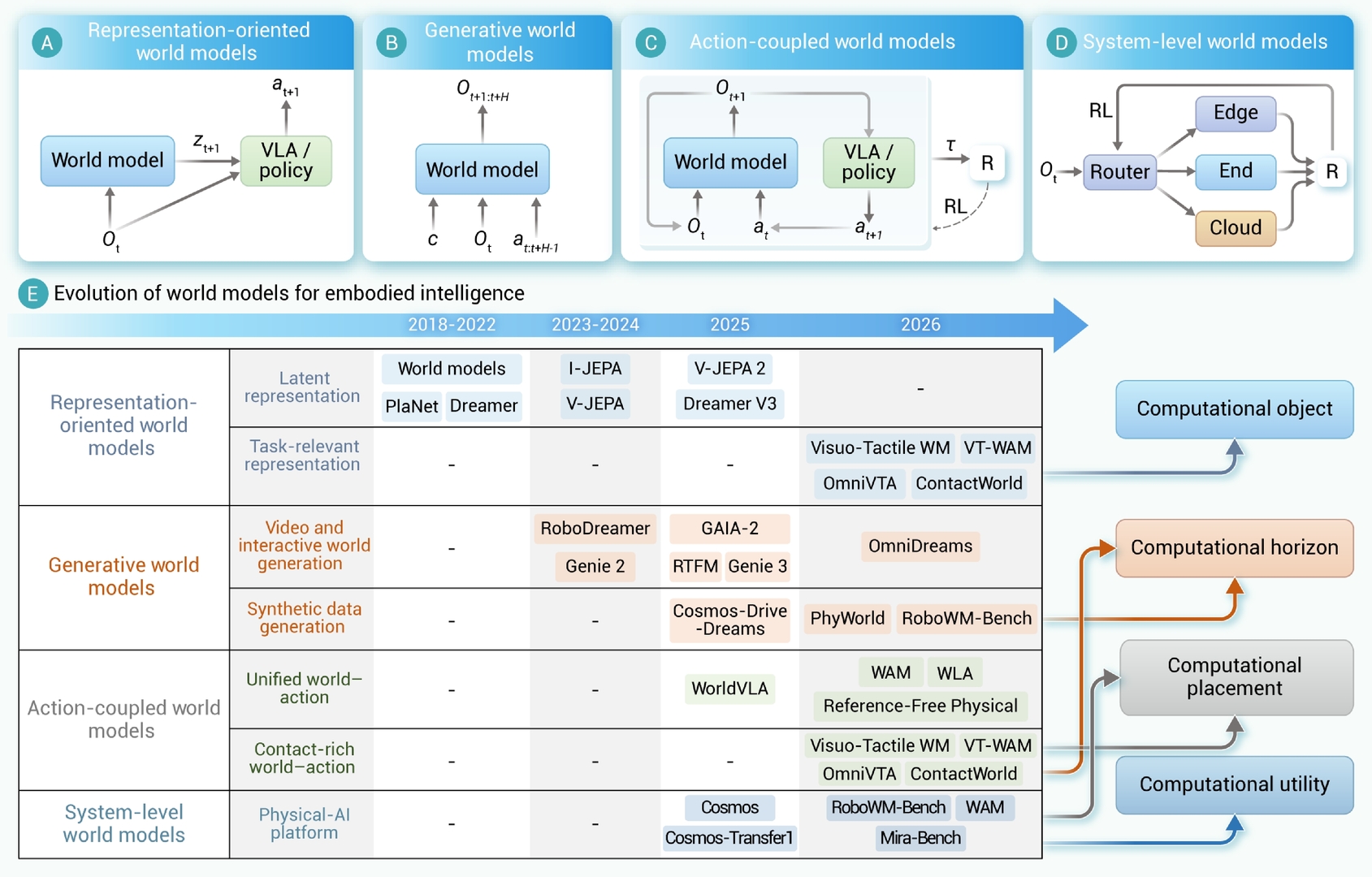
Figure 1.
Architectural taxonomy, evolution, and computational-usability dimensions of world models for embodied intelligence.
-
Figure 2.
Action-oriented data pyramid for computationally usable world models.
