
Oxygen-vacancy origin of robust surface-proximity spin centers in silicon carbide
-
GRAPHICAL ABSTRACT
 DownLoad:
Full size image
-
PUBLIC SUMMARY
-
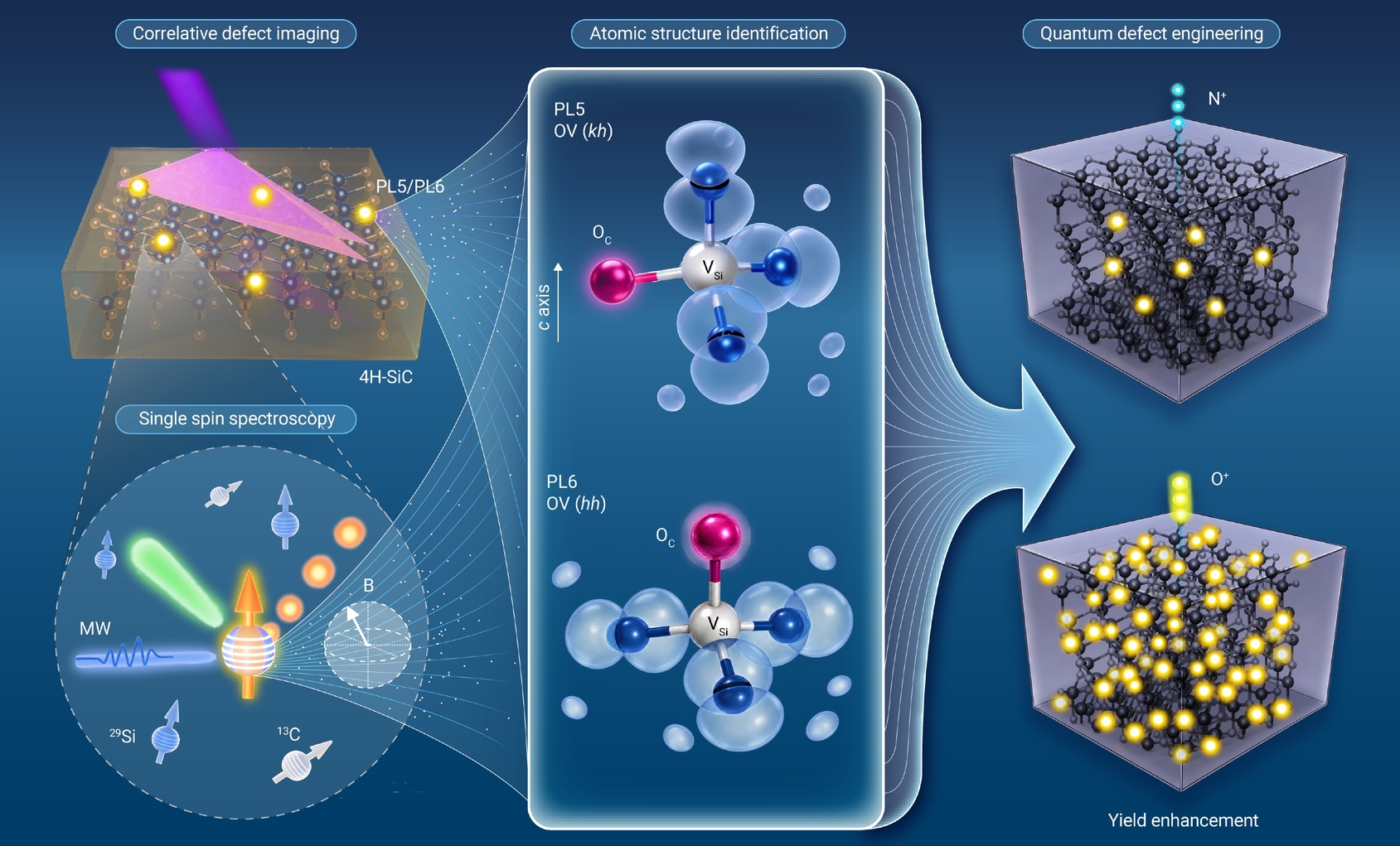
PL5 and PL6 in 4H-SiC are key quantum sensors, but their unknown structures block efficient fabrication.
We identify both as oxygen-vacancy complexes and boost their formation yields via oxygen implantation.
This could enable scalable SiC quantum technologies, from sensor arrays to integrated photonic devices.
-
-
ABSTRACT
Spin defects promise atomic-scale resolution and single-electron sensitivity, but typically deteriorate near surfaces. The PL5 and PL6 centers in SiC have emerged as a notable exception, exhibiting high optical contrast, long spin coherence times, and stable charge states within a few nanometers of the surface at room temperature. However, deterministic creation and scalable fabrication of these centers remain limited by their unresolved microscopic origins, with PL5 and PL6 frequently discussed in connection with divacancies and stacking faults. Here, we show that PL5 and PL6 do not originate from stacking faults, as regions with and without these planar defects exhibit comparable emitter densities. Instead, oxygen implantation increases the yield by more than an order of magnitude compared to nitrogen, and isotopic implantation with 17O yields a spin-5/2 hyperfine signature in the ODMR spectra, providing direct confirmation of oxygen involvement. From the characterization of the zero-field-splitting tensor and hyperfine interactions, together with ab initio calculations, we assign PL5 and PL6 to OCVSi defects in the kh and hh configurations, respectively. These results establish a basis for deterministic generation of near-surface spin qubits and their scalable integration for quantum photonics and nanoscale quantum sensing.-
Keywords:
- silicon carbide /
- spin defects /
- oxygen-vacancy complexes /
- quantum sensing /
- quantum photonics
-

-
REFERENCES
[1] Degen C. L., Reinhard F. and Cappellaro P. (2017). Quantum sensing. Rev. Mod. Phys. 89:035002. DOI:10.1103/revmodphys.89.035002 [2] Atatüre M., Englund D., Vamivakas N., et al. (2018). Material platforms for spin-based photonic quantum technologies. Nat. Rev. Mater. 3:38−51. DOI:10.1038/s41578-018-0008-9 [3] Son N. T., Anderson C. P., Bourassa A., et al. (2020). Developing silicon carbide for quantum spintronics. Appl. Phys. Lett. 116:190501. DOI:10.1063/5.0004454 [4] Zhao X., Liu M., Zhang Q., et al. (2025). Optically active point defects in 4H–SiC: Identification of microscopic mechanisms and prospects for quantum applications. Adv. Funct. Mater. 36:e26154. DOI:10.1002/adfm.202526154 [5] Koehl W. F., Buckley B. B., Heremans F. J., et al. (2011). Room temperature coherent control of defect spin qubits in silicon carbide. Nature 479:84−87. DOI:10.1038/nature10562 [6] Chen Y., Zhang Q., Teng Y., et al. (2025). Single-molecule scale nuclear magnetic resonance spectroscopy using a robust near-infrared spin sensor. arXiv:2512.10278. DOI: 10.48550/arXiv.2512.10278 [7] Janitz E., Herb K., Völker L. A., et al. (2022). Diamond surface engineering for molecular sensing with nitrogen-vacancy centers. J. Mater. Chem. C 10:13533−69. DOI:10.1039/D2TC01258H [8] Li P., Zhou J. Y., Li S., et al. (2025). Non-invasive bioinert room-temperature quantum sensor from silicon carbide qubits. Nat. Mater. 24:1913−1919. DOI:10.1038/s41563-025-02382-9 [9] Hu H., Zhou Y., Yi A., et al. (2024). Room-temperature waveguide integrated quantum register in a semiconductor photonic platform. Nat. Commun. 15:10256. DOI:10.1038/s41467-024-54606-2 [10] Christle D. J., Falk A. L., Andrich P., et al. (2015). Isolated electron spins in silicon carbide with millisecond coherence times. Nat. Mater. 14:160−3. DOI:10.1038/nmat4144 [11] Son N. T., Shafizadeh D., Ohshima T., et al. (2022). Modified divacancies in 4H-SiC. J. Appl. Phys. 132:025703. DOI:10.1063/5.0099017 [12] Jing K., Qi H., Liu H., et al. (2026). Formation preference of divacancy ensemble in 4H-SiC. Chin. Phys. B. 34:096101. DOI:10.1088/1674-1056/ae3e71 [13] Li Q., Wang J. F., Yan F. F., et al. (2022). Room-temperature coherent manipulation of single-spin qubits in silicon carbide with a high readout contrast. Natl. Sci. Rev. 9:nwab122. DOI:10.1093/nsr/nwab122 [14] He Z. X., Zhou J. Y., Li Q., et al. (2024). Robust single modified divacancy color centers in 4H-SiC under resonant excitation. Nat. Commun. 15:10146. DOI:10.1038/s41467-024-53662-y [15] Ivády V., Davidsson J., Delegan N., et al. (2019). Stabilization of point-defect spin qubits by quantum wells. Nat. Commun. 10:5607. DOI:10.1038/s41467-019-13495-6 [16] Bai R., Liu D., Chen S., et al. (2025). Origin of the unidentified color centers in 4H-SiC from first principles. Phys. Rev. B 111:014106. DOI:10.1103/PhysRevB.111.014106 [17] Zhao X., Liu M., Chen Y., et al. (2025). Towards identifying the PL6 center in SiC: From first-principles screening to hyperfine validation of competing defect candidates. Phys. Rev. Mater. 9:116204. DOI:10.1103/nvnt-jtnt [18] Hu H., Bian G., Yi A., et al. (2025). Strain-enhanced spin readout contrast in silicon carbide membranes. Phys. Rev. Lett. 135:110601. DOI:10.1103/tdb3-tqfv [19] Zhao S., Lin X., Luo Q. Y., et al. (2025). Probing the noise spectrum of the environmental spin bath in SiC using divacancy spins. Phys. Rev. Appl. 23:054086. DOI:10.1103/PhysRevApplied.23.054086 [20] Shafizadeh D., Son N. T., Abrikosov I. A., et al. (2025). Evolution of the optically detected magnetic resonance spectra of divacancies in 4H-SiC from liquid-helium to room temperature. Phys. Rev. B 111:165201. DOI:10.1103/PhysRevB.111.165201 [21] Feng G., Suda J. and Kimoto T. (2008). Characterization of stacking faults in 4H-SiC epilayers by room-temperature microphotoluminescence mapping. Appl. Phys. Lett. 92:221906. DOI:10.1063/1.2937097 [22] Iwamoto S., Shimura T., Watanabe H., et al. (2024). Oxygen-related defects in 4H-SiC from first principles. Appl. Phys. Express 17:051008. DOI:10.35848/1882-0786/ad45ae [23] Kobayashi T., Shimura T. and Watanabe H. (2023). Oxygen-vacancy defect in 4H-SiC as a near-infrared emitter: An ab initio study. J. Appl. Phys. 134:145701. DOI:10.1063/5.0169147 [24] Falk A. L., Klimov P. V., Buckley B. B., et al. (2014). Electrically and mechanically tunable electron spins in silicon carbide color centers. Phys. Rev. Lett. 112:187601. DOI:10.1103/PhysRevLett.112.187601 [25] Dolde F., Fedder H., Doherty M. W., et al. (2011). Electric-field sensing using single diamond spins. Nat. Phys. 7:459−63. DOI:10.1038/nphys1969 [26] Biktagirov T., Schmidt W. G. and Gerstmann U. (2020). Spin decontamination for magnetic dipolar coupling calculations: Application to high-spin molecules and solid-state spin qubits. Phys. Rev. Res. 2:022024. DOI:10.1103/PhysRevResearch.2.022024 [27] Falk A. L., Buckley B. B., Calusine G., et al. (2013). Polytype control of spin qubits in silicon carbide. Nat. Commun. 4:1819. DOI:10.1038/ncomms2854 [28] Son N. T., Carlsson P., ul Hassan J., et al. (2006). Divacancy in 4H-SiC. Phys. Rev. Lett. 96:055501. DOI:10.1103/PhysRevLett.96.055501 [29] Wang M., Sun H., Ye X., et al. (2022). Self-aligned patterning technique for fabricating high-performance diamond sensor arrays with nanoscale precision. Sci. Adv. 8:eabn9573. DOI:10.1126/sciadv.abn9573 [30] Lee E. M. Y., Yu A., de Pablo J. J., et al. (2021). Stability and molecular pathways to the formation of spin defects in silicon carbide. Nat. Commun. 12:6325. DOI:10.1038/s41467-021-26419-0 [31] Zhang C., Gygi F. and Galli G. (2023). Engineering the formation of spin-defects from first principles. Nat. Commun. 14:5985. DOI:10.1038/s41467-023-41632-9 [32] Doherty M. W., Dolde F., Fedder H., et al. (2012). Theory of the ground-state spin of the NV- center in diamond. Phys. Rev. B 85:205203. DOI:10.1103/PhysRevB.85.205203 -
ABOUT THIS ARTICLE
Cite this article:
Chen Y., Zhang Q., Liu M., et al. (2026). Oxygen-vacancy origin of robust surface-proximity spin centers in silicon carbide. The Innovation Physics 1:100013. https://doi.org/10.59717/j.tip.2026.100013
Welcome!
To request copyright permission to republish or share portions of our works, please visit Copyright Clearance Center's (CCC) Marketplace website at marketplace.copyright.com.
Export File
Citation
Chen Y., Zhang Q., Liu M., et al. (2026). Oxygen-vacancy origin of robust surface-proximity spin centers in silicon carbide. The Innovation Physics 1:100013. https://doi.org/10.59717/j.tip.2026.100013

Format
Content
-
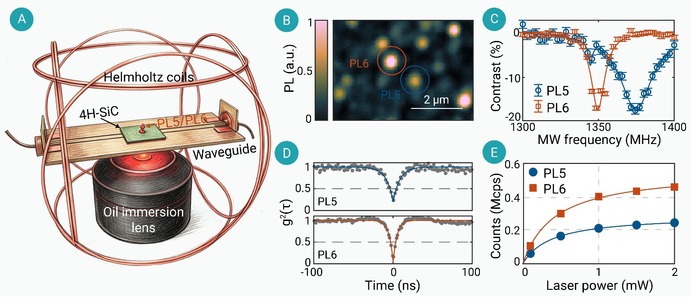
Figure 1.
Experimental setup and basic optical and spin characterization of single PL5 and PL6 centers
-
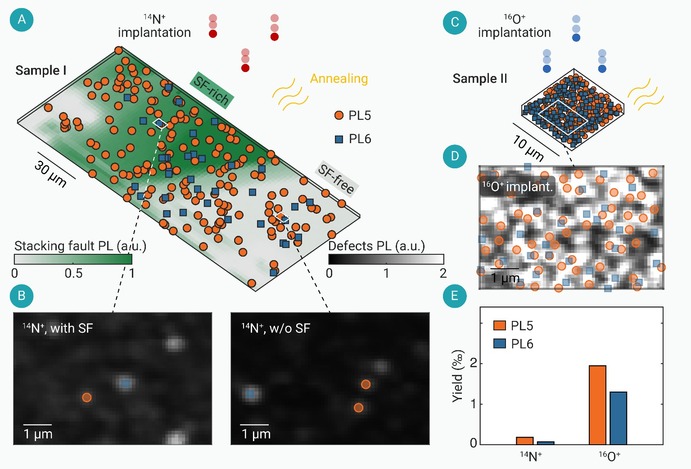
Figure 2.
Decoupling PL5 and PL6 defects from stacking faults and validating oxygen-enhanced formation
-
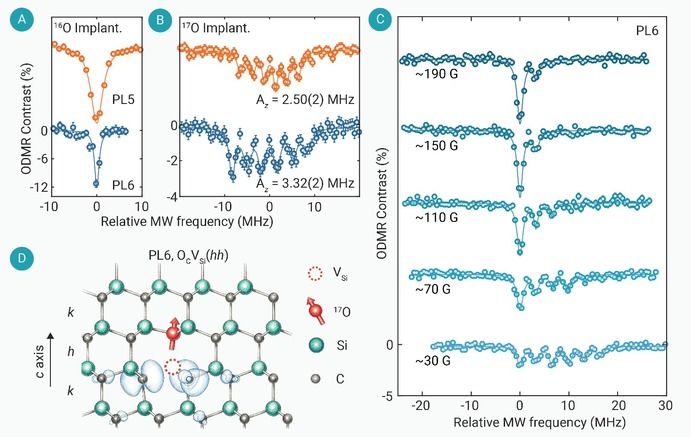
Figure 3.
Direct spectroscopic evidence of oxygen incorporation via 17O isotope engineering
-
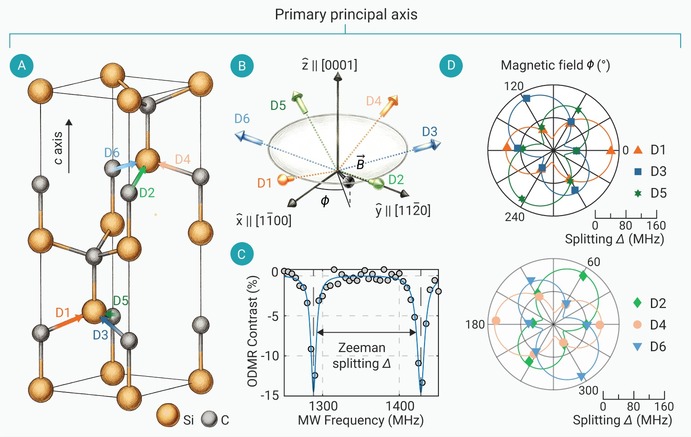
Figure 4.
Determination of the six primary principal axes of PL5
-
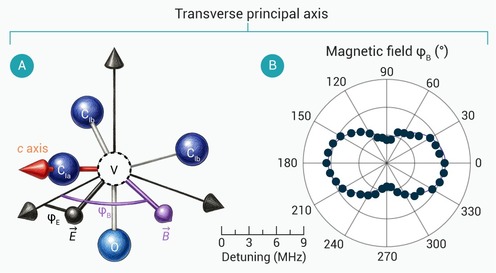
Figure 5.
Transverse principal-axis determination for PL5
-
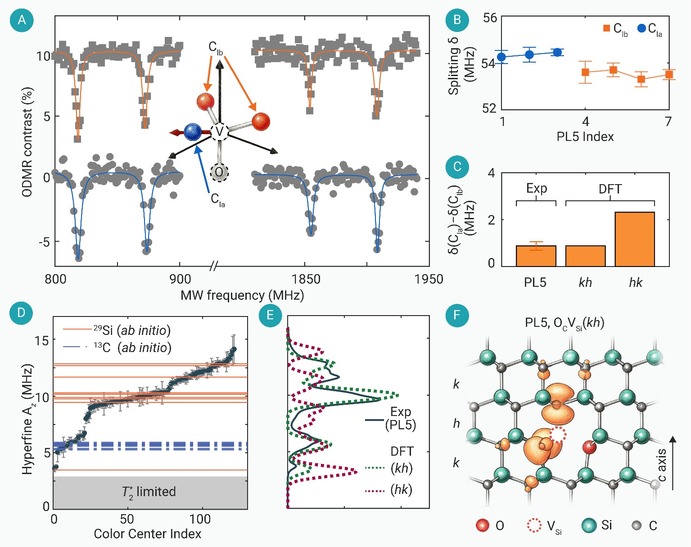
Figure 6.
Statistical mapping of the local nuclear-spin environment and structural assignment of PL5
