
Flood protection and residual risk: From observations to simulations
-

-
REFERENCES
[1] Kreibich H., Van Loon A.F., Schröter K., et al. (2022). The challenge of unprecedented floods and droughts in risk management. Nature 608:80−86. DOI:10.1038/s41586-022-04917-5 [2] Paprotny D., Tilloy A., Treu S., et al. (2025). Attribution of flood impacts shows strong benefits of adaptation in Europe since 1950. Sci. Adv. 11:eadt7068. DOI:10.1126/sciadv.adt7068 [3] Ding M., Lin P., Gao S., et al. (2023). Reversal of the levee effect towards sustainable floodplain management. Nat. Sustain. 6:1578−1586. DOI:10.1038/s41893-023-01202-9 [4] Zhao G., Yamazaki D., Tanaka Y., et al. (2025). Developing a levee module for global flood modeling with a reach‐level parameterization approach. Water Resour. Res. 61:e2024WR039790. DOI:10.1029/2024WR039790 [5] Tanoue M., Taguchi R., Alifu H., et al. (2021). Residual flood damage under intensive adaptation. Nat. Clim. Change 11:823−826. DOI:10.1038/s41558-021-01158-8 -
ABOUT THIS ARTICLE
Cite this article:
Zhou X., Zhao G., Chen J., et al. (2026). Flood protection and residual risk: From observations to simulations. The Innovation Water 1:100008. https://doi.org/10.59717/j.tiw.2026.100008
Welcome!
To request copyright permission to republish or share portions of our works, please visit Copyright Clearance Center's (CCC) Marketplace website at marketplace.copyright.com.
Export File
Citation
Zhou X., Zhao G., Chen J., et al. (2026). Flood protection and residual risk: From observations to simulations. The Innovation Water 1:100008. https://doi.org/10.59717/j.tiw.2026.100008

Format
Content
 DownLoad:
-
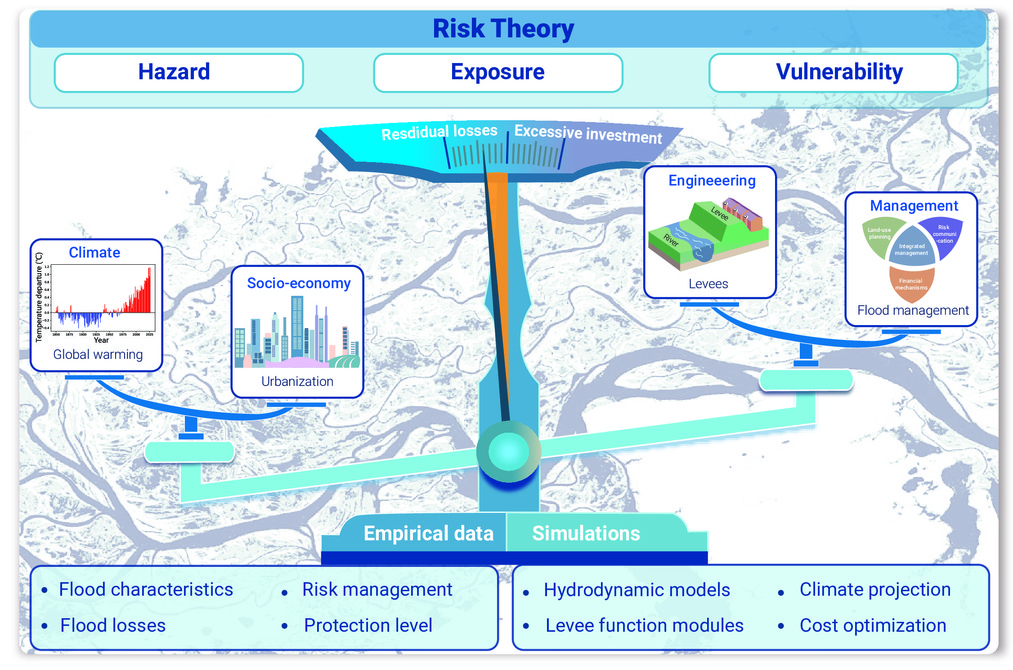
Figure 1.
Illustration of the unbalanced contribution of different components (i.e., climate, socio-economy, flood protection engineering, and management) to flood impact, within the concept of risk theory
