
Generative AI reshapes the PROTAC discovery paradigm: From empirical screening to rational design
-
ABSTRACT
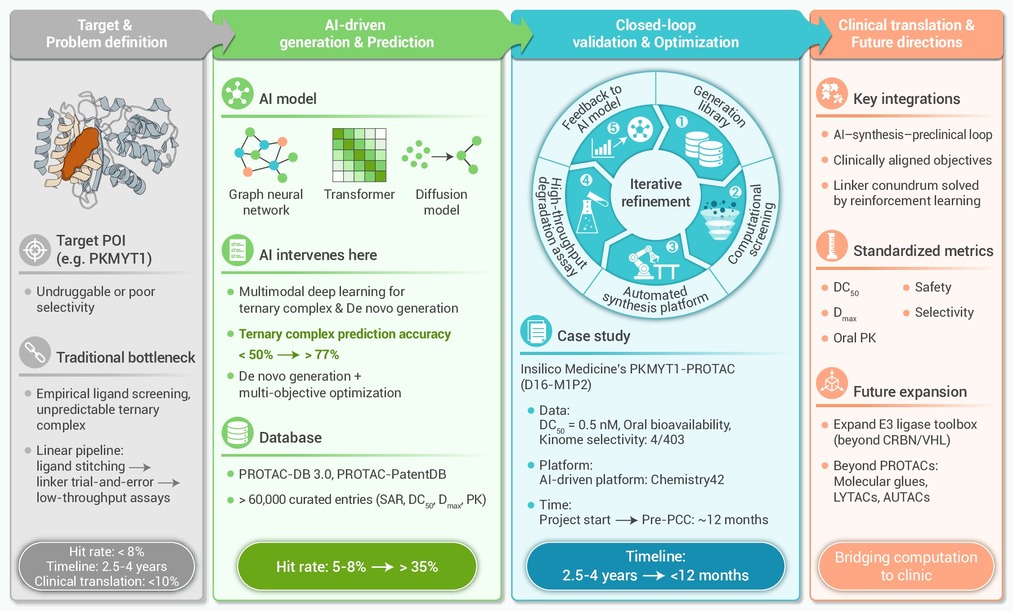
PROTACs are revolutionary therapeutics that eliminate pathogenic proteins via catalytic event-driven degradation. Conventional development suffers from unpredictable ternary complexes, empirical linker modification and blind ligand screening, yielding clinical success below 10% and requiring 3-4 years to obtain preclinical candidates. Generative artificial intelligence (AI) offers a promising avenue for data-driven rational design. This perspective explores how multimodal deep learning enhances ternary complex prediction accuracy and boosts molecular design hit rates from 5-8% to over 35%. Closed-loop research and development (R&D) ecosystems supported by databases accelerate PROTAC development. The landmark case of Insilico Medicine’s PKMYT1-PROTAC, developed via its AI platform Chemistry 42, achieves a DC50 of 0.5 nM and exhibits a dual degradation-inhibition mechanism, and has advanced to the preclinical candidate (PCC) validation stage within approximately 12 months. We further discuss how to integrate AI design with clinical translation. Future efforts focus on advanced computational strategies, establishing standardized evaluation metrics and expanding the E3 ligase toolbox. This AI-powered strategy will expedite PROTAC research and expand the application of targeted protein degradation therapy.-
Keywords:
- PROTAC /
- Generative AI /
- Drug discovery /
- Rational design /
- Preclinical candidate
-

-
REFERENCES
[1] Guedeney N, Cornu M, Schwalen F, et al. (2023). PROTAC technology: A new drug design for chemical biology with many challenges in drug discovery. Drug Discov Today 28:103395. DOI:10.1016/j.drudis.2022.103395 [2] Ge J, Hsieh C-Y, Fang M, et al. (2024). Development of PROTACs using computational approaches. Trends Pharmacol Sci 45:1162−1174. DOI:10.1016/j.tips.2024.10.006 [3] Dou B, Zhu Z, Merkurjev E, et al. (2023). Machine Learning Methods for Small Data Challenges in Molecular Science. Chem Rev 123:8736−8780. DOI:10.1021/acs.chemrev.3c00189 [4] Chen Z, Gu C, Tan S, et al. (2025). Interpretable PROTAC Degradation Prediction With Structure-Informed Deep Ternary Attention Framework. Adv Sci 12:08138. DOI:10.1002/advs.202508138 [5] Cai H, Yao G, Shi Y, et al. (2025). PROTAC-PatentDB: A PROTAC Patent Compound Dataset. Sci Data 12:1840. DOI:10.1038/s41597-025-06136-9 [6] Ge J, Li S, Weng G, et al. (2025). PROTAC-DB 3.0: an updated database of PROTACs with extended pharmacokinetic parameters. Nucleic Acids Res 53:1510-1515. DOI:10.1093/nar/gkae768. [7] Ivanenkov YA, Polykovskiy D, Bezrukov D, et al. (2023). Chemistry42: An AI-Driven Platform for Molecular Design and Optimization. J Chem Inf Model 63:695−701. DOI:10.1021/acs.jcim.2c01191 [8] Wang Y, Wang X, Liu T, et al. (2025). Discovery of a bifunctional PKMYT1-targeting PROTAC empowered by AI-generation. Nat Commun 16:10759. DOI:10.1038/s41467-025-65796-8 [9] Schapira M, Calabrese MF, Bullock AN, et al. (2019). Targeted protein degradation: expanding the toolbox. Nat Rev Drug Discov 18:949−963. DOI:10.1038/s41573-019-0047-y -
ABOUT THIS ARTICLE
Cite this article:
Li P., Sun S., Wei T., et al. (2026). Generative AI reshapes the PROTAC discovery paradigm: From empirical screening to rational design. The Innovation Drug Discovery 1:100027. https://doi.org/10.59717/j.xinn-drugdisc.2026.100027
Welcome!
To request copyright permission to republish or share portions of our works, please visit Copyright Clearance Center's (CCC) Marketplace website at marketplace.copyright.com.
Export File
Citation
Li P., Sun S., Wei T., et al. (2026). Generative AI reshapes the PROTAC discovery paradigm: From empirical screening to rational design. The Innovation Drug Discovery 1:100027. https://doi.org/10.59717/j.xinn-drugdisc.2026.100027

Format
Content
 DownLoad:
-
Figure 1.
Schematic diagram of generative AI expediting the PROTAC research and translational pipeline
