
Integrating diverse drug modalities and reshaping the clinical translation ecosystem in next-generation therapeutics
-

-
REFERENCES
[1] Zhang P., Gao C., Hua K., et al. (2026). Systematically decoding pathological morphologies and molecular profiles with unified multimodal embedding. Nat. Methods 23:903−908. DOI:10.1038/s41592-026-03070-5 [2] Mak I., Evaniew N. and Ghert M. (2014). Lost in translation: animal models and clinical trials in cancer treatment. Am. J. Transl. Res. 6: 114-118. PMCID: PMC3902221 [3] Jayatunga M., Ayers M., Bruens L., et al. (2024). How successful are AI-discovered drugs in clinical trials. A first analysis and emerging lessons. Drug Discov. Today 6:104009. DOI:10.1016/j.drudis.2024.104009 [4] U.S. Food and Drug Administration. (2025). Roadmap to reducing animal testing in preclinical safety studies. https://www.animallaw.info/administrative/us-research-roadmap-reducing-animal-testing-preclinical-safety-studies [5] Han J., Wu Z., Zhan S., et al. (2025). Biorhythm-mimicking growth hormone patch. Nat. Mater. 24:1283−1294. DOI:10.1038/s41563-025-02188-9 -
ABOUT THIS ARTICLE
Cite this article:
Wang W., Yang Y., Wang S., et al. (2026). Integrating diverse drug modalities and reshaping the clinical translation ecosystem in next-generation therapeutics. The Innovation Drug Discovery 1:100047. https://doi.org/10.59717/j.xinn-drugdisc.2026.100047
Welcome!
To request copyright permission to republish or share portions of our works, please visit Copyright Clearance Center's (CCC) Marketplace website at marketplace.copyright.com.
Export File
Citation
Wang W., Yang Y., Wang S., et al. (2026). Integrating diverse drug modalities and reshaping the clinical translation ecosystem in next-generation therapeutics. The Innovation Drug Discovery 1:100047. https://doi.org/10.59717/j.xinn-drugdisc.2026.100047

Format
Content
 DownLoad:
-
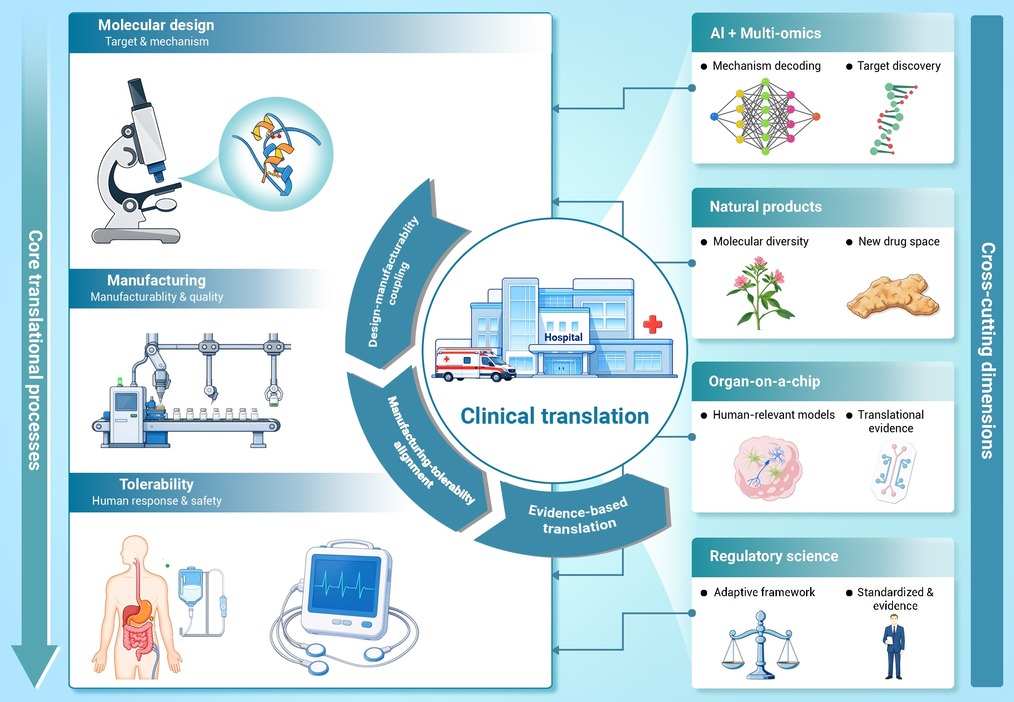
Figure 1.
Structural causes of the translational gap from technological, model, and regulatory bottlenecks.
