
Battery internal short circuit diagnosis based on vision transformer without real data
-
GRAPHICAL ABSTRACT

 DownLoad:
Full size image
DownLoad:
Full size image
-
PUBLIC SUMMARY
-
Developing AI models for ISC diagnosis in lithium-ion batteries is challenging due to limited fault data.
By extracting features from a mechanism model, AI model construction is achieved using only virtual data features.
When applied to real ISC data, the model demonstrates high accuracy, robustness, and generalization.
-
-
ABSTRACT
The diagnosis of an internal short circuit (ISC) fault is an integral part of thermal runaway warning for lithium-ion batteries. A higher level of accuracy in ISC fault diagnosis needs an artificial intelligence model, but lack of fault data and label ambiguity present challenges. To address these demands and challenges, features are extracted using a mean difference model to amplify the difference between fault data and normal data, while reduce the inherent error between virtual data and real data. Additionally, the model considers the influence of other faults and the variability within the real data. The Vision Transformer model is then trained with only this virtual feature to achieve 100% accuracy when verifying real ISC fault data under constant current charging condition. By breaking away from the reliance on real fault data for modeling, this approach greatly reduces the cost of human labor, materials, time, and carbon emissions, and also provides a reference for other projects facing similar challenges. -

-
REFERENCES
[1] Yin, H., Ma, S., Li, H., et al. (2021). Modeling strategy for progressive failure prediction in lithium-ion batteries under mechanical abuse. eTransportation 7: 100098. DOI: 10.1016/j.etran.2020.100098. [2] Li, C., Wu, Y., Li, X., et al. (2024). Flame-retardant composite phase change material with silicone resin and melamine phosphate for battery thermal safety. The Innovation Energy 1: 100021. DOI: 10.59717/j.xinn-energy.2024.100021. [3] Ren, D., Feng, X., Liu, L., et al. (2021). Investigating the relationship between internal short circuit and thermal runaway of lithium-ion batteries under thermal abuse condition. Energy Storage Mater. 34: 563−573. DOI: 10.1016/j.ensm.2020.10.020. [4] Wang, Y., Zhang, X., Li, K., et al. (2023). Perspectives and challenges for future lithium-ion battery control and management. eTransportation 18: 100260. DOI: 10.1016/j.etran.2023.100260. [5] Abaza, A., Ferrari, S., Wong, H.K., et al. (2018). Experimental study of internal and external short circuits of commercial automotive pouch lithium-ion cells. J. Energy Storage. 16: 211−217. DOI: 10.1016/j.est.2018.01.015. [6] Wang, H., Simunovic, S., Maleki, H., et al. (2016). Internal configuration of prismatic lithium-ion cells at the onset of mechanically induced short circuit. J. Power Sources. 306: 424−430. DOI: 10.1016/j.jpowsour.2015.12.026. [7] Sun, Y., Yuan, Y., Lu, L., et al. (2022). A comprehensive research on internal short circuits caused by copper particle contaminants on cathode in lithium-ion batteries. eTransportation 13: 100183. DOI: 10.1016/j.etran.2022.100183. [8] Meng, J., Yue, M., and Diallo, D. (2023). Nonlinear extension of battery constrained predictive charging control with transmission of jacobian matrix. Int. J. Elec. Power. 146: 108762. DOI: 10.1016/j.ijepes.2022.108762. [9] Kong, D., Lv, H., Ping, P., et al. (2023). A review of early warning methods of thermal runaway of lithium ion batteries. J. Energy Storage 64: 107073. DOI: 10.1016/j.est.2023.107073. [10] Lyu, P., Liu, X., Qu, J., et al. (2020). Recent advances of thermal safety of lithium ion battery for energy storage. Energy Storage Mater. 31: 195−220. DOI: 10.1016/j.ensm.2020.06.042. [11] Feng, X., Ouyang, M., Liu, X., et al. (2018). Thermal runaway mechanism of lithium ion battery for electric vehicles: A review. Energy Storage Mater. 10: 246−267. DOI: 10.1016/j.ensm.2017.05.013. [12] Xiong, R., Ma, S., Li, H., et al. (2020). Toward a safer battery management system: A critical review on diagnosis and prognosis of battery short circuit. iScience 23: 101010. DOI: 10.1016/j.isci.2020.101010. [13] Qiao, D., Wei, X., Jiang, B., et al. (2024). Data-driven fault diagnosis of internal short circuit for series-connected battery packs using partial voltage curves. IEEE T. Ind. Inform. 20: 6751−6761. DOI: 10.1109/TII.2024.3353872. [14] Jia, Y.K., Li, J.N., Yuan, C.H., et al. (2021). Data-driven safety risk prediction of lithium-ion battery. Adv. Energy Mater. 11: 2003868. DOI: 10.1002/aenm.202003868. [15] Jia, Y. and Xu, J. (2023). Data-driven short circuit resistance estimation in battery safety issues. J. Energy Chem. 79: 37−44. DOI: 10.1016/j.jechem.2022.12.035. [16] Samanta, A., Chowdhuri, S., and Williamson, S.S. (2021). Machine learning-based data-driven fault detection/diagnosis of lithium-ion battery: A critical review. Electronics 10: 1309. DOI: 10.3390/electronics10111309. [17] Kong, X.D., Zheng, Y.J., Ouyang, M.G., et al. (2018). Fault diagnosis and quantitative analysis of micro-short circuits for lithium-ion batteries in battery packs. J. Power Sources 395: 358−368. DOI: 10.1016/j.jpowsour.2018.05.097. [18] Qiao, D.D., Wang, X.Y., Lai, X., et al. (2022). Online quantitative diagnosis of internal short circuit for lithium-ion batteries using incremental capacity method. Energy 243: 123082. DOI: 10.1016/j.energy.2021.123082. [19] Qiao, D., Wei, X., Jiang, B., et al. (2024). Quantitative diagnosis of internal short circuit for lithium-ion batteries using relaxation voltage. IEEE T. Ind. Electron. 71: 13201−13210. DOI: 10.1109/TIE.2023.3342289. [20] Xue, Q., Li, G., Zhang, Y., et al. (2021). Fault diagnosis and abnormality detection of lithium-ion battery packs based on statistical distribution. J. Power Sources 482: 228964. DOI: 10.1016/j.jpowsour.2020.228964. [21] Wang, G., Zhao, J., Yang, J., et al. (2023). Multivariate statistical analysis based cross voltage correlation method for internal short-circuit and sensor faults diagnosis of lithium-ion battery system. J. Energy Storage 62: 106978. DOI: 10.1016/j.est.2023.106978. [22] Sun, Z., Wang, Z., Chen, Y., et al. (2022). Modified relative entropy-based lithium-ion battery pack online short-circuit detection for electric vehicle. IEEE T. Transp. Electr. 8: 1710−1723. DOI: 10.1109/TTE.2021.3128048. [23] Wang, G., Yang, J., and Jiao, J. (2023). Voltage correlation-based principal component analysis method for short circuit fault diagnosis of series battery pack. IEEE T. Ind. Electron. 70: 9025−9034. DOI: 10.1109/TIE.2022.3210588. [24] Xia, B., Shang, Y., Nguyen, T., et al. (2017). A correlation based fault detection method for short circuits in battery packs. J. Power Sources 337: 1−10. DOI: 10.1016/j.jpowsour.2016.11.007. [25] Feng, X.N., Pan, Y., He, X.M., et al. (2018). Detecting the internal short circuit in large-format lithium-ion battery using model-based fault-diagnosis algorithm. J. Energy Storage 18: 26−39. DOI: 10.1016/j.est.2018.04.020. [26] Hu, J., He, H., Wei, Z., et al. (2022). Disturbance-immune and aging-robust internal short circuit diagnostic for lithium-ion battery. IEEE T. Ind. Electron. 69: 1988−1999. DOI: 10.1109/tie.2021.3063968. [27] Deng, J., Bae, C., Marcicki, J., et al. (2018). Safety modelling and testing of lithium-ion batteries in electrified vehicles. Nat. Energy 3: 261−266. DOI: 10.1038/s41560-018-0122-3. [28] Ma, R., Deng, Y., and Wang, X. (2023). Simplified electrochemical model assisted detection of the early-stage internal short circuit through battery aging. J. Energy Storage 66: 107478. DOI: 10.1016/j.est.2023.107478. [29] Meng, J.W., Boukhnifer, M., and Diallo, D. (2019). On-line model-based short circuit diagnosis of lithium-ion batteries for electric vehicle application. 45th Annual Conference of the IEEE Industrial Electronics Society (IECON 2019) 1:6022-6027. DOI: 10.1109/IECON.2019.8927671. [30] Mariani, M.M., Machado, I., Magrelli, V., et al. (2023). Artificial intelligence in innovation research: A systematic review, conceptual framework, and future research directions. Technovation 122: 102623. DOI: 10.1016/j.technovation.2022.102623. [31] Wang, Y., Tian, J., Sun, Z., et al. (2020). A comprehensive review of battery modeling and state estimation approaches for advanced battery management systems. Renew. Sust. Energ. Rev. 131: 110015. DOI: 10.1016/j.rser.2020.110015. [32] Zhang, X., Li, Z., Luo, L., et al. (2022). A review on thermal management of lithium-ion batteries for electric vehicles. Energy 238: 121652. DOI: 10.1016/j.energy.2021.121652. [33] Wang, Y., Wang, L., Li, M., et al. (2020). A review of key issues for control and management in battery and ultra-capacitor hybrid energy storage systems. eTransportation 4: 100064. DOI: 10.1016/j.etran.2020.100064. [34] Liang, Y., Emadi, A., Gross, O., et al. (2022). A comparative study between physics, electrical and data driven lithium-ion battery voltage modeling approaches. SAE Tech. Pap. 2022-2001-0700. DOI: 10.4271/2022-01-0700. [35] Hossain Lipu, M.S., Hannan, M.A., Karim, T.F., et al. (2021). Intelligent algorithms and control strategies for battery management system in electric vehicles: Progress, challenges and future outlook. J. Cleaner Prod. 292: 126044. DOI: 10.1016/j.jclepro.2021.126044. [36] Zhang, X., Chen, S., Zhu, J.Z., et al. (2023). A critical review of thermal runaway prediction and early-warning methods for lithium-ion batteries. Energy Mater. Adv. 4: 0008. DOI: 10.34133/energymatadv.0008. [37] Finegan, D.P., Zhu, J.E., Feng, X.N., et al. (2021). The application of data-driven methods and physics-based learning for improving battery safety. Joule 5: 316−329. DOI: 10.1016/j.joule.2020.11.018. [38] Sun, Z., Wang, Z., Liu, P., et al. (2021). Overview of fault diagnosis in new energy vehicle power battery system. Chin. J. Mech. Eng. (Engl. Ed.) 57: 87−104. DOI: 10.3901/JME.2021.14.087. [39] Schmid, M., Kleiner, J., and Endisch, C. (2022). Early detection of internal short circuits in series-connected battery packs based on nonlinear process monitoring. J. Energy Storage 48: 103732. DOI: 10.1016/j.est.2021.103732. [40] Liu, H., Hao, S., Han, T., et al. (2023). Random forest-based online detection and location of internal short circuits in lithium battery energy storage systems with limited number of sensors. IEEE T. Instrum. Meas. 72: 1−11. DOI: 10.1109/TIM.2023.3304674. [41] Xie, J.L., Zhang, L., Yao, T.Q., et al. (2020). Quantitative diagnosis of internal short circuit for cylindrical li-ion batteries based on multiclass relevance vector machine. J. Energy Storage 32: 101957. DOI: 10.1016/j.est.2020.101957. [42] Cui, B., Wang, H., Li, R., et al. (2023). Internal short circuit early detection of lithium-ion batteries from impedance spectroscopy using deep learning. J. Power Sources 563: 232824. DOI: 10.1016/j.jpowsour.2023.232824. [43] Lu, X., Qiu, J., Lei, G., et al. (2023). State of health estimation of lithium iron phosphate batteries based on degradation knowledge transfer learning. IEEE T. Transp. Electr. 9: 4692−4703. DOI: 10.1109/TTE.2023.3240617. [44] Su, S., Li, W., Mou, J., et al. (2023). A hybrid battery equivalent circuit model, deep learning, and transfer learning for battery state monitoring. IEEE T. Transp. Electr. 9: 1113−1127. DOI: 10.1109/TTE.2022.3204843. [45] Dong, Z.K., Ji, X.Y., Wang, J.Y., et al. (2024). Icncs: Internal cascaded neuromorphic computing system for fast electric vehicle state-of-charge estimation. IEEE T. Consum. Electr. 70: 4311−4320. DOI: 10.1109/TCE.2023.3257201. [46] Cai, L.H., Wang, H., Dong, Z.K., et al. (2023). A multi-fault diagnostic method based on category-reinforced domain adaptation network for series-connected battery packs. J. Energy Storage 60: 106690. DOI: 10.1016/j.est.2023.106690. [47] Wang, H., Nie, J.H., He, Z.W., et al. (2023). A reconstruction-based model with transformer and long short-term memory for internal short circuit detection in battery packs. Energy Rep. 9: 2420−2430. DOI: 10.1016/j.egyr.2023.01.092. -
ABOUT THIS ARTICLE
Cite this article:
Cai H., Liu X., Sun L., et al., (2024). Battery internal short circuit diagnosis based on vision transformer without real data. The Innovation Energy 1(3): 100041. https://doi.org/10.59717/j.xinn-energy.2024.100041
Welcome!
To request copyright permission to republish or share portions of our works, please visit Copyright Clearance Center's (CCC) Marketplace website at marketplace.copyright.com.

Article Metrics
Relative Articles
Cited by
Export File
Citation
Cai H., Liu X., Sun L., et al., (2024). Battery internal short circuit diagnosis based on vision transformer without real data. The Innovation Energy 1(3): 100041. https://doi.org/10.59717/j.xinn-energy.2024.100041

Format
Content

-
Figure 1.
The process of building AI models based on virtual data.
-
Figure 2.
Virtual data and feature data curve
-
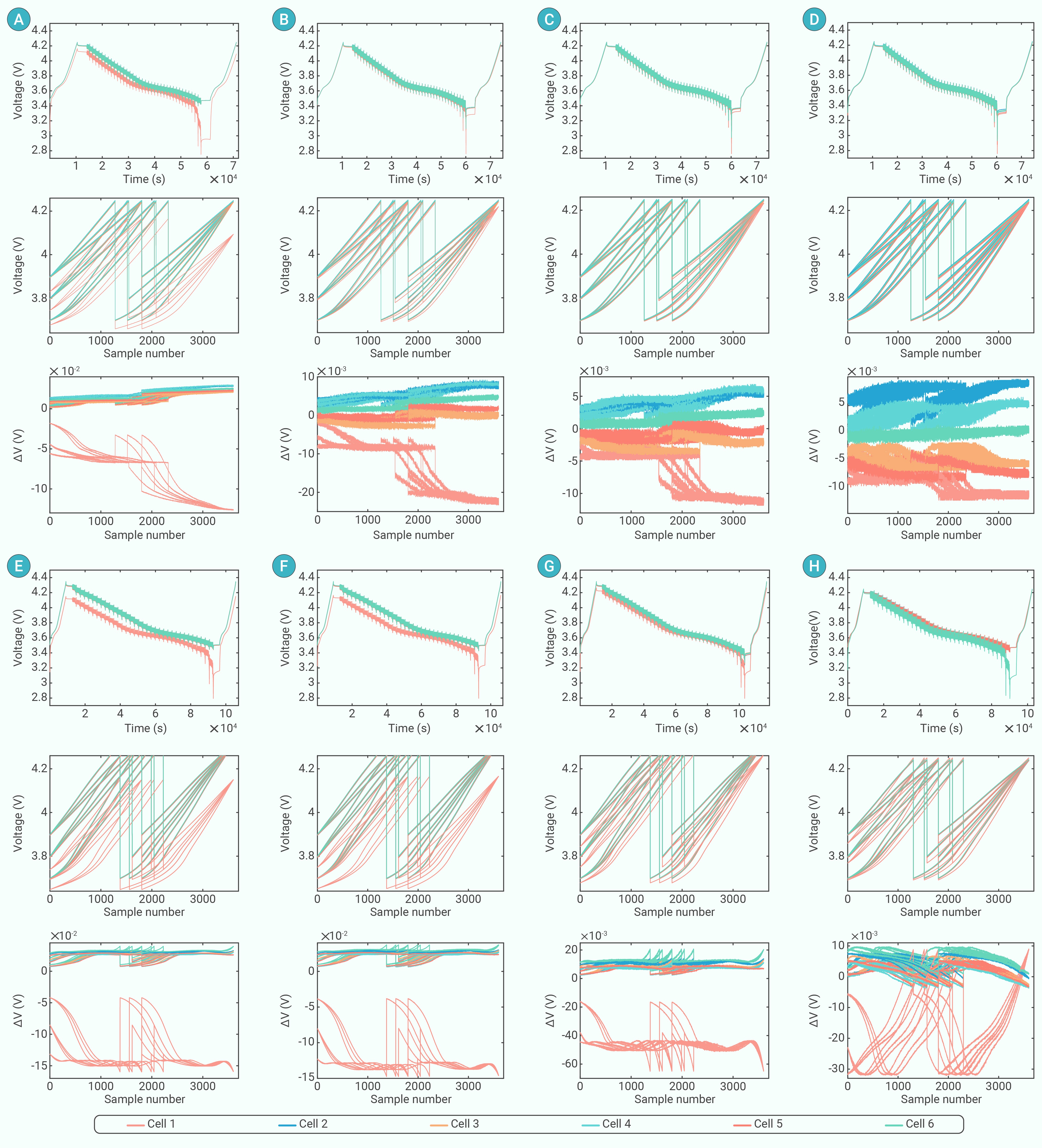
Figure 3.
The experimental test voltage curve, the original curve of the two-cycle charging voltage combination, and the feature curve of the two-cycle charging voltage combination extracted by MDM
-
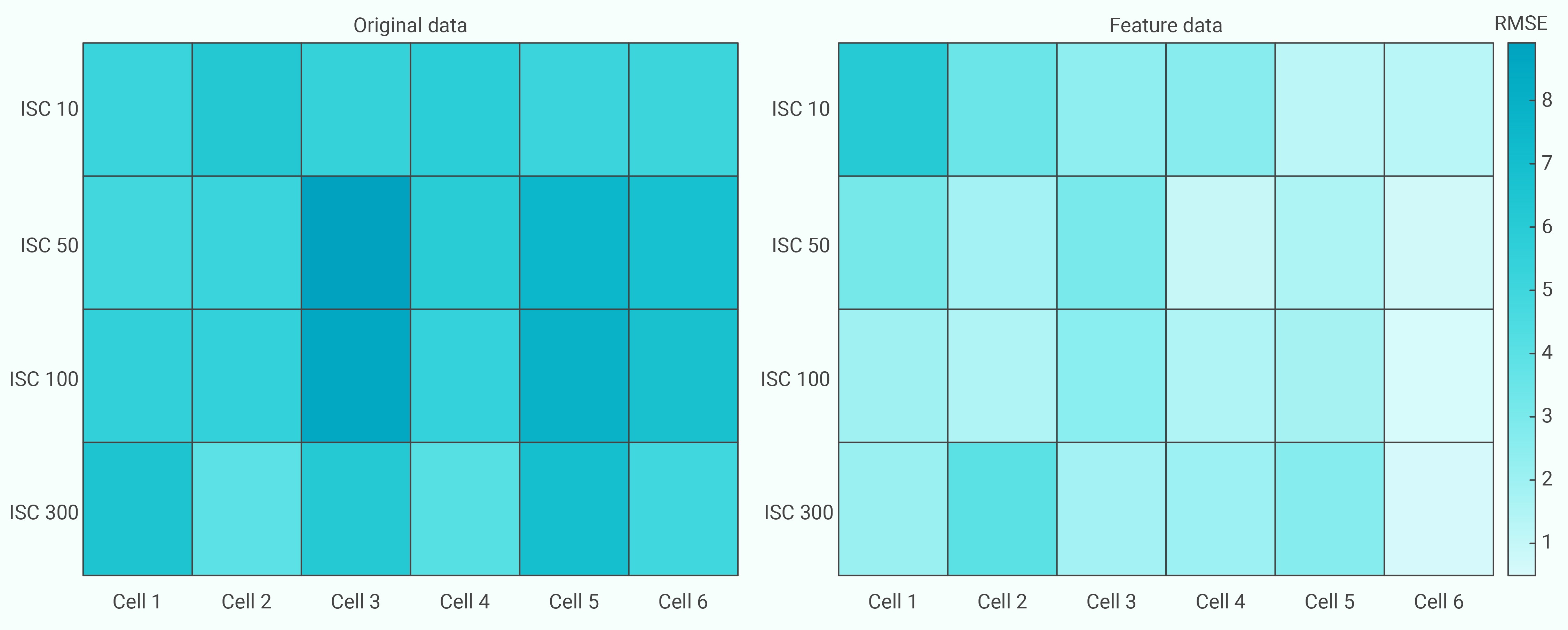
Figure 4.
Comparison of the mean RMSE between virtual data and real data before and after feature extraction.
-
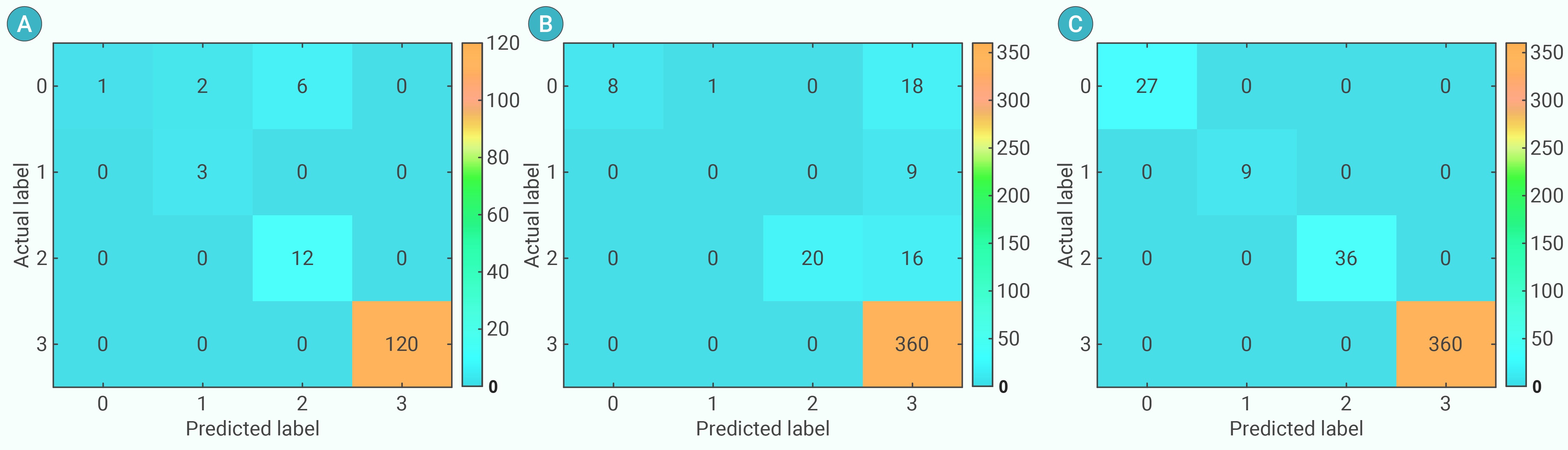
Figure 5.
The diagnosis results of the ViT model
-
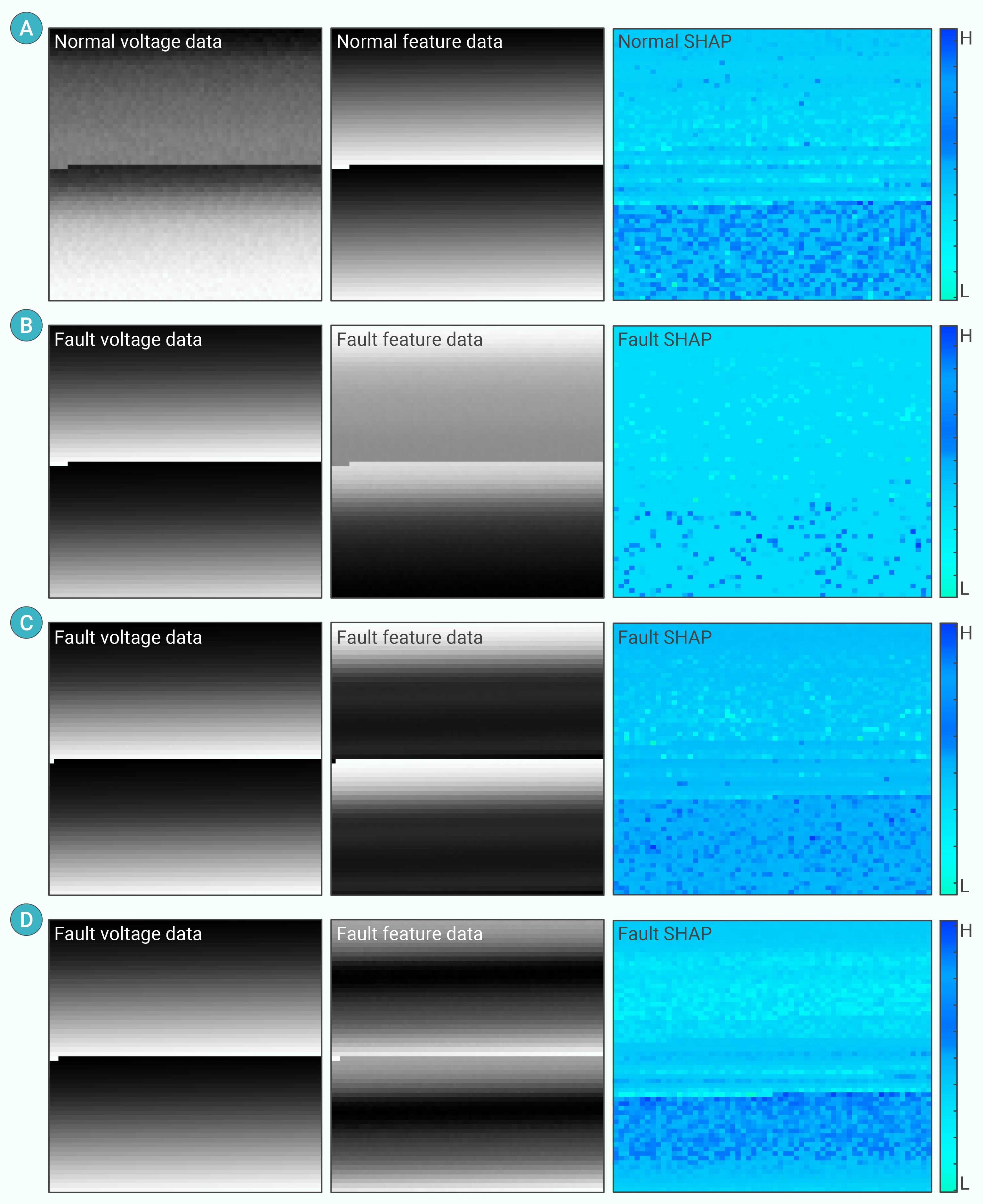
Figure 6.
Grayscale images and SHAP (SHapley Additive exPlanations) graphs of different types of fault data
