
The climate mitigation ambition-capacity gap in the global transportation sector
-

-
REFERENCES
[1] Tsepi E., Sebos I. and Kyriakopoulos G. L. (2024). Decomposition Analysis of CO2 Emissions in Greece from 1996 to 2020. Strat. Plan. Energy Environ. 43. DOI:10.13052/spee1048-5236.4332 [2] United Nations Environment Programme (2024). Emissions Gap Report 2024: No more hot air … please! With a massive gap between rhetoric and reality, countries draft new climate commitments. https://wedocs.unep.org/20.500.11822/46404 [3] Dekker M. M., Hof A. F., van den Berg M., et al. (2023). Spread in climate policy scenarios unravelled. Nature 624:309−316. DOI:10.1038/s41586-023-06738-6 [4] Hahn T., Morfeldt J., Höglund R., et al. (2024). Estimating countries’ additional carbon accountability for closing the mitigation gap based on past and future emissions. Nat. Commun. 15:9707. DOI:10.1038/s41467-024-54039-x [5] Stokes L. C. and Warshaw C. (2017). Renewable energy policy design and framing influence public support in the United States. Nat. Energy 2:17107. DOI:10.1038/nenergy.2017.107 -
ABOUT THIS ARTICLE
Cite this article:
Liang J., Ren W. and Peng X. (2026). The climate mitigation ambition-capacity gap in the global transportation sector. The Innovation Energy 3:100128. https://doi.org/10.59717/j.xinn-energy.2026.100128
Welcome!
To request copyright permission to republish or share portions of our works, please visit Copyright Clearance Center's (CCC) Marketplace website at marketplace.copyright.com.
Export File
Citation
Liang J., Ren W. and Peng X. (2026). The climate mitigation ambition-capacity gap in the global transportation sector. The Innovation Energy 3:100128. https://doi.org/10.59717/j.xinn-energy.2026.100128

Format
Content
 DownLoad:
-
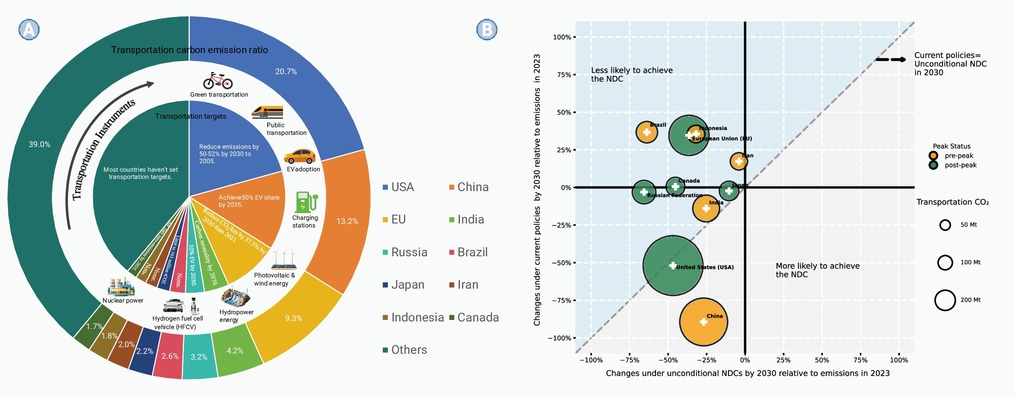
Figure 1.
Scenarios of transportation carbon emission and mitigation capacity for the top 10 countries
