
Integrating climate risk assessment into the Renewable-dominated Power System
-
ABSTRACT
Renewable-dominated Power System (RDPS) is emerging as critical trend to achieve CO2 emission reduction, and the COP28 climate summit has set a global goal to triple its capacity to at least 11,000 GW by 2030. However, this system is heavily reliant on weather and climate conditions. While the inclusion of the storage in the RDPS can alleviate the impact of the volatility and intermittency, the new source-grid-load-storage system creates more risks resulting from increasing complexity of interconnections. These include heightened variability in renewable energy generation under extreme weather, growing instability in transmission infrastructure due to climate-induced stress, performance degradation of storage systems under temperature extremes, and limited flexibility in demand response during climate-driven load surges. Critically, these risks are not isolated but often interdependent, as climate-triggered disruptions in one part of the system can cascade across interconnected components and amplify local failures into large-scale outages. In this perspective, we assess the risks for the system across source, grid, load, and storage from the dimensions of hazard, exposure and vulnerability, highlight the emerging cascading risks driven by climate variability and extremes, and call for an urgent expansion of climate risk assessment frameworks to ensure the resilience and reliability of future power systems. -

-
REFERENCES
[1] WMO (World Meteorological Organization). (2025). WMO confirms 2024 as warmest year on record at about 1.55°C above pre-industrial level. https://wmo.int/news/media-centre/wmo-confirms-2024-warmest-year-record-about-155degc-above-pre-industrial-level [2] GCB (Global Carbon Budget). (2024). https://globalcarbonbudget.org/gcb-2024/ [3] IRENA (International Renewable Energy Agency). (2023). World energy transitions outlook 2023: 1.5°C pathway. https://www.irena.org/Publications/2023/Jun/World-Energy-Transitions-Outlook-2023 [4] IEA (International Energy Agency) (2025). Global Energy Review 2025. https://www.iea.org/reports/global-energy-review-2025/co2-emissions [5] IRENA (International Renewable Energy Agency). (2025). Renewable capacity statistics 2025, International Renewable Energy Agency, Abu Dhabi. https://www.irena.org/-/media/Files/IRENA/Agency/Publication/2025/Mar/IRENA_DAT_RE_Capacity_Statistics_2025.pdf [6] GEIDCO (Global Energy Interconnection Development and Cooperation Organization). (2025). Global Energy Interconnection Report. China Electric Power Press. https://wikimili.com/en/List_of_major_power_outages [7] Radziemska E. (2003). The effect of temperature on the power drop in crystalline silicon solar cells. Renew. Energy 28:1−12. DOI:10.1016/S0960-1481(02)00015-0 [8] Intergovernmental Panel on Climate Change. (2021). Climate Change 2021: The Physical Science Basis. IPCC 2:2391. https://www.ipcc.ch/report/ar6/wg1/ [9] National Development and Reform Commission. (2022). The 14th Five-Year Plan for Renewable Energy Development. https://www.ndrc.gov.cn/xwdt/tzgg/202206/t20220601_1326720.html [10] National Renewable Energy Laboratory. (2023). Moving Beyond 4-Hour Li-Ion Batteries: Challenges and Opportunities for Long(er)-Duration Energy Storage. https://research-hub.nrel.gov/en/publications/moving-beyond-4-hour-li-ion-batteries-challenges-and-opportunitie -
ABOUT THIS ARTICLE
Cite this article:
Zhou J., Wang Y., Su B., et al. (2026). Integrating climate risk assessment into the Renewable-dominated Power System. The Innovation Energy 3:100146. https://doi.org/10.59717/j.xinn-energy.2026.100146
Welcome!
To request copyright permission to republish or share portions of our works, please visit Copyright Clearance Center's (CCC) Marketplace website at marketplace.copyright.com.
Export File
Citation
Zhou J., Wang Y., Su B., et al. (2026). Integrating climate risk assessment into the Renewable-dominated Power System. The Innovation Energy 3:100146. https://doi.org/10.59717/j.xinn-energy.2026.100146

Format
Content
 DownLoad:
-
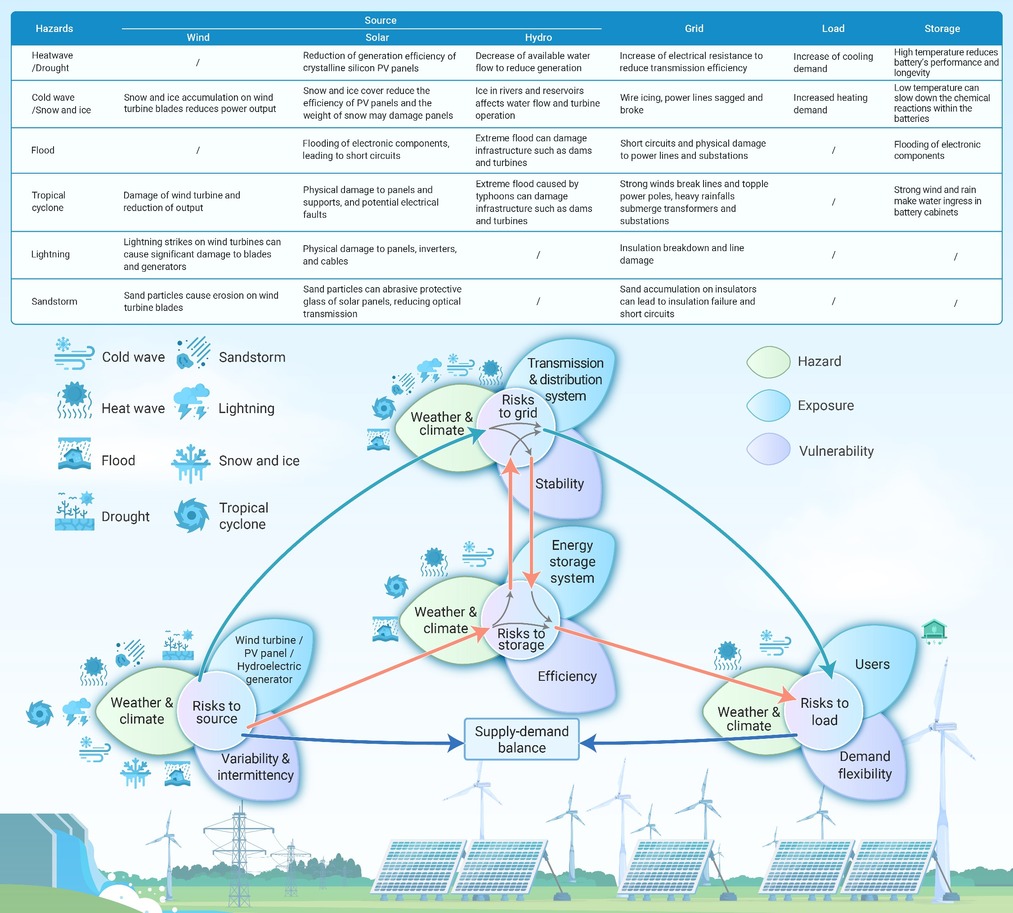
Figure 1.
Framework of the climate risk assessment for the RDPS
