
Increased wildfire exposure of energy infrastructure amid declining global wildfire activity
-

-
REFERENCES
[1] Cunningham C.X., Williamson G.J. and Bowman D. (2024). Increasing frequency and intensity of the most extreme wildfires on Earth. Nat. Ecol. Evol. 8:1420−1425. DOI:10.1038/s41559-024-02452-2 [2] Xu R.B., Ye T.T., Huang W.Z., et al. (2024). Global, regional, and national mortality burden attributable to air pollution from landscape fires: a health impact assessment study. Lancet. 404:2447−2459. DOI:10.1016/S0140-6736(24)02251-7 [3] Cranney K., Fell C. and Wilson G. (2020). Solar power and extreme weather in Australia. CSIRO. https://www.csiro.au/en/news/all/articles/2020/march/solar-power-and-extreme-weather-in-australia [4] Cheng Y., Xu Z.C. and Liu H.M. (2024). Sustainable development in global border regions. Science 384:1309−1309. DOI:10.1126/science.adp0639 [5] Hou Z., Wang C., Xu C., et al. (2024) Promotion Strategy and Evaluation Method of Distribution Network Resilience Considering Load Importance. J. Electric Power Sci. Tech. 39:78-85. DOI: 10.19781/j.issn.1673-9140.2024.03.009 -
ABOUT THIS ARTICLE
Cite this article:
He C., Wu Q., Huang C., et al. (2026). Increased wildfire exposure of energy infrastructure amid declining global wildfire activity. The Innovation Energy 3:100159. https://doi.org/10.59717/j.xinn-energy.2026.100159
Welcome!
To request copyright permission to republish or share portions of our works, please visit Copyright Clearance Center's (CCC) Marketplace website at marketplace.copyright.com.
Export File
Citation
He C., Wu Q., Huang C., et al. (2026). Increased wildfire exposure of energy infrastructure amid declining global wildfire activity. The Innovation Energy 3:100159. https://doi.org/10.59717/j.xinn-energy.2026.100159

Format
Content
 DownLoad:
-
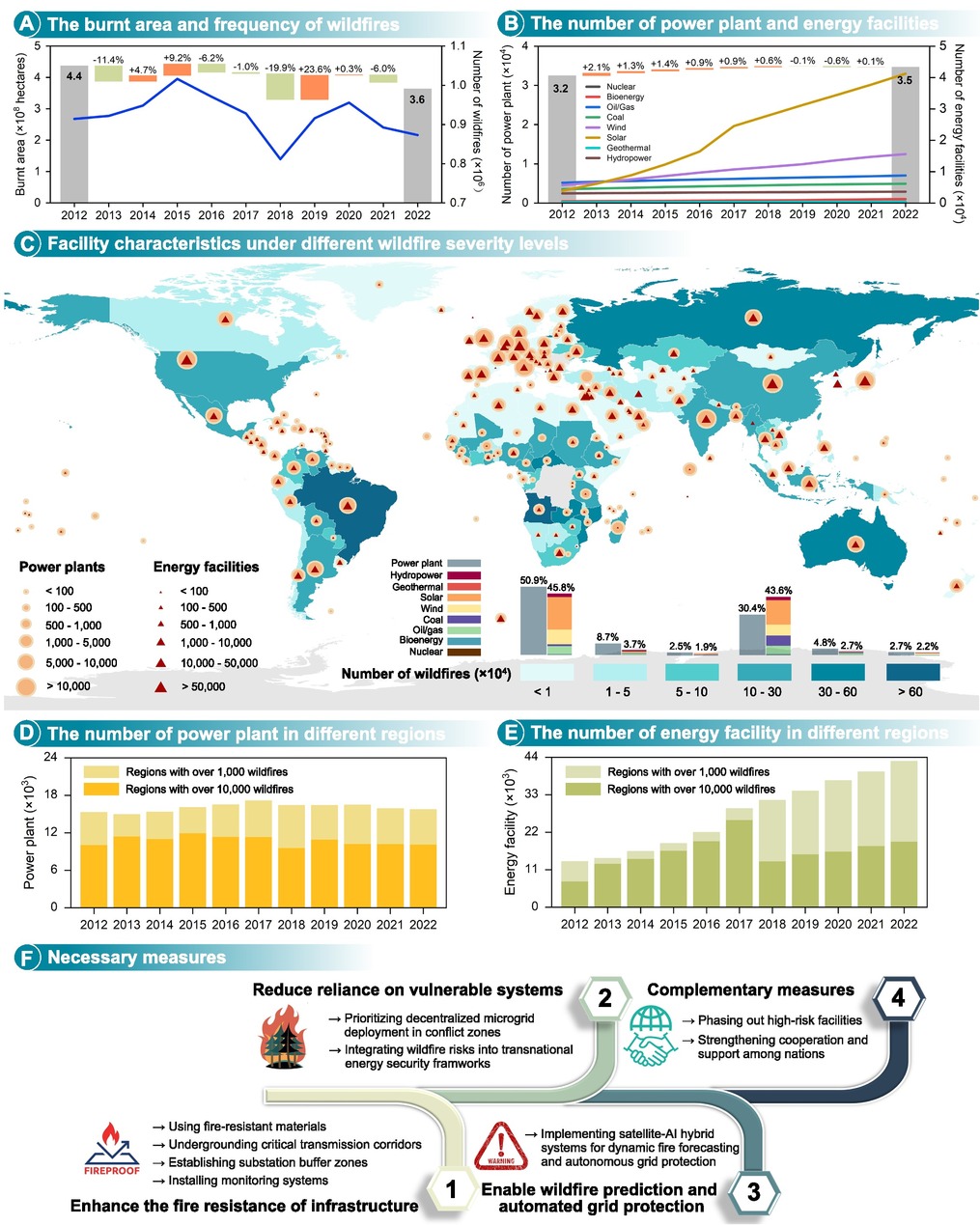
Figure 1.
The multidimensional spatio-temporal patterns of energy infrastructure exposure to wildfires.
