
Experimental study on multi-mode start-up and dynamic characteristics of proton exchange membrane (PEM) electrolyzer system
-
GRAPHICAL ABSTRACT
 DownLoad:
Full size image
DownLoad:
Full size image
-
PUBLIC SUMMARY
-
Systematic experimental investigation of PEM electrolyzer dynamics covering cold start, hot start, and load regulation.
An entropy-TOPSIS integrated evaluation framework for objective and quantitative dynamic performance assessment.
Identification of critical current threshold enabling effective hot start-up to inform rapid operational strategies.
Stepwise load regulation proves superior in enhancing system efficiency and stability, especially during unloading.
-
-
ABSTRACT
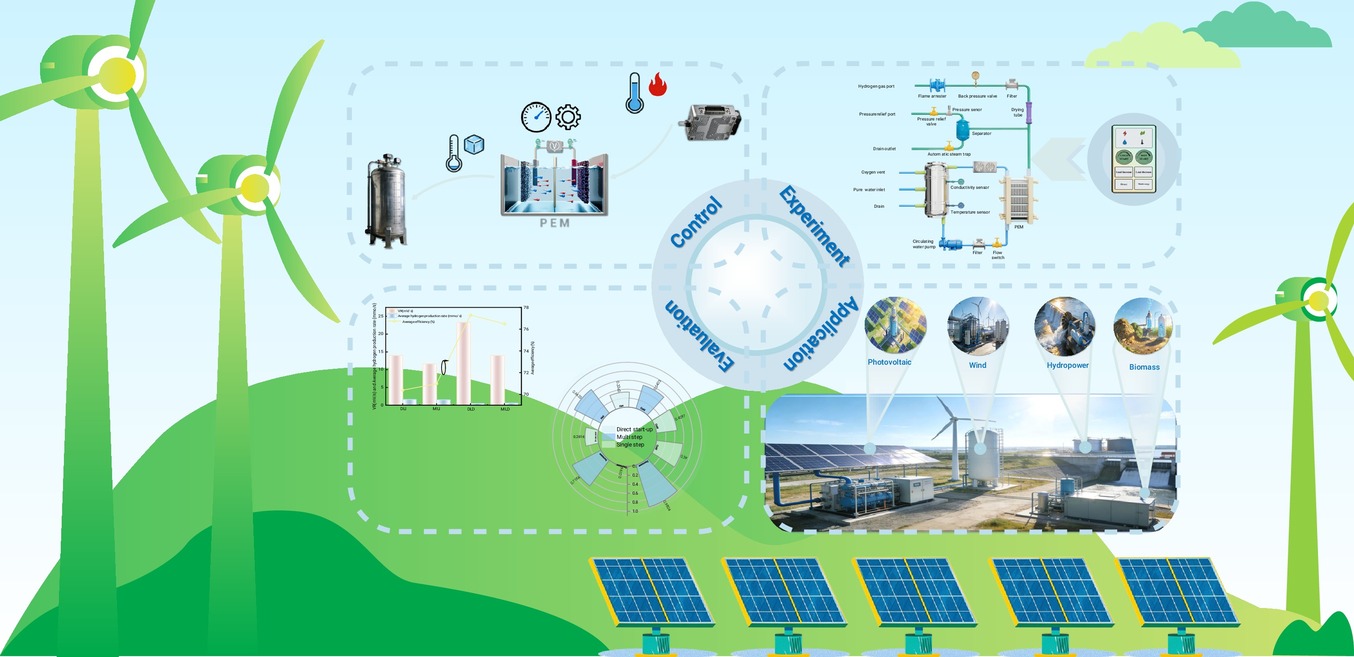
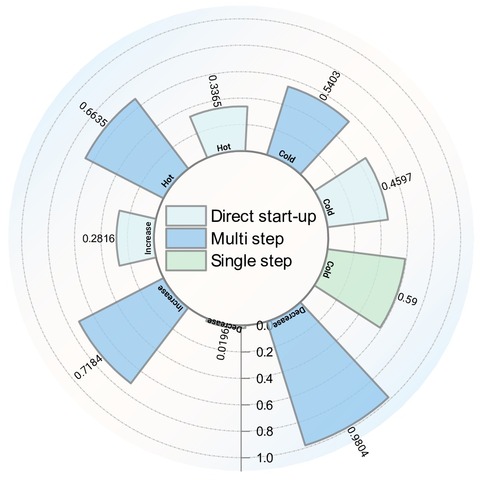
This study experimentally investigates and comparatively analyzes the dynamic performance of a proton exchange membrane (PEM) electrolyzer during cold start, hot start, and load regulation. The experimental comparison specifically includes three cold start-up strategies: direct, single-step, and double-step; two hot start-up approaches: direct and multi-step; and two load regulation modes: direct and stepwise. To comprehensively evaluate the dynamic performance of the PEM electrolyzer, this study adopts indicators such as voltage rise rate, average efficiency, and average hydrogen production rate for assessment. To objectively determine the weights of each indicator, the entropy weight method was adopted. Subsequently, the Technique for Order Preference by Similarity to Ideal Solution (TOPSIS) was used to calculate the closeness coefficient of each operational strategy to the ideal solution, thereby quantifying their overall performance ranking. Results show that the single-step cold start-up strategy exhibits the best overall performance, with its voltage rise rate, average efficiency, and average hydrogen production rate being 2.32 mV/s, 69.68%, and 1.324 mmol/s, respectively. The multi-step hot start-up strategy demonstrates superior overall performance compared to the direct hot start-up, with corresponding indicators of 4.25 mV/s, 71.92%, and 1.315 mmol/s, respectively. The multi-step load regulation strategy exhibits significantly better overall performance than the direct regulation method, particularly during load-decreasing operations. The relative closeness coefficients are0.2816 and0.7184 for direct and multi-step load increasing, respectively, and0.0196 and0.9804 for direct and multi-step load decreasing, respectively. This study provides both experimental evidence and a comprehensive assessment framework for optimizing the dynamic operation strategies of PEM electrolyzers. -

-
REFERENCES
[1] Xu Z.Y. and Wang R.Z. (2024). Prospects of heat pump for thermal energy decarbonization. Innov. Energy 1:100032. DOI:10.59717/j.xinn-energy.2024.100032 [2] Jiao F., Chen C., Liu T.X., et al. (2024). Insights of water-to-hydrogen conversion from thermodynamics. Innov. Energy 1:100004. DOI:10.59717/j.xinn-energy.2024.100004 [3] Lin B. and Li J. (2015). Analyzing cost of grid-connection of renewable energy development in China. Renew. Sustain. Energy Rev. 50:1373−1382. DOI:10.1016/j.rser.2015.04.194 [4] Luo D., Liu J., Wu H., et al. (2025). Advancing smart net-zero energy buildings with renewable energy and electrical energy storage. J. Energy Storage 114:115850. DOI:10.1016/j.est.2025.115850 [5] Ozarslan A. (2012). Large-scale hydrogen energy storage in salt caverns. Int. J. Hydrogen Energy 37:14265−14277. DOI:10.1016/j.ijhydene.2012.07.111 [6] Ferraren D. and Abundo M. (2021). A review of biohydrogen production technology for hydrogen fuel cells. Renew. Sustain. Energy Rev. 151:111413. DOI:10.1016/j.rser.2021.111413 [7] Luo L., Cristofari C. and Levrey S. (2023). Cogeneration systems and energy efficiency via exergy analysis. J. Energy Storage 66:107433. DOI:10.1016/j.est.2023.107433 [8] Handayani K., Anugrah P., Goembira F., et al. (2022). ASEAN pathways to net-zero emissions power sector in 2050. Appl. Energy 311:118580. DOI:10.1016/j.apenergy.2022.118580 [9] Ahn S.Y., Kim K.J., Kim B.J., et al. (2023). Trends of catalysts and sorbents for hydrogen production. Renew. Sustain. Energy Rev. 186:113635. DOI:10.1016/j.rser.2021.113635 [10] Tello A., Catano F.A., Arunachalam A., et al. (2025). Green hydrogen production by photovoltaic-assisted electrolysis. Int. J. Hydrogen Energy 107:378−395. DOI:10.1016/j.ijhydene.2024.04.333 [11] Zhang C., Wang J., Ren Z., et al. (2021). Wind-powered electrolyzer for hydrogen production. Int. J. Hydrogen Energy 46:34550−34564. DOI:10.1016/j.ijhydene.2021.08.029 [12] Olivier P., Bourasseau C. and Bouamama P.B. (2017). Low-temperature electrolysis system modelling. Renew. Sustain. Energy Rev. 78:280−300. DOI:10.1016/j.rser.2017.03.099 [13] Zhang J., Wang Z., He Y., et al. (2023). LCA comparison of wind hydrogen production systems. Sustain. Energy Technol. Assess. 60:103515. DOI:10.1016/j.seta.2023.103515 [14] Hirokazu K., Kensaku N., Naoto T., et al. (2023). Influence of renewable fluctuations on electrolysis. Int. J. Hydrogen Energy 48:4572−4593. DOI:10.1016/j.ijhydene.2022.11.018 [15] Sebbahi S., Assila A., Belghiti A.A., et al. (2024). Advances in alkaline water electrolysis. Int. J. Hydrogen Energy 82:583−599. DOI:10.1016/j.ijhydene.2024.07.428 [16] Zhang B., Harun N.F., Zhou N., et al. (2023). A real-time multiphysics model of a pressurized solid oxide electrolysis cell (SOEC) for cyber-physical simulation. Energy Convers. Manage. 298:117778. DOI:10.1016/j.enconman.2023.117778 [17] Ruuskanen V., Koponen J., Huoman K., et al. (2017). PEM water electrolyzer model for a power-hardware-in-loop simulator. Int. J. Hydrogen Energy 42:10775−10784. DOI:10.1016/j.ijhydene.2017.03.046 [18] Asiaban S., Bozalakov D. and Vandevelde L. (2024). Dynamic model of PEM electrolyser for integration into large-scale power systems. Energy Convers. Manage. X 23:100610. DOI:10.1016/j.ecmx.2024.100610 [19] Midilli A., Inac S. and Ozsaban M. (2017). Exergetic sustainability indicators for hydrogen systems. Int. J. Hydrogen Energy 42:21379−21391. DOI:10.1016/j.ijhydene.2017.04.299 [20] Ganjehsarabi H. (2019). Mixed refrigerant as working fluid in Organic Rankine Cycle for hydrogen production driven by geothermal energy. Int. J. Hydrogen Energy 44:18703−18711. DOI:10.1016/j.ijhydene.2018.11.231 [21] Corumlu V., Ozsoy A. and Ozturk M. (2018). Thermodynamic studies of a novel heat pipe evacuated tube solar collectors based integrated process for hydrogen production. Int. J. Hydrogen Energy 43:1060−1070. DOI:10.1016/j.ijhydene.2017.10.107 [22] Rauls E., Hehemann M., Keller R., et al. (2023). Favorable Start-Up behavior of polymer electrolyte membrane water electrolyzers. Appl. Energy 330:120350. DOI:10.1016/j.apenergy.2022.120350 [23] Sakas G., Rentschler P., Kosonen A., et al. (2025). Dynamic mass and energy balance model of a 50 kW proton exchange membrane electrolyzer system. Appl. Energy 382:125199. DOI:10.1016/j.apenergy.2024.125199 [24] Hüner B. (2024). Mathematical modeling of an integrated photovoltaic-assisted PEM water electrolyzer system for hydrogen production. Int. J. Hydrogen Energy 79:594−608. DOI:10.1016/j.ijhydene.2024.07.041 [25] Mraoui A., Benyoucef B. and Hassaine L. (2018). Experiment and simulation of electrolytic hydrogen production: Case study of photovoltaic-electrolyzer direct connection. Int. J. Hydrogen Energy 43:3441−3450. DOI:10.1016/j.ijhydene.2017.11.035 [26] Keller R., Baader F.J., Bardow A., et al. (2025). Experimental demonstration of dynamic demand response scheduling for PEM-electrolyzers. Appl. Energy 393:126014. DOI:10.1016/j.apenergy.2025.126014 [27] Kesercioglu M.A., Boyacı San F.G., Sözbir N., et al. (2025). Performance optimization of PEM electrolyzers: An experimental and Taguchi-based approach. Int. J. Hydrogen Energy 152:150214. DOI:10.1016/j.ijhydene.2025.150214 [28] Wang Y. and Xie G. (2023). Multi-objective optimisation of K-shape notch multi-way spool valve using CFD analysis, discharge area parameter model, and NSGA-II algorithm. Energy Convers. Manage. 283:116952. DOI:10.1016/j.enconman.2023.116952 -
ABOUT THIS ARTICLE
Cite this article:
Zhang H., Wang P., Zhao L., et al. (2026). Experimental study on multi-mode start-up and dynamic characteristics of proton exchange membrane (PEM) electrolyzer system. The Innovation Energy 3:100160. https://doi.org/10.59717/j.xinn-energy.2026.100160
Welcome!
To request copyright permission to republish or share portions of our works, please visit Copyright Clearance Center's (CCC) Marketplace website at marketplace.copyright.com.
Export File
Citation
Zhang H., Wang P., Zhao L., et al. (2026). Experimental study on multi-mode start-up and dynamic characteristics of proton exchange membrane (PEM) electrolyzer system. The Innovation Energy 3:100160. https://doi.org/10.59717/j.xinn-energy.2026.100160

Format
Content
-
Figure 1.
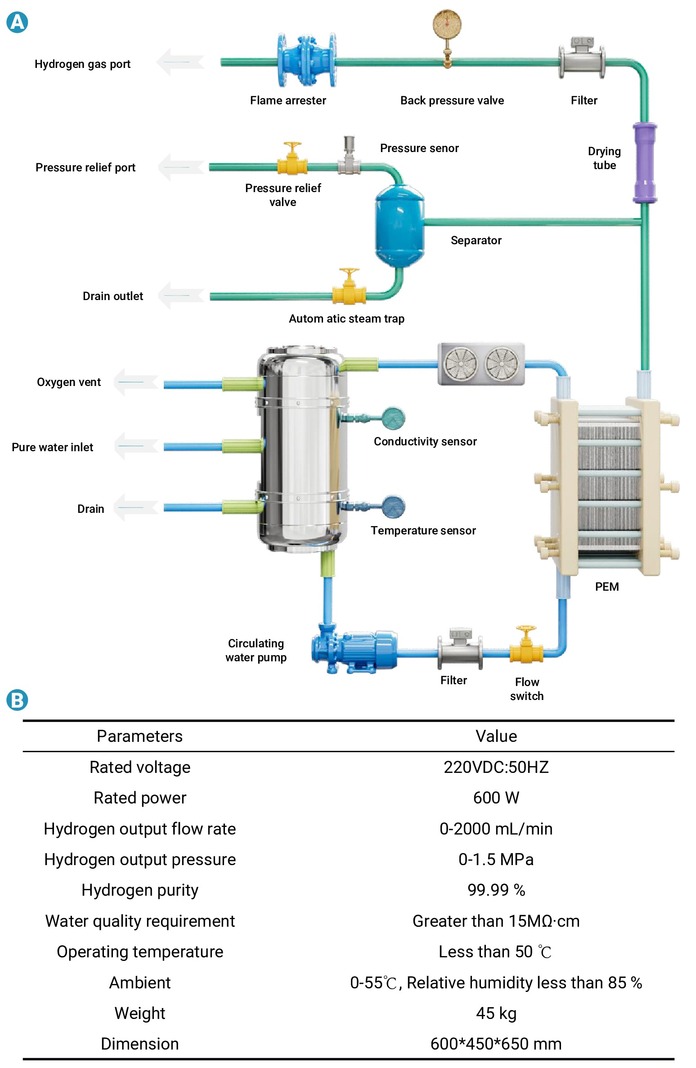
(A) The principle of the experimental system. (B) Key technical parameters and requirements of the PEM
-
Figure 2.
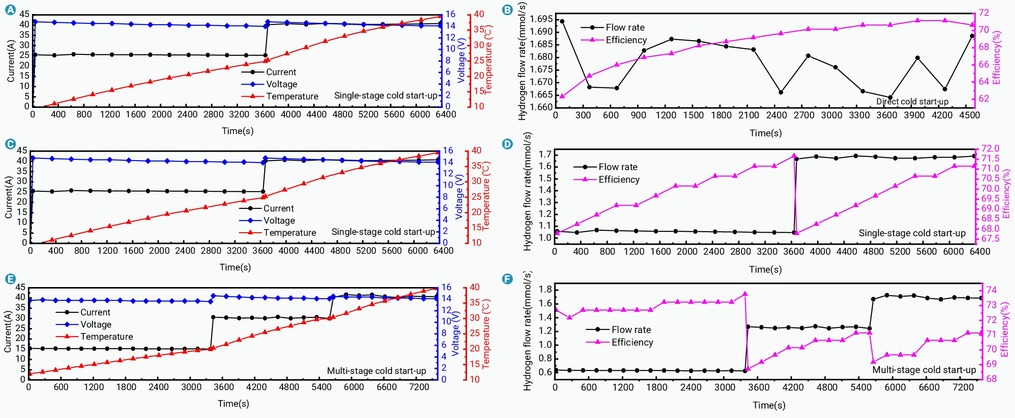
Cold start-up characteristics (A) Current, voltage, and temperature in DCS process (B) Hydrogen flow rate, and efficiency in DCS process (C) Current, voltage, and temperature in SCS process (D) Hydrogen flow rate, and efficiency in SCS process (E) Current, voltage, and temperature in MCS process (F) Hydrogen flow rate, and efficiency in MCS process
-
Figure 3.
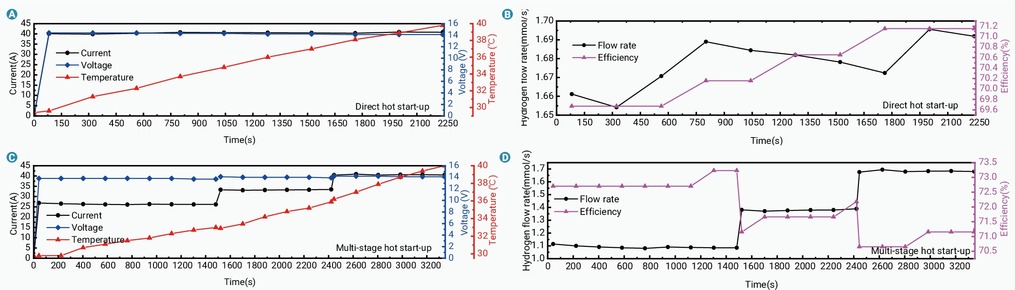
Hot start-up characteristics (A) Current, voltage, and temperature in DHS process (B) Hydrogen flow rate, and efficiency in DHS process (C) Current, voltage, and temperature in MHS process (D) Hydrogen flow rate, and efficiency in MHS process
-
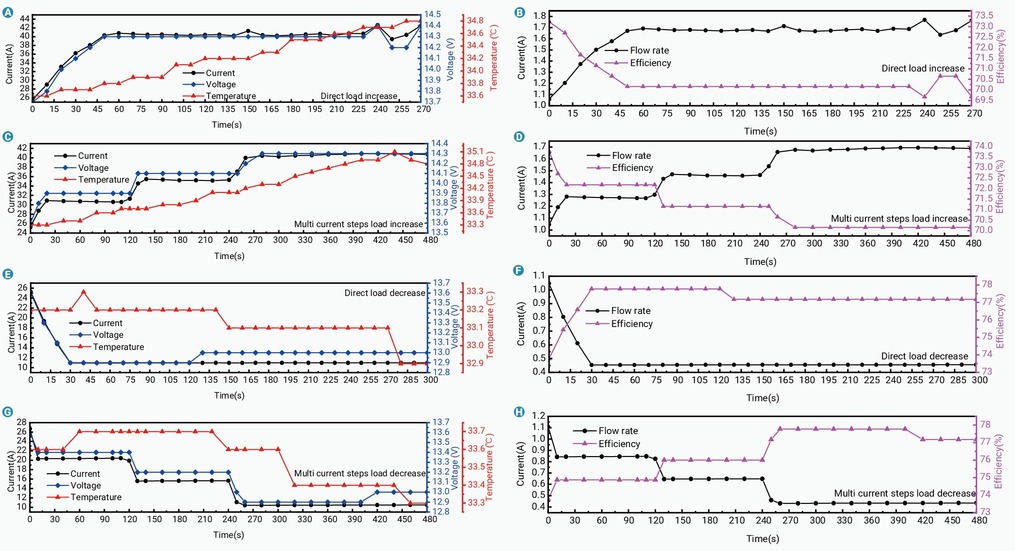
Figure 4.
Load regulation Characteristics (A) Current, voltage, and temperature in DLI process (B) Hydrogen flow rate, and efficiency in DLI process (C) Current, voltage, and temperature in MLI process (D) Hydrogen flow rate, and efficiency in MLI process (E) Current, voltage, and temperature in DLD process (F) Hydrogen flow rate, and efficiency in DLD process (G) Current, voltage, and temperature in MLD process (H) Hydrogen flow rate, and efficiency in MLD process
-
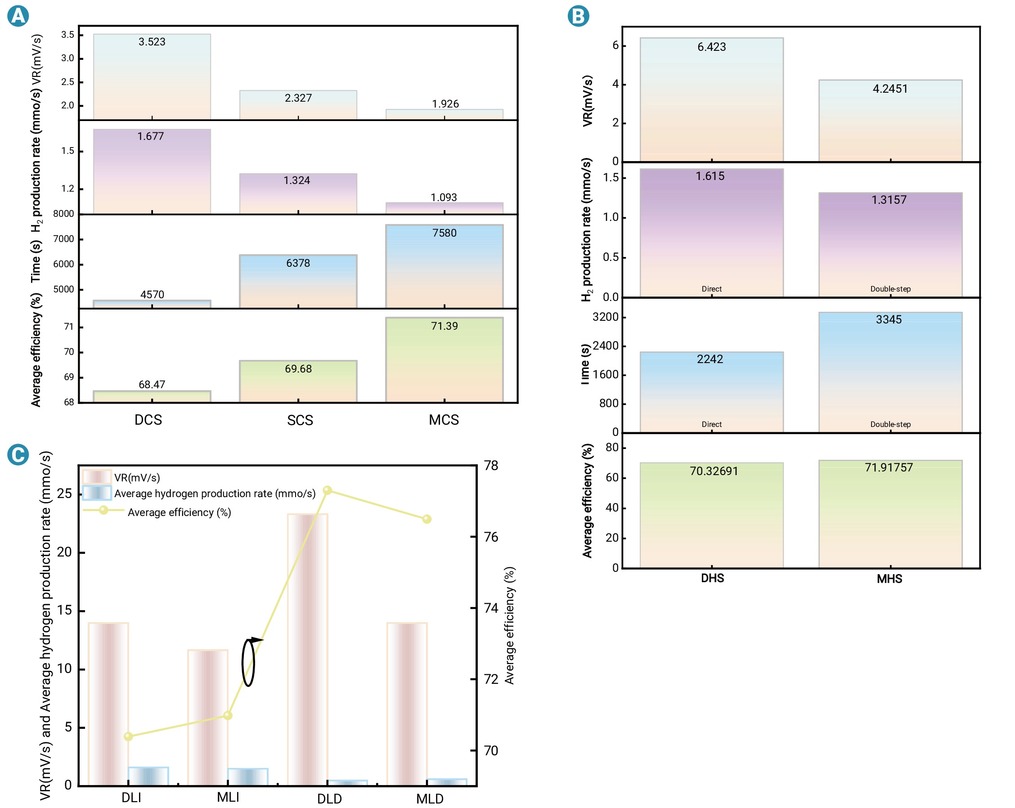
Figure 5.
Integrated start-up and load regulation characteristics (A) cold start-up (B) hot start-up (C) load increase and decrease
-
Figure 6.
Comprehensive evaluation based on TOPSIS and entropy weight method
