
Beyond the checkpoint: Governing cross-boundary electric mobility in the Greater Bay Area
-

-
REFERENCES
[1] The State Council of China. (2019). Outline Development Plan for the Guangdong-Hong Kong-Macao Greater Bay Area. https://www.bayarea.gov.hk/tc/outline/plan.html [2] HKSAR Government. (2026). LCQ10: Implementation of Southbound Travel for Guangdong Vehicles. https://www.info.gov.hk/gia/general/202604/29/P2026042900237.htm [3] Ma J., Kong H., Wang J., et al. (2024). Carbon-neutral pathway to mitigating transport-power grid cross-sector effects. The Innovation 5:100611. DOI:10.1016/j.xinn.2021.100127 [4] Chen X., Zhang H., Xu Z., et al. (2018). Impacts of fleet types and charging modes for electric vehicles on emissions under different penetrations of wind power. Nat. Energy 3:413−421. DOI:10.1038/s41560-018-0133-0 [5] Powell S., Cezar G.V., Min L., et al. (2022). Charging infrastructure access and operation to reduce the grid impacts of deep electric vehicle adoption. Nat. Energy 7:932−945. DOI:10.1038/s41560-022-01105-7 -
ABOUT THIS ARTICLE
Cite this article:
Shang Y., Liu D., Li S., et al. (2026). Beyond the checkpoint: Governing cross-boundary electric mobility in the Greater Bay Area. The Innovation Energy 3:100184. https://doi.org/10.59717/j.xinn-energy.2026.100184
Welcome!
To request copyright permission to republish or share portions of our works, please visit Copyright Clearance Center's (CCC) Marketplace website at marketplace.copyright.com.
Export File
Citation
Shang Y., Liu D., Li S., et al. (2026). Beyond the checkpoint: Governing cross-boundary electric mobility in the Greater Bay Area. The Innovation Energy 3:100184. https://doi.org/10.59717/j.xinn-energy.2026.100184

Format
Content
 DownLoad:
-
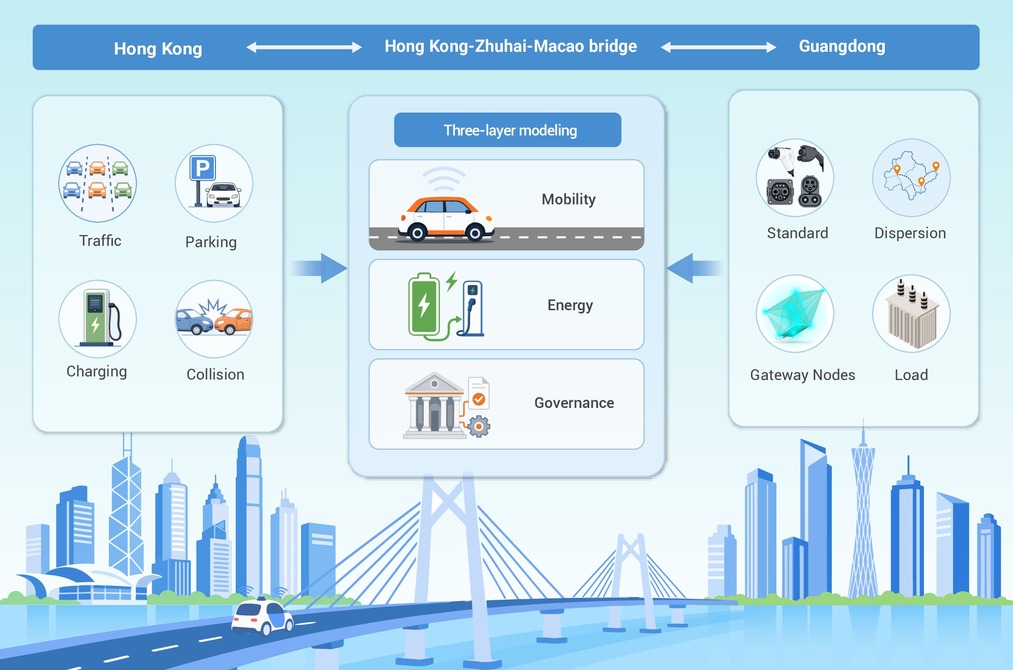
Figure 1.
Cross-boundary electric mobility coupled system framework
