
Coupling mechanisms and coordinated dispatch strategies for computing-power coordination
-

-
REFERENCES
[1] Mural R., Pherwani D., Gupta C., et al. (2026). AI, data centers, and the U.S. electric grid: A watershed moment. https://www.belfercenter.org/research-analysis/ai-data-centers-us-electric-grid [2] Liu W., Mao H., Cao Y., et al. (2021). Long-term energy consumption forecasting for data center industry in China. IEEE EI2. :4392-4397. DOI:10.1109/EI252483.2021.9713390 [3] Wang Y., Wang R., Tanaka K., et al. (2023). Accelerating the energy transition towards photovoltaic and wind in China. Nature 619:761−767. DOI:10.1038/s41586-023-06180-8 [4] Arabzadeh V. and Frank R. (2024). Creating a renewable energy-powered energy system: Extreme scenarios and novel solutions for large-scale renewable power integration. Appl. Energy 374:124088. DOI:10.1016/j.apenergy.2024.124088 [5] Essaddi N., Saidani K. and Besbes M. (2025). Overcoming the integration bottleneck: A global review of renewable energy and grid adaptation strategies. Int. J. Sustain. Energy 44:2569922. DOI:10.1080/14786451.2025.2569922 [6] Guo J., Hou W., Wang X., et al. (2026). Toward a new spatial paradigm of electricity-computing synergy under renewable energy endowments and geographical environmental constraints. Appl. Energy 409:127495. DOI:10.1016/j.apenergy.2026.127495 [7] Li M., Han C., Meng L., et al. (2025). Spatiotemporal dynamics and factors of renewable energy mismatch in China. Renew. Sustain. Energy Rev. 212:115424. DOI:10.1016/j.rser.2025.115424 -
ABOUT THIS ARTICLE
Cite this article:
Xiao J., Sun F., Wang S., et al. (2026). Coupling mechanisms and coordinated dispatch strategies for computing-power coordination. The Innovation Energy 3:100203. https://doi.org/10.59717/j.xinn-energy.2026.100203
Welcome!
To request copyright permission to republish or share portions of our works, please visit Copyright Clearance Center's (CCC) Marketplace website at marketplace.copyright.com.
Export File
Citation
Xiao J., Sun F., Wang S., et al. (2026). Coupling mechanisms and coordinated dispatch strategies for computing-power coordination. The Innovation Energy 3:100203. https://doi.org/10.59717/j.xinn-energy.2026.100203

Format
Content
 DownLoad:
-
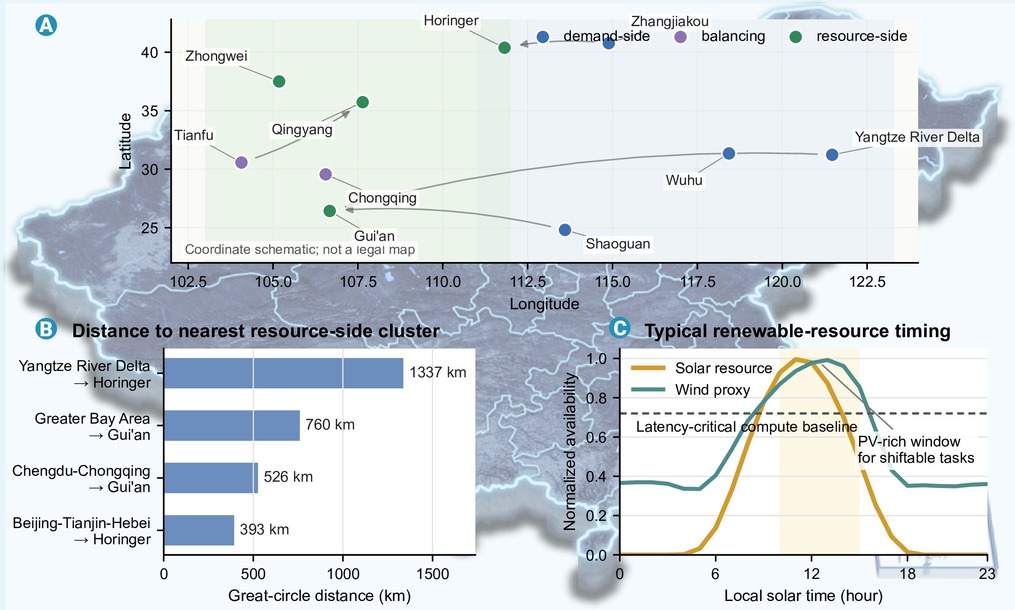
Figure 1.
Spatial and temporal mismatch in computing-power coordination in China
