
Accelerated multiphase water transformation in global mountain regions since 1990
-
GRAPHICAL ABSTRACT
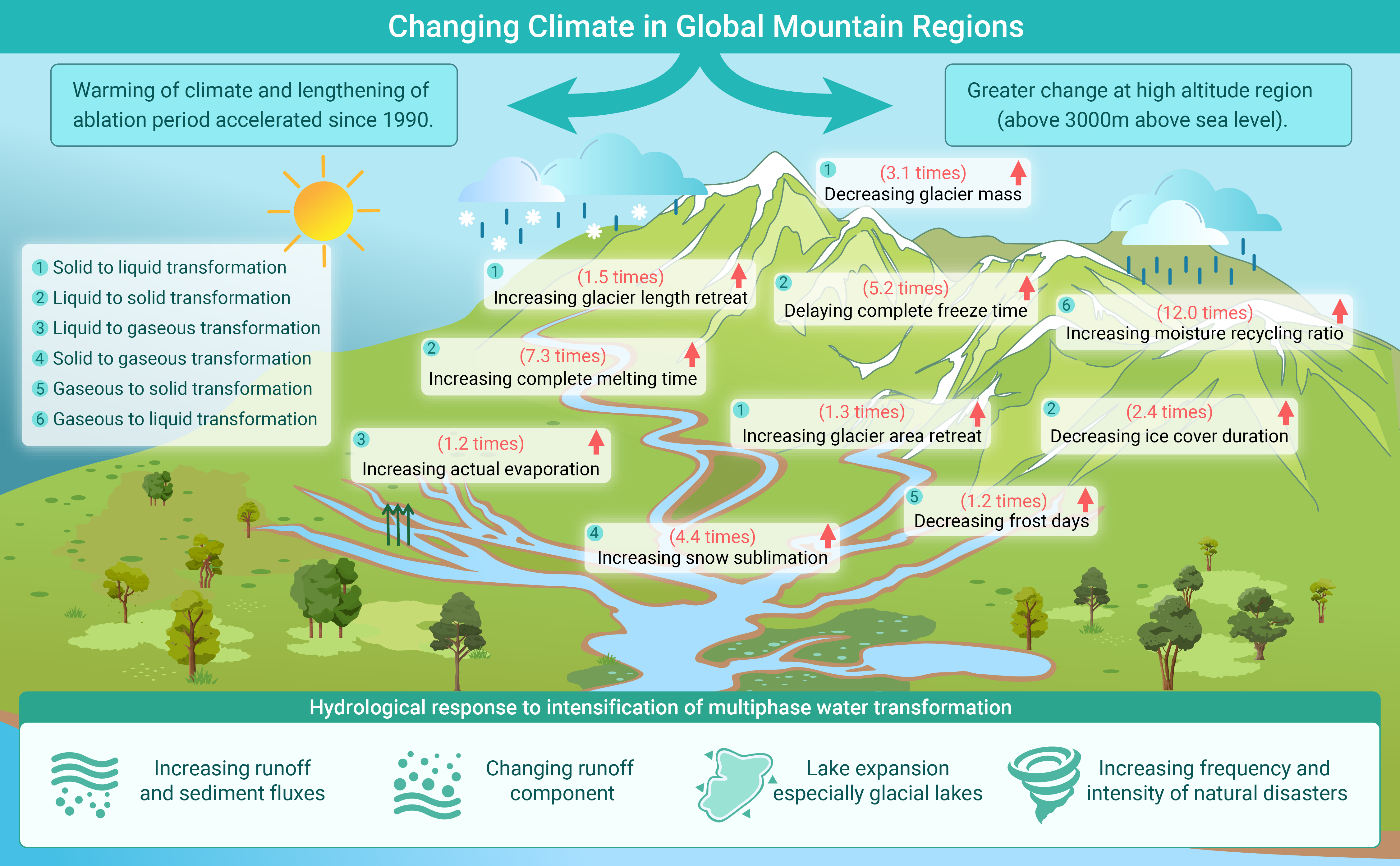
 DownLoad:
Full size image
DownLoad:
Full size image
-
PUBLIC SUMMARY
-
Accelerated warming and lengthening ablation period since 1990s strengthened multiphase water transformation (MWT).
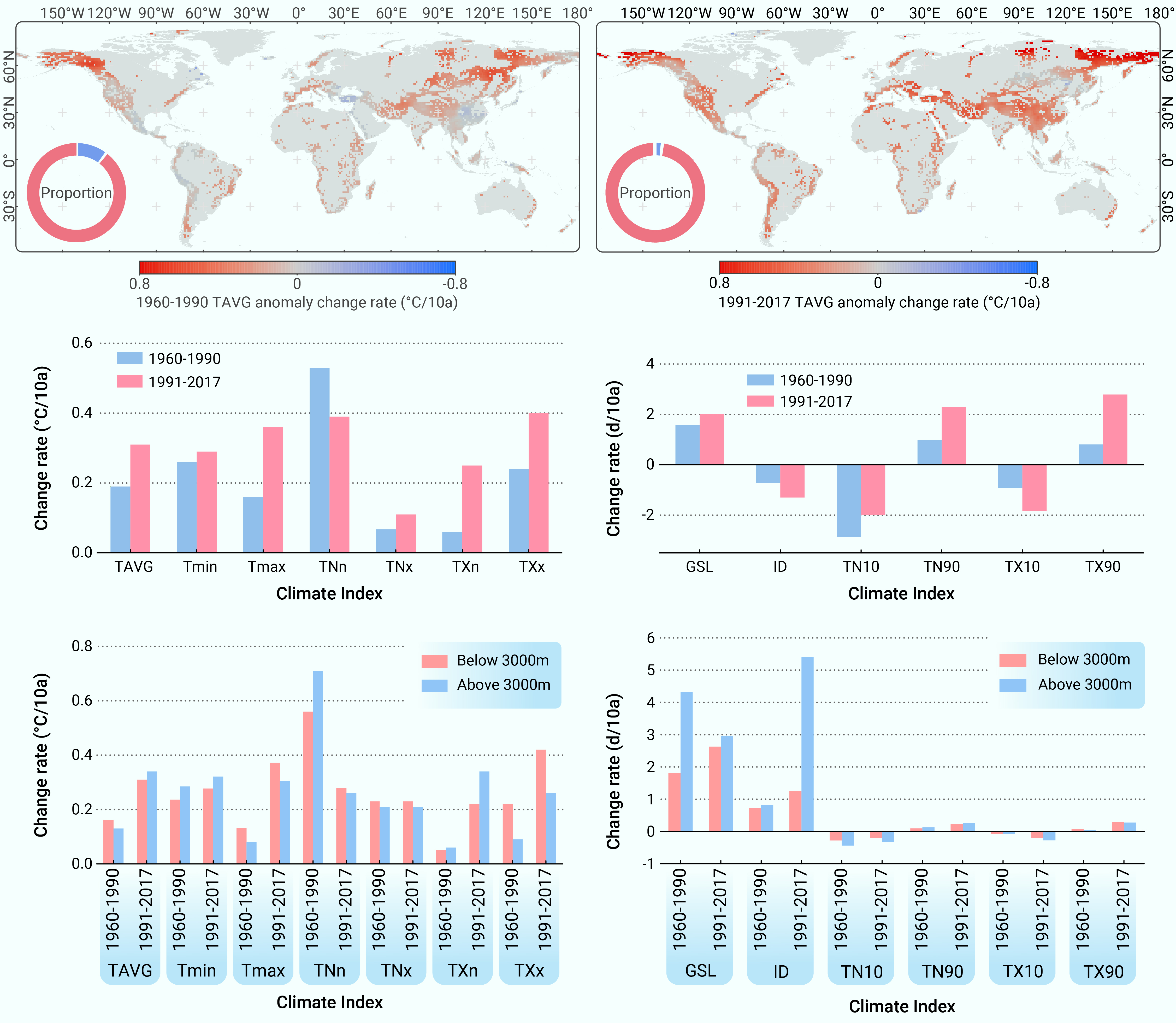
Warming and ablation period indices were higher in 1991–2017 than in 1960–1990.
Warming trends were greater in high-altitude regions than low-altitude regions.
-
-
ABSTRACT
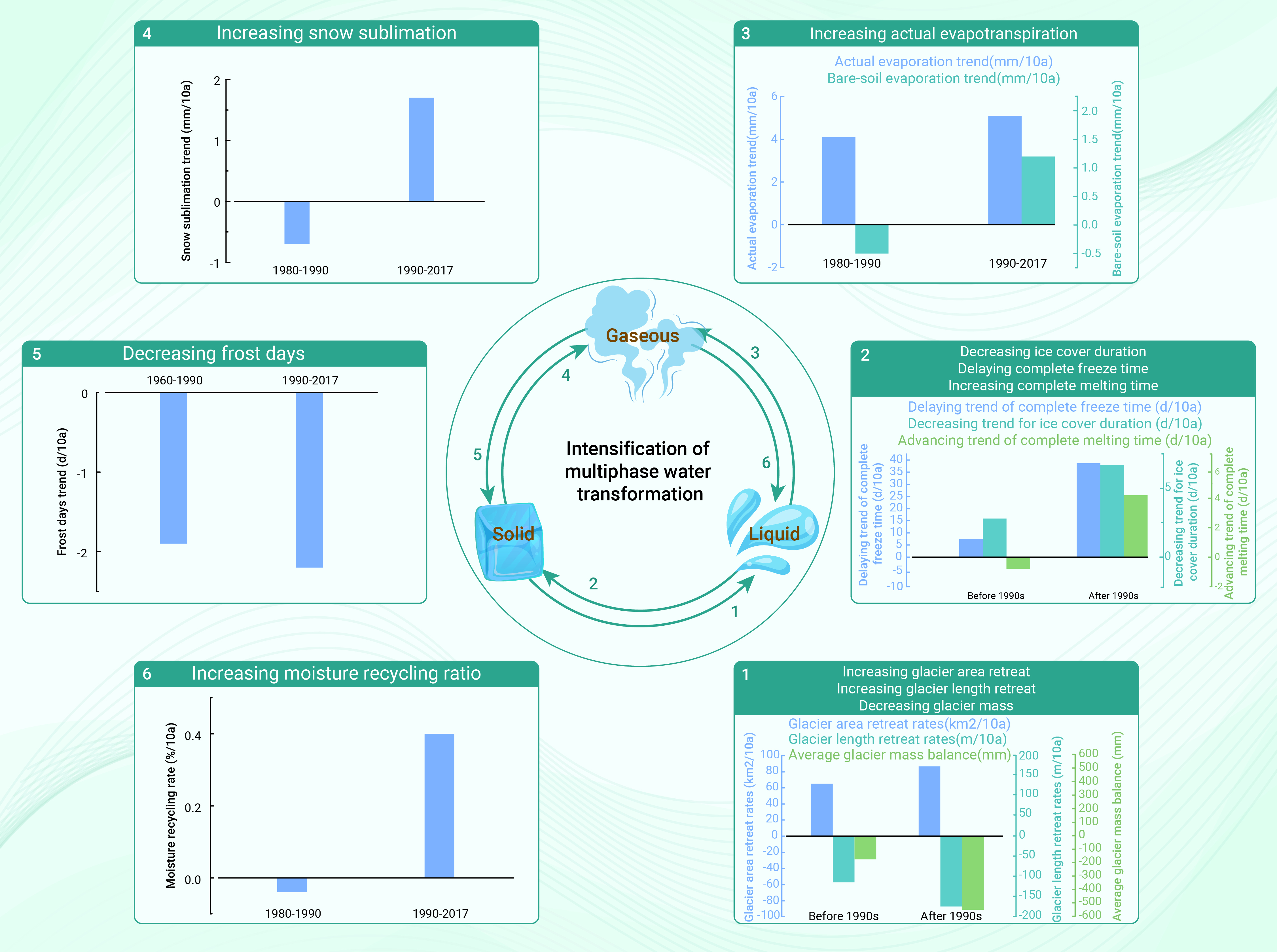
Mountains are sensitive to climate change, and while amplified warming at high elevations is widely observed and fairly well understood, changes in the water cycles of mountain regions remain poorly quantified. Due to low temperatures at higher elevations, these changes involve multiphase water transformation (MWT). Through analyzing extensive data from global mountain regions, we determined that under the accelerating warming and lengthening ablation period since the 1990s, the strengthening solid–liquid transformation can be confirmed for 45 glacier basins or single glaciers. This is marked by an increase of 21.5 km2/10a in glacier area retreat rate, 387.65 mm for average negative glacier mass balance, and 60 m/10a for average glacier length retreat rate (of 414 glaciers) from the study period before the 1990s until the period after the 1990s. The accelerating liquid–solid transformation was indicated by an increase of 31.2 d/10a for the delaying trend of complete freeze time, an increase of 4.3 d/10a for the advancing trend of complete melting time, and an increase of 3.9 d/10a for the decreasing trend of ice cover duration for 22 lakes from the period before the 1990s until the period after the 1990s. The accelerating liquid–gas transformation can be confirmed by an increase of 1 and 0.69 mm/d/10a in the variation trend of actual evaporation and bare-soil evaporation from 1980–1990 to 1990–2017, respectively. Snow sublimation decreased by 0.69 mm/d/10a during 1980–1990, followed by a statistically significant increase of 1.66 mm/d/10a during 1990–2017, further confirming the accelerating solid–gas transformation. The accelerating gas–solid transformation can be reflected by an increase of 0.3 d/10a for the decreasing trend of frost days from 1960–1990 to 1990–2017. The moisture recycling ratio decreased by –0.042 %/10a during 1980–1990 and then increased by 0.443 %/10a during 1990–2017, with the corresponding average values of 12.3% and 13.6%, respectively, which indicates an accelerating gas–liquid transformation. Approximately 59 rivers displayed an increase of 108.60 m3/s/10a for the runoff variation trend from the period before the 1990s until the period after the 1990s. In addition, the trends for lake number and lake area in the Tibetan Plateau increased 3.86 and 5.75 times, respectively, from 1976–1995 to 1995–2019. This acceleration can significantly change the spatiotemporal pattern of water resources and increase the frequency and intensity of disaster events, such as glacial lake outbursts, flooding, and waterlogging. Consequently, most mountain regions will require strong adaptation efforts to sustain water, food, and ecological security. -

-
REFERENCES
[1] Allen, M. R., and Ingram. W. (2002). Constraints on future changes in climate and the hydrologic cycle. Nature 419, 224−232. [2] Helm, K. P., Bindoff, N. L., and Church, J. A. (2010). Changes in the global hydrological-cycle inferred from ocean salinity. Geophys Res Lett. 37, 1−5. [3] Wentz, F. J., Ricciardulli, L., Hilburn, K., and Mears, C. (2007). How much more rain will global warming bring. Science 317, 233−235. [4] Durack, P. J., Wijffels S. E., and Matear, R. J. (2012). Ocean salinities reveal strong global water cycle intensification during 1950 to 2000. Science 336, 455−458. [5] Skliris, N., Zika, J. D., and Nurser, G. (2016). Global water cycle amplifying at less than the Clausius-Clapeyron rate. Sci Rep. 6, 38752. [6] Liu, J., and Curry, J. A. (2010). Accelerated warming of the Southern Ocean and its impacts on the hydrological cycle and sea ice. P Nat Aca Sci. 107, 14987−14992. [7] Miralles, D. G., van den Berg, M. J., Gash, J. H., et al. (2014). El Niño–La Niña cycle and recent trends in continental evaporation. Nat Clim Change. 4, 122−126. [8] Tajdarul, H., Syed, J. S., Famigliettia, D. P. et al. (2010). Satellite-based global-ocean mass balance estimates of interannual variability and emerging trends in continental freshwater discharge. P Nat Aca Sci. 107, 1−6. [9] Jung, M., Reichstein, M., Ciais, P., et al. (2010). Recent decline in the global land evapotranspiration trend due to limited moisture supply. Nature 467, 951−954. [10] Peterson, T. C., Golubev, V. S., and Groisman, P. V. (1995). Evaporation losing its strength. Nature 377, 687−688. [11] Chattopadhyay, N., and Hulme, M. (1997). Evaporation and potential evapotranspiration in India under conditions of recent and future climate change. Agr Forest Meteorol. 87, 55−73. [12] Thomas, A. (2000). Spatial and temporal characteristics of potential ET trends over China. Inter J Climatol. 20, 381−396. [13] Ohmura, A., and Wild, M. (2002). Is the hydrological cycle accelerating. Science 298, 1345−1346. [14] Huntington, T. G. (2006). Evidence for intensification of the global water cycle: review and synthesis. J Hydrol. 319, 83−95. [15] Brun, F., Berthier, E., Wagnon, P., et al. (2017). A spatially resolved estimate of High Mountain Asia glacier mass balances from 2000 to 2016. Nat Geosci. 10, 668−673. [16] Nogués-Bravo, D., Araújo, M.B., Errea, M.P., and Martínez-Rica J.P. (2007). Exposure of global mountain systems to climate warming during the 21st Century. Global Environmental Change. 17, 420−428. [17] Li, Z. X., Feng, Q., Li, Z. J., et al. (2019). Climate background, fact and hydrological effect of multiphase water transformation in cold regions of the western China: A review. Earth-Sci Rev. 190, 33−57. [18] Li, Z. X., Yuan, R. F., Feng, Q., et al. (2019). Climate background, relative rate, and runoff effect of multiphase water transformation in qilian mountains, the third pole region. Sci Total Environ. 663, 315−328. [19] Li, Z. X., He, Y. Q., Yang, X. M., et al. (2010). Changes of the Hailuogou glacier, Mt. Gongga, China, against the background of climate change during the Holocene. Quater Int. 218, 166−175. [20] Yao, T. D., Thompson, L., Yang, W., et al. (2012). Different glacier status with atmospheric circulations in Tibetan Plateau and surroundings. Nat Clim Change. 2, 663−667. [21] Wang, P. Y., Li Z. Q., Li, H. L., et al. (2014). Comparison of glaciological and geodetic mass balance at Urumqi Glacier No. 1, Tian Shan, Central Asia. Global Planet Change 114 , 14-22. [22] Leclercq, P.W., and Oerlemans, J. (2011). Global and hemispheric temperature reconstruction from glacier length fluctuations. Clim Dynam. 38, 1065−1079. [23] Leclercq, P. W., Oerlemans, J., Basagic, H. J., et al. (2014). A data set of worldwide glacier length fluctuations. Cryosphere D. 8, 659−672. [24] Mota, F. S. D. (1983). Meteorologia agrícola. 7. ed. São Paulo: Nobel, 376 p. [25] Martens, B., Miralles, D.G., Lievens, H. (2016). GLEAM v3: satellite-based land evaporation and root-zone soil moisture. Geosci Model Dev. 10, 1903−1925. [26] Miralles, D. G., Holmes, T. R. H., and De, J. R. A. M., et al. (2010). Global land-surface evaporation estimated from satellite-based observations. Hydrol Earth Syst Sc. 7, 453−469. [27] Broxton, P. D., Harpold, A. A., Biederman, J. A., et al. (2014). Quantifying the effects of vegetation structure on snow accumulation and ablation in mixed-conifer forests. Ecohydrology 8, 1073−1094. [28] Li, D. F., Lu, X. X., Overeem, I., et al. (2021). Exceptional increases in fluvial sediment fluxes in a warmer and wetter High Mountain Asia. Science 374, 599−603. [29] Shugar, D. H., Burr, A., Haritashya, U. K., et al. (2020). Rapid worldwide growth of glacial lakes since 1990. Nat Clim Change. 10, 939−945. [30] Zhang, G. Q., Luo, W., Chen, W. F., and Zheng, G. X. (2019). A robust but variable lake expansion on the Tibetan Plateau. Sci Bull. 64, 1306−1309. [31] Blöchl, G., Hall, J., Parajka, J., et al. (2017). Changing climate shifts timing of European floods. Science 357, 588−590. [32] Papathoma-Köhle, M., Schlögl, M., and Fuchs, S. (2019). Vulnerability indicators for natural hazards: an innovative selection and weighting approach. Sci Rep. 9, 272−288. [33] Nie, Y., Pritchard, H. D., Liu, Q., et al. (2021). Glacial change and hydrological implications in the Himalaya and Karakoram. Nat Rev Earth Environ. 2, 91−106. [34] Winsemius, H. C., Aerts, J. C. J. H., van Beek, L. P. H., et al. (2016). Global drivers of future river flood risk. Nat Clim Change. 6, 381−385. [35] Ding, J. Z., Chen, L. Y., Ji, C. J., et al. (2017). Decadal soil carbon accumulation across Tibetan permafrost regions. Nat Geosci. 10, 420−425. [36] Avis, C. A., Weaver, A. J., and Meissner, K. J. (2011). Reduction in areal extent of high-latitude wetlands in response to permafrost thaw. Nat Geosci. 4, 444−448. [37] Sorg, A., Bolch, T., Stoffel, M., et al. (2012). Climate change impacts on glaciers and runoff in Tien Shan (Central Asia). Nat Clim Change. 2, 725−731. [38] Richardson, S. D., and Reynolds, J. M. (2000). An overview of glacial hazards in the Himalayas. Quatern Int. 65, 31−47. [39] Cook, K. L., Andermann, C., Gimbert, F., et al. (2018). Glacial lake outburst floods as drivers of fluvial erosion in the Himalaya. Science 362, 53−57. [40] Osti, R., and Egashira, S. j. (2009). Hydrodynamic characteristics of the Tam Pokhari Glacial Lake outburst flood in the Mt. Everest region, Nepal. Hydrol Process 23, 2943−2955. [41] Coe, J. A., Bessette-Kirton, E. K., and Geertsema, M. (2018). Increasing rock-avalanche size and mobility in Glacier Bay National Park and Preserve, Alaska detected from 1984 to 2016 Landsat imagery. Landslides 15, 393−407. [42] Kos, A., Amann, F., Strozzi, T., et al. (2016). Contemporary glacier retreat triggers a rapid landslide response, Great Aletsch Glacier, Switzerland. Geophys Res Lett. 43, 12466−12474. [43] Liu, J., Wu, Y. M., and Gao, X. (2021). Increase in occurrence of large glacier-related landslides in the high mountains of Asia. Sci Rep. 11, 1−12. [44] Hungr, O., Evans, S. G., and Hazzard, J. (1999). Magnitude and frequency of rock falls and rock slides along the main transportation corridors of southwestern British Columbia. Can Geotech J. 36, 224−238. [45] Milly, P. C. D., Wetherald, R. T., Dunne, K. A., and Delworth, T. L. (2002). Increasing risk of great floods in a changing climate. Nature 415, 514−517. [46] Gariano, S. L., and Guzzetti, F. (2016). Landslides in a changing climate. Earth-Sci Rev. 162, 227−252. [47] Statham, G., Haegeli, P., Greene, E., et al. (2018). A conceptual model of avalanche hazard. Nat Hazards. 90, 663−691. [48] Mann, H. B. (1945). Nonparametric tests against trend. Econometrica: J econom soc. 13, 245−259. [49] Sen, Kumar, P. (1968). Estimates of the regression coefficient based on kendall's tau. Pub Americ Statis Associa. 63, 1379−1389. [50] Zhang, X.B., Hegerl, G., Zwiers, F. W., and Kenyon, J. (2005). Avoiding inhomogeneity in percentile-based indices of temperature extremes. J Clim. 18, 1641−1651. [51] Pettitt, A. N. (1979). A non‐parametric approach to the change‐point problem. J Roy Statis Soc. 28, 126−135. [52] Buishand, T. A. (1982). Some methods for testing the homogeneity of rainfall records, J Hydrol. 58 , 11–27. [53] Vezzoli, R., Pecora, S., Zenoni, E., and Tonelli, F. (2012). Data analysis to detect inhomogeneity, change points, trends in observations: an application to po river discharge extremes. Social Science Electronic Publishing, 138 . doi:10.2139/ssrn.219534. [54] Sellers, W. D. (1976). A Two–Dimensional Global Climatic Model. Monthly Weather Review, 104, 233−248. [55] Brubaker, K.L., Entehabi, D., and Eagleson, P.S. (1993). Estimation of continental precipitation recycling. J Climate. 6, 1077−1089. [56] Eltahir, E. A. B., and Bras, R. L. (1994). Precipitation recycling in the Amazon Basin. Q Journal Roy Meteor Soc. 120, 861−880. [57] Eltahir, E. A. B., and Bras, R. L. (1996). Precipitation recycling. Rev Geophys. 34, 367−378. [58] Van der Ent, R. J., Savenije, H. H. G., Schaefli, B., and Steele-Dunne, S. C. (2010). Origin and fate of atmospheric moisture over continents. Water Resour Res. 46, 1−12. -
ABOUT THIS ARTICLE
Cite this article:
Li Z., Feng Q., Wang X., et al., (2023). Accelerated multiphase water transformation in global mountain regions since 1990. The Innovation Geoscience 1(3), 100033. https://doi.org/10.59717/j.xinn-geo.2023.100033
Welcome!
To request copyright permission to republish or share portions of our works, please visit Copyright Clearance Center's (CCC) Marketplace website at marketplace.copyright.com.
Article Metrics
Relative Articles
Cited by
Export File
Citation
Li Z., Feng Q., Wang X., et al., (2023). Accelerated multiphase water transformation in global mountain regions since 1990. The Innovation Geoscience 1(3), 100033. https://doi.org/10.59717/j.xinn-geo.2023.100033

Format
Content
-
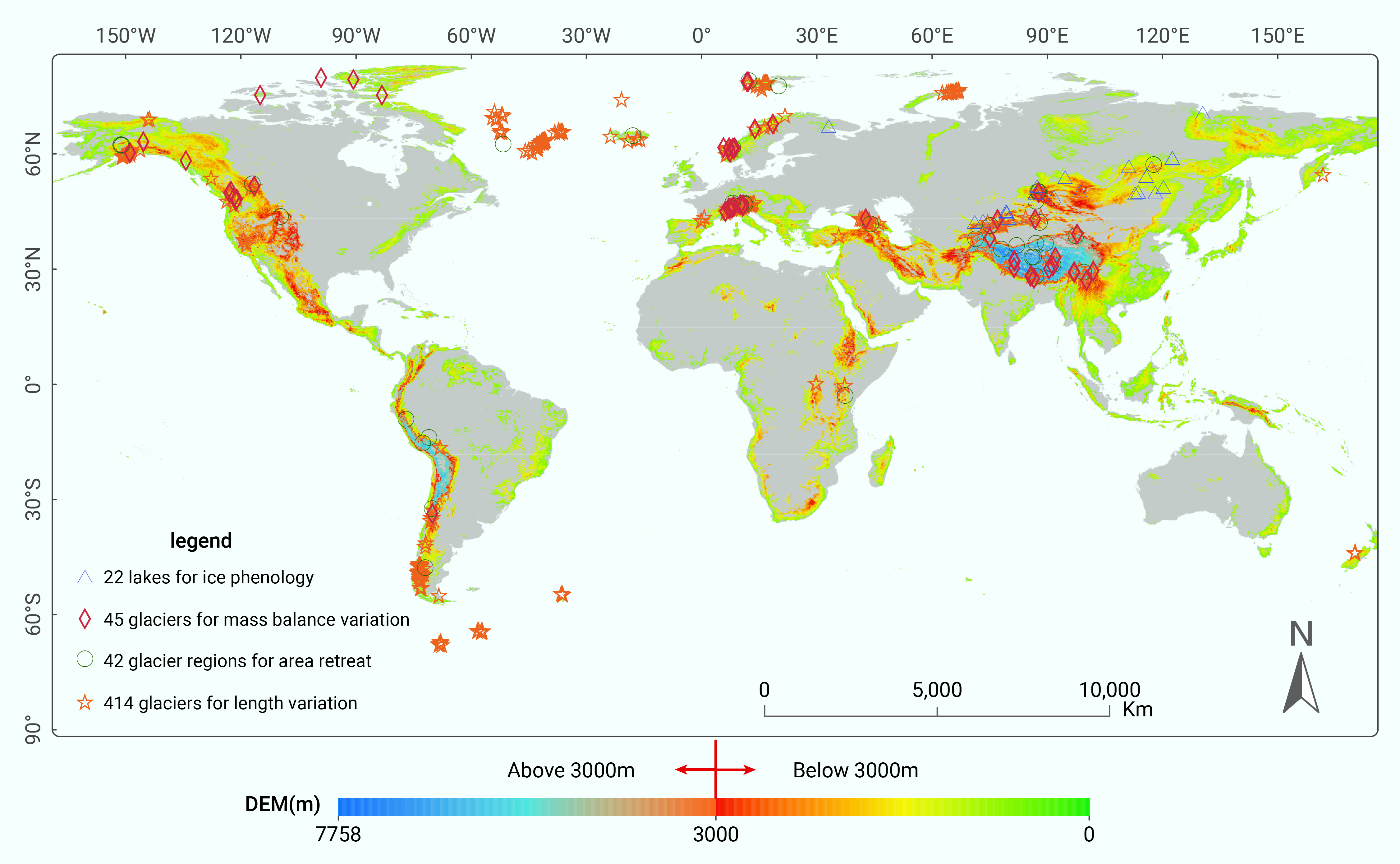
Figure 1.
Global mountainous region:
-
Figure 2.
The times for variation rate of MWT after 1990 of that before 1990 in the global mountainous region:
-
Figure 3.
The anomaly change rate of annual average temperature (TAVG) during 1960–1990 (oC/10a)
