
Changes in groundwater storage represent a significant source of atmospheric CO2 in China
-
GRAPHICAL ABSTRACT
 DownLoad:
Full size image
DownLoad:
Full size image
-
PUBLIC SUMMARY
-
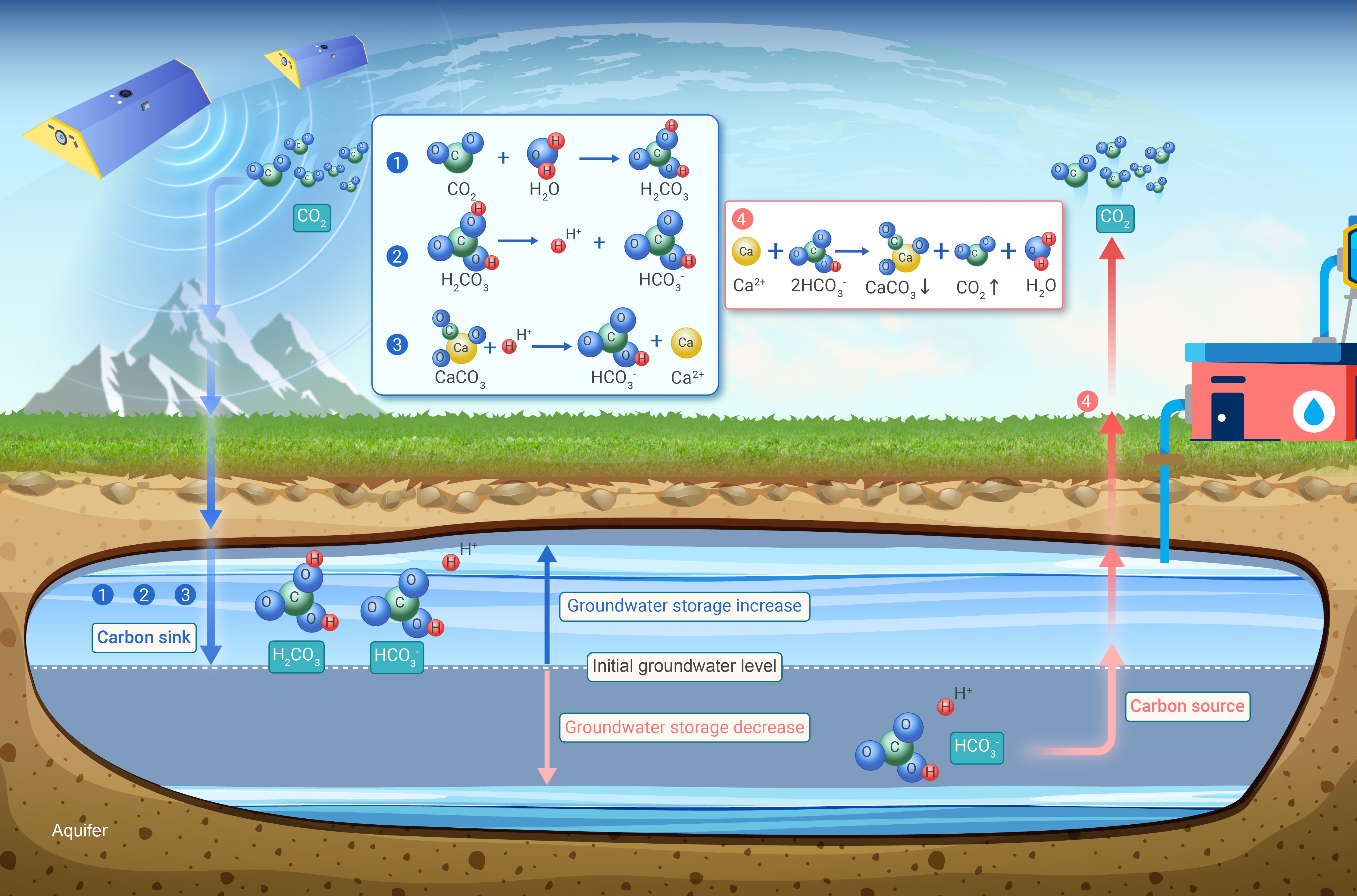
The CO2 emission due to groundwater storage change in China is estimated to be 2.1±2.3 Mt/yr in 2003–2015.
Groundwater storage change exceeds 15% emission sources listed in China Carbon Emission Accounts and Datasets.
China’s groundwater overdraft control will lead to a total reduction of 5.3 Mt CO2 by 2025.
-
-
ABSTRACT
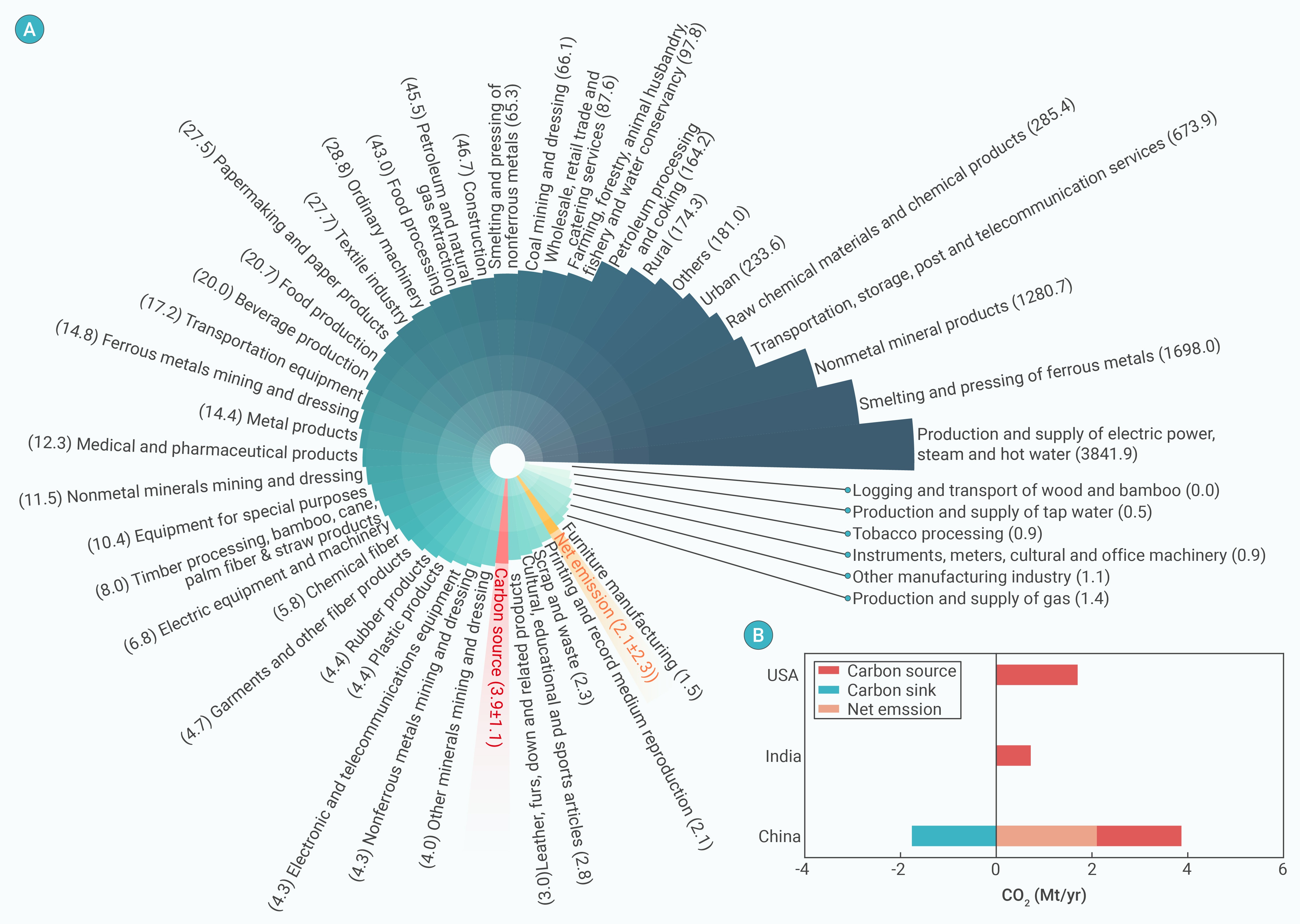
Recent studies show that groundwater depletion is an unreported source of atmospheric CO2 through bicarbonate reactions in the groundwater released from aquifer. However, the depletion can be mitigated or offset by recharge, and thus the contrasting roles of depletion and recharge on carbon cycle remain unclear at a national scale. Here, we extend previous studies to use the satellite–derived groundwater storage change (GWSC) and substantial in situ measurements of the bicarbonate ion concentration (BIC), for the first time evaluation of GWSC–induced CO2 emission/sequestration in China. Results show that the GWSC represents as a significant source of atmospheric CO2 in China, with a net CO2 emission rate of 2.1±2.3 Mt/yr, which is larger than 15% of the emission sources listed in China Carbon Emission Accounts and Datasets. Besides, emission and sequestration induced by groundwater storage (GWS) decrease and increase is also significant, with a rate of 3.9±1.1 Mt/yr and 1.8±1.2 Mt/yr, respectively. Notably, we also find that China’s stricter groundwater measures can contribute a total reduction of 5.3 Mt CO2 emission in the major overdraft areas by 2025. Despite of notable uncertainties, this study highlights the unneglectable contributions of GWSC to atmospheric CO2 emission and sequestration at a national to global scale.-
Keywords:
- carbon /
- carbon source and sink /
- GRACE /
- groundwater storage change /
- groundwater chemistry
-

-
REFERENCES
[1] Famiglietti, J.S. (2014). The global groundwater crisis. Nat. Clim. Change 4: 945−948. DOI: 10.1038/nclimate2425. [2] Battin, T.J., Lauerwald, R., Bernhardt, E.S., et al. (2023). River ecosystem metabolism and carbon biogeochemistry in a changing world. Nature 613: 449−459. DOI: 10.1038/s41586-022-05500-8. [3] Wang, C., Brennwald, M.S., Xie, Y., et al. (2023). Quantifying carbon cycling across the Groundwater-Stream-Atmosphere Continuum using High-Resolution time series of multiple dissolved gases. Environ. Sci. Technol. 57: 13487−13495. DOI: 10.1021/acs.est.3c03378. [4] Falkowski, P., Scholes, R.J., Boyle, E., et al. (2000). The global carbon cycle: A test of our knowledge of Earth as a system. Science 290: 291−296. DOI: 10.1126/science.290.5490.291. [5] Monger, H.C., Kraimer, R.A., Khresat, S.e., et al. (2015). Sequestration of inorganic carbon in soil and groundwater. Geology 43: 375−378. DOI: 10.1130/g36449.1. [6] Wallmann, K. and Aloisi, G. (2012). The Global Carbon Cycle: Geological Processes. In Fundamentals of Geobiology, A. H. Knoll, D. E. Canfield, and K. O. Konhauser, eds. (Wiley), In pp. 20-35. DOI: 10.1002/9781118280874.ch3. [7] de Klein, J.J.M. and van der Werf, A.K. (2014). Balancing carbon sequestration and GHG emissions in a constructed wetland. Ecol. Eng. 66: 36−42. DOI: 10.1016/j.ecoleng.2013.04.060. [8] Keller, P.S., Marcé, R., Obrador, B., et al. (2021). Global carbon budget of reservoirs is overturned by the quantification of drawdown areas. Nat. Geosci. 14: 402−408. DOI: 10.1038/s41561-021-00734-z. [9] Gruber, N., Bakker, D.C.E., DeVries, T., et al. (2023). Trends and variability in the ocean carbon sink. Nat. Rev. Earth Environ. 4: 119−134. DOI: 10.1038/s43017-022-00381-x. [10] Le, T.P.Q., Marchand, C., Ho, C., et al. (2018). CO2 partial pressure and CO2 emission along the lower Red River (Vietnam). Biogeosciences 15: 4799−4814. DOI: 10.5194/bg-15-4799-2018. [11] Duan, H., Xiao, Q., and Qi, T. (2023). Measuring lake carbon dioxide from space: Opportunities and challenges. The Innovation Geoscience 1: 100025. DOI: 10.59717/j.xinn-geo.2023.100025. [12] Lawter, A.R., Qafoku, N.P., Asmussen, R.M., et al. (2017). Risk of geologic sequestration of CO2 to groundwater aquifers: Current knowledge and remaining questions. Energy Procedia 114: 3052−3059. DOI: 10.1016/j.egypro.2017.03.1433. [13] Macpherson, G.L. (2009). CO2 distribution in groundwater and the impact of groundwater extraction on the global C cycle. Chem. Geol. 264: 328−336. DOI: 10.1016/j.chemgeo.2009.03.018. [14] Liu, Z., Dreybrodt, W., and Wang, H. (2008). A possible important CO2 sink by the global water cycle. Chinese Science Bulletin 53(3): 402−407. DOI: 10.1007/s11434-008-0096-9. [15] Hartmann, J., Jansen, N., Dürr, H.H., et al. (2009). Global CO2-consumption by chemical weathering: What is the contribution of highly active weathering regions. Glob. Planet. Change 69: 185−194. DOI: 10.1016/j.gloplacha.2009.07.007. [16] Rothausen, S.G.S.A. and Conway, D. (2011). Greenhouse-gas emissions from energy use in the water sector. Nat. Clim. Change 1: 210−219. DOI: 10.1038/nclimate1147. [17] Wang, J., Rothausen, S.G.S.A., Conway, D., et al. (2012). China’s water–energy nexus: Greenhouse-gas emissions from groundwater use for agriculture. Environ. Res. Lett. 7: 014035. DOI: 10.1088/1748-9326/7/1/014035. [18] Qin, J., Duan, W., Zou, S., et al. (2024). Global energy use and carbon emissions from irrigated agriculture. Nat. Commun. 15: 3084. DOI: 10.1038/s41467-024-47383-5. [19] Liu, Z. and Dreybrodt, W. (2015). Significance of the carbon sink produced by H2O–carbonate–CO2–aquatic phototroph interaction on land. Sci. Bull. 60: 182−191. DOI: 10.1007/s11434-014-0682-y. [20] Gong, H., Pan, Y., Zheng, L., et al. (2018). Long-term groundwater storage changes and land subsidence development in the North China Plain (1971–2015). Hydrogeol. J. 26: 1417−1427. DOI: 10.1007/s10040-018-1768-4. [21] Leng, P., Li, F., Du, K., et al. (2020). Flow velocity and nutrients affect CO2 emissions from agricultural drainage channels in the North China Plain. Environ. Sci. Eur. 32: 146. DOI: 10.1186/s12302-020-00426-2. [22] Zhang, Z., Shi, D., Ren, F., et al. (1997). Evolution of Quaternary groundwater system in North China Plain. Sci. China Earth Sci. 40: 276−283. DOI: 10.1007/BF02877536. [23] Wood, W.W. and Hyndman, D.W. (2017). Groundwater depletion: A significant unreported source of atmospheric carbon dioxide. Earth's Future 5: 1133−1135. DOI: 10.1002/2017EF000586. [24] Mishra, V., Asoka, A., Vatta, K., et al. (2018). Groundwater depletion and associated CO2 emissions in India. Earth's Future 6: 1672−1681. DOI: 10.1029/2018EF000939. [25] Kessler, T.J. and Harvey, C.F. (2001). The global flux of carbon dioxide into groundwater. Geophys. Res. Lett. 28: 279−282. DOI: 10.1029/2000GL011505. [26] Dong, S., Liu, B., Lei, J., et al. (2022). Carbon balance model of groundwater system –A field application. J. Hydrol. 610: 127845. DOI: 10.1016/j.jhydrol.2022.127845. [27] Jasechko, S., Seybold, H., Perrone, D., et al. (2024). Rapid groundwater decline and some cases of recovery in aquifers globally. Nature 625: 715−721. DOI: 10.1038/s41586-023-06879-8. [28] Zhang, C., Duan, Q., J.-F. Yeh, P., et al. (2021). Sub-regional groundwater storage recovery in North China Plain after the South-to-North water diversion project. J. Hydrol. 597: 126156. DOI: 10.1016/j.jhydrol.2021.126156. [29] Pan, Y., Zhang, C., Gong, H., et al. (2017). Detection of human-induced evapotranspiration using GRACE satellite observations in the Haihe River basin of China. Geophys. Res. Lett. 44: 190−199. DOI: 10.1002/2016GL071287. [30] Yang, J., Pan, Y., Zhang, C., et al. (2024). Comparison of groundwater storage changes over losing and gaining aquifers of China using GRACE satellites, modeling and in-situ observations. Sci. Total Environ. 938: 173514. DOI: 10.1016/j.scitotenv.2024.173514. [31] Rodell, M., Famiglietti, J.S., Wiese, D.N., et al. (2018). Emerging trends in global freshwater availability. Nature 557: 651−659. DOI: 10.1038/s41586-018-0123-1. [32] Rodell, M. and Reager, J.T. (2023). Water cycle science enabled by the GRACE and GRACE-FO satellite missions. Nature Water 1: 47−59. DOI: 10.1038/s44221-022-00005-0. [33] Li, Q., Pan, Y., Zhang, C., et al. (2023). Quantifying multi-Source uncertainties in GRACE-Based estimates of groundwater storage changes in mainland China. Remote Sens. 15: 2744. DOI: 10.3390/rs15112744. [34] Wan Isahak, W.N.R., Che Ramli, Z.A., Mohamed Hisham, M.W., et al. (2015). The formation of a series of carbonates from carbon dioxide: Capturing and utilisation. Renew. Sustain. Energy Rev. 47: 93−106. DOI: 10.1016/j.rser.2015.03.020. [35] Dreybrodt, W., Eisenlohr, L., Madry, B., et al. (1997). Precipitation kinetics of calcite in the system CaCO3 H2O CO2: The conversion to CO2 by the slow process H++HCO3- → CO2+H2O as a rate limiting step. Geoch. Cosm. Act. 61: 3897−3904. DOI: 10.1016/S0016-7037(97)00201-9. [36] Wu, Yanan and Pan, Yun (2021). Estimating glacial material balance in the Asian high sierra 1999–2019 using Degree-Day models and gravity satellites. Master's thesis, Capital Normal University. [37] Hugonnet, R., McNabb, R., Berthier, E., et al. (2021). Accelerated global glacier mass loss in the early twenty-first century. Nature 592: 726−731. DOI: 10.1038/s41586-021-03436-z. [38] Duan, Q., Ajami, N.K., Gao, X., et al. (2007). Multi-model ensemble hydrologic prediction using Bayesian model averaging. Adv. Water Resour. 30: 1371−1386. DOI: 10.1016/j.advwatres.2006.11.014. [39] Long, D., Pan, Y., Zhou, J., et al. (2017). Global analysis of spatiotemporal variability in merged total water storage changes using multiple GRACE products and global hydrological models. Remote Sens. Environ. 192: 198−216. DOI: 10.1016/j.rse.2017.02.011. [40] Jia, B., Cai, X., Zhao, F., et al. (2020). Potential future changes of terrestrial water storage based on climate projections by ensemble model simulations. Adv. Water Resour. 142: 103635. DOI: 10.1016/j.advwatres.2020.103635. [41] Zhong, Y., Zhong, M., Feng, W., et al. (2018). Groundwater depletion in the west Liaohe river basin, China and its implications revealed by GRACE and in situ measurements. Remote Sens. 10: 493. DOI: 10.3390/rs10040493. [42] Su, Y., Guo, B., Zhou, Z., et al. (2020). Spatio-Temporal variations in groundwater revealed by GRACE and its driving factors in the Huang-Huai-Hai Plain, China. Sensors 20: 922. DOI: 10.3390/s20030922. [43] Yin, Z., Xu, Y., Zhu, X., et al. (2021). Variations of groundwater storage in different basins of China over recent decades. J. Hydrol. 598: 126282. DOI: 10.1016/j.jhydrol.2021.126282. [44] Yi, S., Wang, Q., and Sun, W. (2016). Basin mass dynamic changes in China from GRACE based on a multibasin inversion method. J. Geophys. Res. Solid Earth 121: 3782−3803. DOI: 10.1002/2015JB012608. [45] Zhao, K., Fang, Z., Li, J., et al. (2023). Spatial-temporal variations of groundwater storage in China: A multiscale analysis based on GRACE data. Resour. Conserv. Recycl. 197: 107088. DOI: 10.1016/j.resconrec.2023.107088. [46] Zhang, G., Yao, T., Shum, C.K., et al. (2017). Lake volume and groundwater storage variations in Tibetan Plateau's endorheic basin. Geophys. Res. Lett. 44: 5550−5560. DOI: 10.1002/2017GL073773. [47] Zou, Y., Kuang, X., Feng, Y., et al. (2022). Solid water melt dominates the increase of total groundwater storage in the Tibetan Plateau. Geophys. Res. Lett. 49: e2022GL100092. DOI: 10.1029/2022GL100092. [48] Feng, W., Shum, C.K., Zhong, M., et al. (2018). Groundwater storage changes in China from satellite gravity: An overview. Remote Sens. 10: 674. DOI: 10.3390/rs10050674. [49] Long, D., Yang, Y., Wada, Y., et al. (2015). Deriving scaling factors using a global hydrological model to restore GRACE total water storage changes for China's Yangtze River Basin. Remote Sens. Environ. 168: 177−193. DOI: 10.1016/j.rse.2015.07.003. [50] Huang, Y., Salama, M.S., Krol, M.S., et al. (2015). Estimation of human-induced changes in terrestrial water storage through integration of GRACE satellite detection and hydrological modeling: A case study of the Yangtze River basin. Water Resour. Res. 51: 8494−8516. DOI: 10.1002/2015WR016923. [51] Zhu, Q., Li, X., Jiang, Z., et al. (2015). Impacts of CO2 leakage into shallow formations on groundwater chemistry. Fuel Process. Technol. 135: 162−167. DOI: 10.1016/j.fuproc.2014.11.042. [52] Liu, F., Zhang, G.-L., Song, X., et al. (2020). High-resolution and three-dimensional mapping of soil texture of China. Geoderma 361: 114061. DOI: 10.1016/j.geoderma.2019.114061. [53] Jianhua, S., Qi, F., Xiaohu, W., et al. (2009). Major ion chemistry of groundwater in the extreme arid region northwest China. Environ. Geol. 57: 1079−1087. DOI: 10.1007/s00254-008-1394-x. [54] Piao, S., Ciais, P., Huang, Y., et al. (2010). The impacts of climate change on water resources and agriculture in China. Nature 467: 43−51. DOI: 10.1038/nature09364. [55] Shan, Y., Guan, D., Zheng, H., et al. (2018). China CO2 emission accounts 1997–2015. Sci. Data 5: 170201. DOI: 10.1038/sdata.2017.201. [56] Shan, Y., Huang, Q., Guan, D., and Hubacek, K. (2020). China CO2 emission accounts 2016–2017. Sci. Data 7: 54. DOI: 10.1038/s41597-020-0393-y. [57] Konikow, L.F. (2011). Contribution of global groundwater depletion since 1900 to sea-level rise. Geophys. Res. Lett. 38: L17401. DOI: 10.1029/2011GL048604. [58] Wada, Y., van Beek, L.P.H., Sperna Weiland, F.C., et al. (2012). Past and future contribution of global groundwater depletion to sea-level rise. Geophys. Res. Lett. 39: L09402. DOI: 10.1029/2012GL051230. [59] Hasan, M.F., Smith, R., Vajedian, S., et al. (2023). Global land subsidence mapping reveals widespread loss of aquifer storage capacity. Nat. Commun. 14: 6180. DOI: 10.1038/s41467-023-41933-z. [60] Kuang, X., Liu, J., Scanlon, B.R., et al. (2024). The changing nature of groundwater in the global water cycle. Science 383 : eadf0630. DOI: 10.1126/science.adf0630. [61] Huo, P. and Gao, P. (2024). Degassing of greenhouse gases from groundwater under different irrigation methods: A neglected carbon source in agriculture. Agric. Water Manag. 301: 108941. DOI: 10.1016/j.agwat.2024.108941. [62] Lal, R. (2004). Carbon emission from farm operations. Environ. Int. 30: 981−990. DOI: 10.1016/j.envint.2004.03.005. [63] McDonough, L.K., Andersen, M.S., Behnke, M.I., et al. (2022). A new conceptual framework for the transformation of groundwater dissolved organic matter. Nat. Commun. 13: 2153. DOI: 10.1038/s41467-022-29711-9. -
ABOUT THIS ARTICLE
Cite this article:
Li Q., Pan Y., Zhang C., et al., (2024). Changes in groundwater storage represent a significant source of atmospheric CO2 in China. The Innovation Geoscience 2(4): 100094. https://doi.org/10.59717/j.xinn-geo.2024.100094
Welcome!
To request copyright permission to republish or share portions of our works, please visit Copyright Clearance Center's (CCC) Marketplace website at marketplace.copyright.com.
Article Metrics
Relative Articles
Cited by
Export File
Citation
Li Q., Pan Y., Zhang C., et al., (2024). Changes in groundwater storage represent a significant source of atmospheric CO2 in China. The Innovation Geoscience 2(4): 100094. https://doi.org/10.59717/j.xinn-geo.2024.100094

Format
Content

-
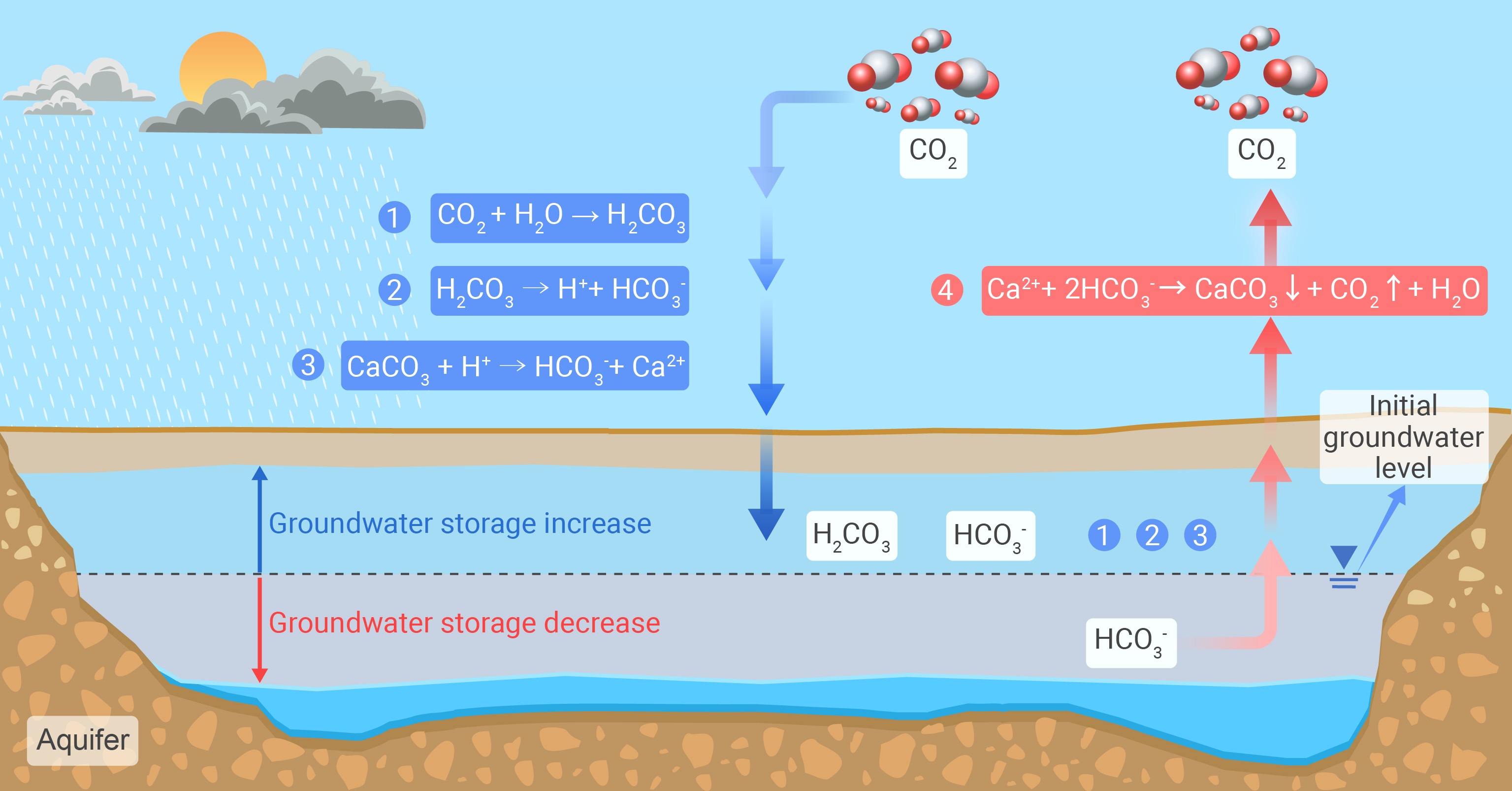
Figure 1.
Schematic diagram illustrating the reaction mechanisms between GWSC and inorganic carbon cycling in groundwater.
-
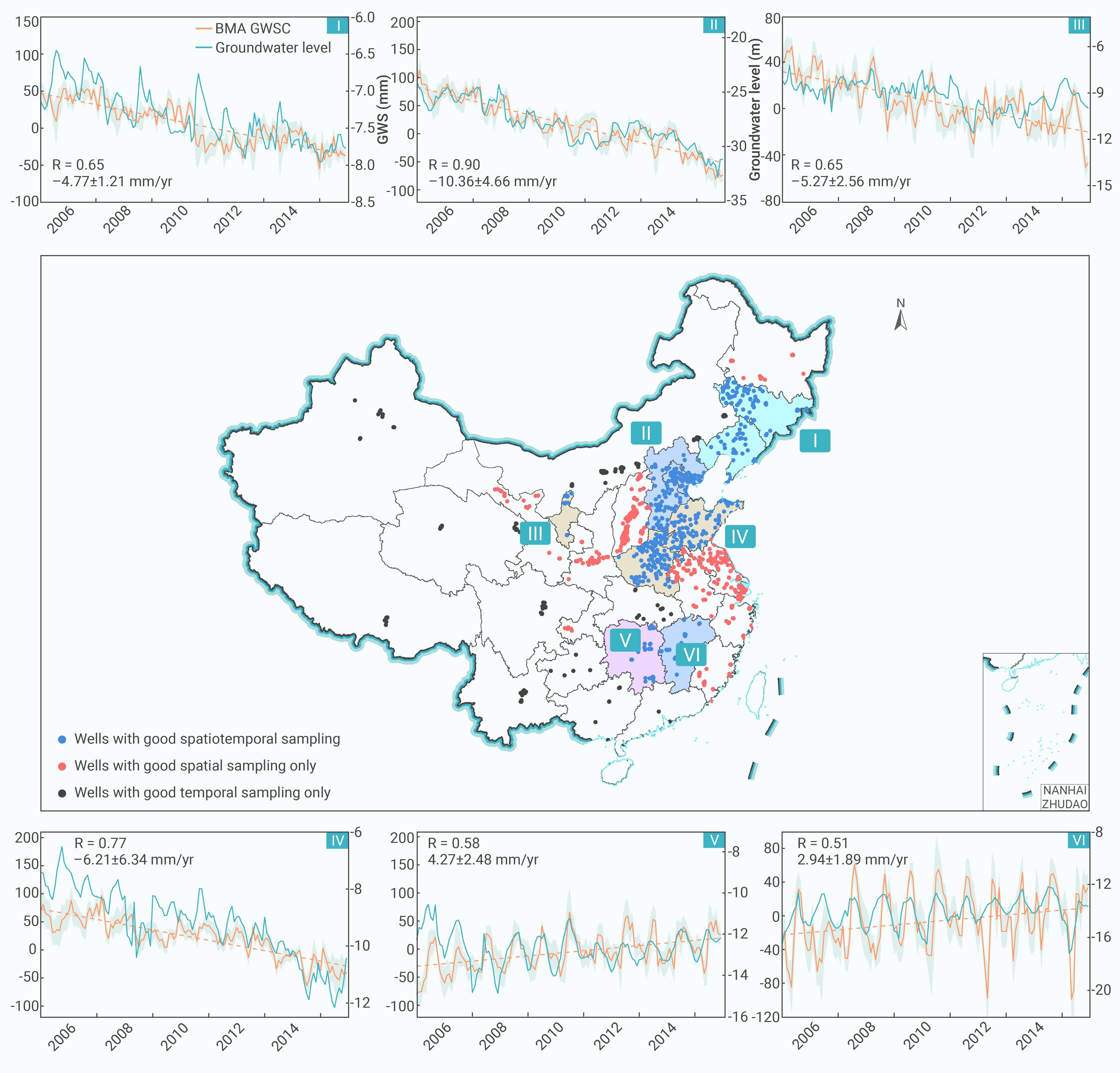
Figure 2.
Comparison of GRACE–derived GWSC and well–observed groundwater level data in six typical regions of China
-
Figure 3.
Distribution of groundwater BIC, annual GWSC trend, and the total CO2 emission
-
Figure 4.
China’s GWSC–induced CO2 emission
