
Key scientific questions to address climate crisis: Insights from the second climate change science conference
-

-
REFERENCES
[1] Rockström J., Gupta J., Qin D., et al. (2023). Safe and just Earth system boundaries. Nature 619:102−111. DOI:10.1038/s41586-023-06083-8 [2] Jiang T., He X., Su B., et al. (2024). COP 28: challenge of coping with climate crisis. The Innovation 5:100559. DOI:10.1016/j.xinn.2023.100559 [3] Wang F., Harindintwali J.D., Yuan Z., et al. (2021). Technologies and perspectives for achieving carbon neutrality. The Innovation 2:100180. DOI:10.1016/j.xinn.2021.100180 [4] Weisheimer A., Baker L.H., Bröcker J., et al. (2024). The Signal-to-Noise paradox in climate forecasts: revisiting our understanding and identifying future priorities. Bull. Amer. Meteorol. Soc. 105:E651−E659. DOI:10.1175/BAMS-D-24-0019.1 [5] Wei T., Yang S., Moore J.C., et al. (2012). Developed and developing world responsibilities for historical climate change and CO2 mitigation. P. Natl. Acad. Sci. USA 109:12911−12915. DOI:10.1073/pnas.1203282109 -
ABOUT THIS ARTICLE
Cite this article:
Shen X., Zhang X., Liu F., et al. (2025). Key scientific questions to address climate crisis: Insights from the second climate change science conference. The Innovation Geoscience 3:100112. https://doi.org/10.59717/j.xinn-geo.2024.100112
Welcome!
To request copyright permission to republish or share portions of our works, please visit Copyright Clearance Center's (CCC) Marketplace website at marketplace.copyright.com.
Export File
Citation
Shen X., Zhang X., Liu F., et al. (2025). Key scientific questions to address climate crisis: Insights from the second climate change science conference. The Innovation Geoscience 3:100112. https://doi.org/10.59717/j.xinn-geo.2024.100112

Format
Content
 DownLoad:
-
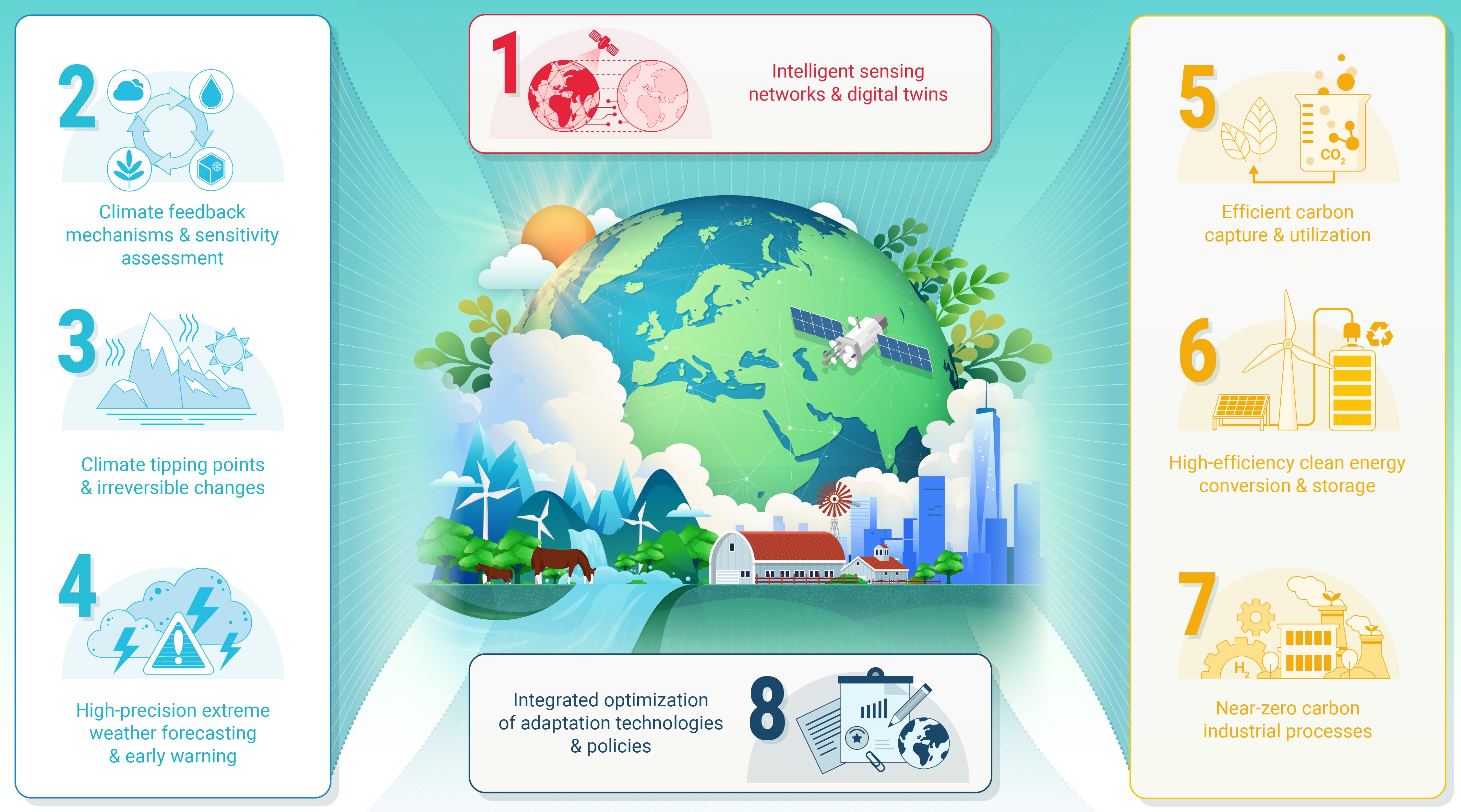
Figure 1.
Key Scientific Questions in climate change science.
