
Carbon utilization in construction materials: Technologies, challenges, and opportunities
-

-
REFERENCES
[1] Al Khaffaf I., Hawileh R.A., Sahoo S., et al. (2025). Toward carbon- neutral construction: A review of zero-carbon concrete. J. Build. Eng. 99:111578. DOI:10.1016/j.jobe.2024.111578 [2] Panesar D.K. and Zhang R. (2020). Performance comparison of cement replacing materials in concrete: Limestone fillers and supplementary cementing materials – A review. Constr. Build. Mater. 251:118866. DOI:10.1016/j.conbuildmat.2020.118866 [3] Kaliyavaradhan S.K. and Ling T.C. (2017). Potential of CO2 sequestration through construction and demolition (C&D) waste - An overview. J. CO2 Util. 20:234–242.DOI: 10.1016/j.jcou.2017.05.014 [4] Wu C., Zhu Y., Zhang X., et al. (2018). Improving the properties of recycled concrete aggregate with bio-deposition approach. Cem. Concr. Compos. 94:248−254. DOI:10.1016/j.cemconcomp.2018.09.012 [5] Liu J.L., Wang T.T., Wang Y.H., et al. (2025). China’s 1+N policy system supports an earlier peak in carbon emissions. Renew. Sustain. Energy Rev. 215:115626. DOI:10.1016/j.rser.2025.115626 -
ABOUT THIS ARTICLE
Cite this article:
Liu M., Li D., Wang X., et al. (2025). Carbon utilization in construction materials: Technologies, challenges, and opportunities. The Innovation Geoscience 3:100149. https://doi.org/10.59717/j.xinn-geo.2025.100149
Welcome!
To request copyright permission to republish or share portions of our works, please visit Copyright Clearance Center's (CCC) Marketplace website at marketplace.copyright.com.
Export File
Citation
Liu M., Li D., Wang X., et al. (2025). Carbon utilization in construction materials: Technologies, challenges, and opportunities. The Innovation Geoscience 3:100149. https://doi.org/10.59717/j.xinn-geo.2025.100149

Format
Content
 DownLoad:
-
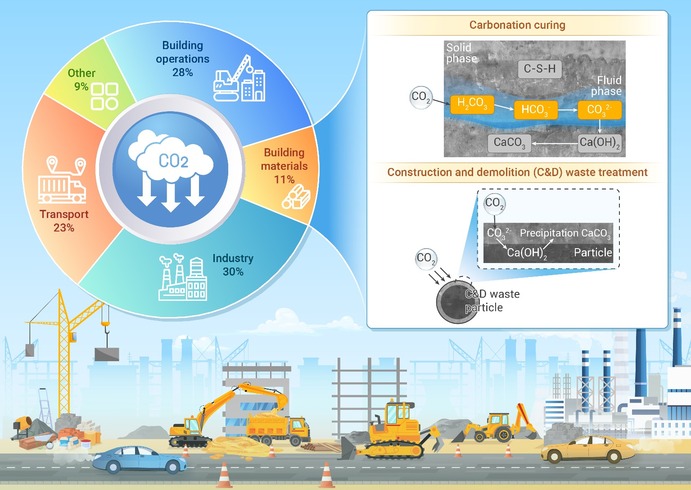
Figure 1.
Global CO2 emissions by sectors.
