
Intraspecific competition might reduce pollen productivity of grassland plants on the Tibetan Plateau
-

-
REFERENCES
[1] Broström A., Nielsen A.B., Gaillard M.J., et al. (2008). Pollen productivity estimates of key European plant taxa for quantitative reconstruction of past vegetation: A review. Veg. Hist. Archaeobot. 17:461−478. DOI:10.1007/s00334-008-0148-8 [2] Trondman A.K., Gaillard M.J., Mazier F., et al. (2015). Pollen-based quantitative reconstruction of Holocene regional vegetation cover (plant-functional types and land-cover types) in Europe suitable for climate modelling. Global Change Biol. 21:676−697. DOI:10.1111/gcb.12737 [3] Jin Y., Wang H., Wei L., et al. (2022). A plot-based dataset of plant community on the Qingzang Plateau. Chin. J. Plant Ecol. 46:846−954. DOI:10.17521/cjpe.2022.0174 [4] Liao M., Li K., Jin Y., et al. (2025). Modern pollen dataset of the Tibetan Plateau. Earth Syst. Sci. Data 17:5601-5613. DOI: 10.5194/essd-2025-71 [5] Parsons R.W., Prentice I.C. (1981). Statistical approaches to R-values and the pollen–vegetation relationship. Rev. Palaeobot. Palynol. 32:127−152. DOI:10.1016/0034-6667(81)90001-4 -
ABOUT THIS ARTICLE
Cite this article:
Cao X., Liao M., Li K., et al. (2025). Intraspecific competition might reduce pollen productivity of grassland plants on the Tibetan Plateau. The Innovation Geoscience 3:100168. https://doi.org/10.59717/j.xinn-geo.2025.100168
Welcome!
To request copyright permission to republish or share portions of our works, please visit Copyright Clearance Center's (CCC) Marketplace website at marketplace.copyright.com.
Export File
Citation
Cao X., Liao M., Li K., et al. (2025). Intraspecific competition might reduce pollen productivity of grassland plants on the Tibetan Plateau. The Innovation Geoscience 3:100168. https://doi.org/10.59717/j.xinn-geo.2025.100168

Format
Content
 DownLoad:
-
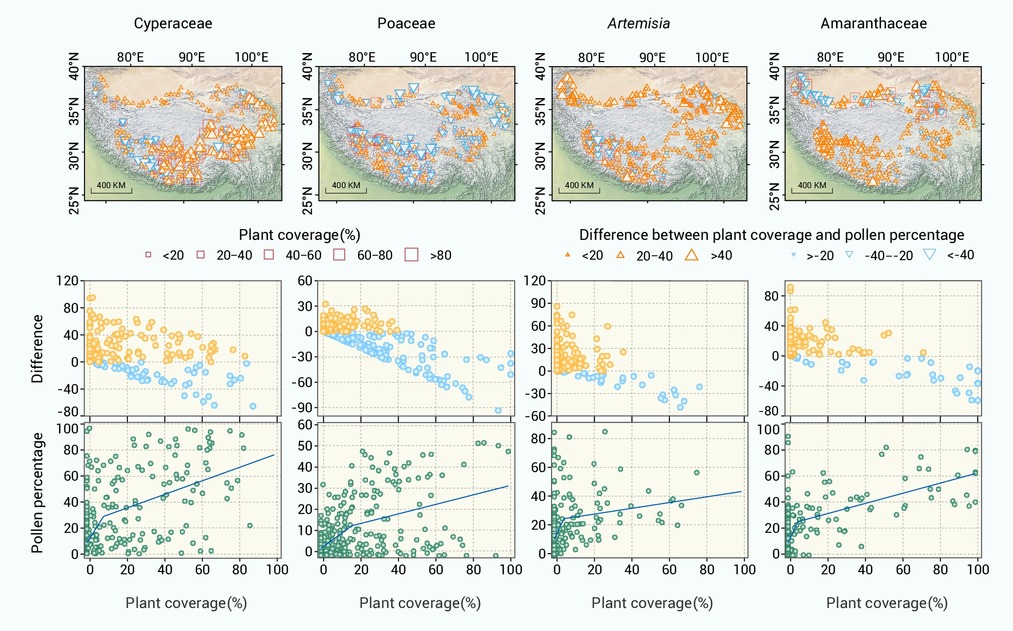
Figure 1.
Relationships between pollen percentage and plant cover for four dominant pollen taxa on the Tibetan Plateau
