
Pagoda construction ages reveal historical human migration in the Western Tibetan Plateau
-
GRAPHICAL ABSTRACT
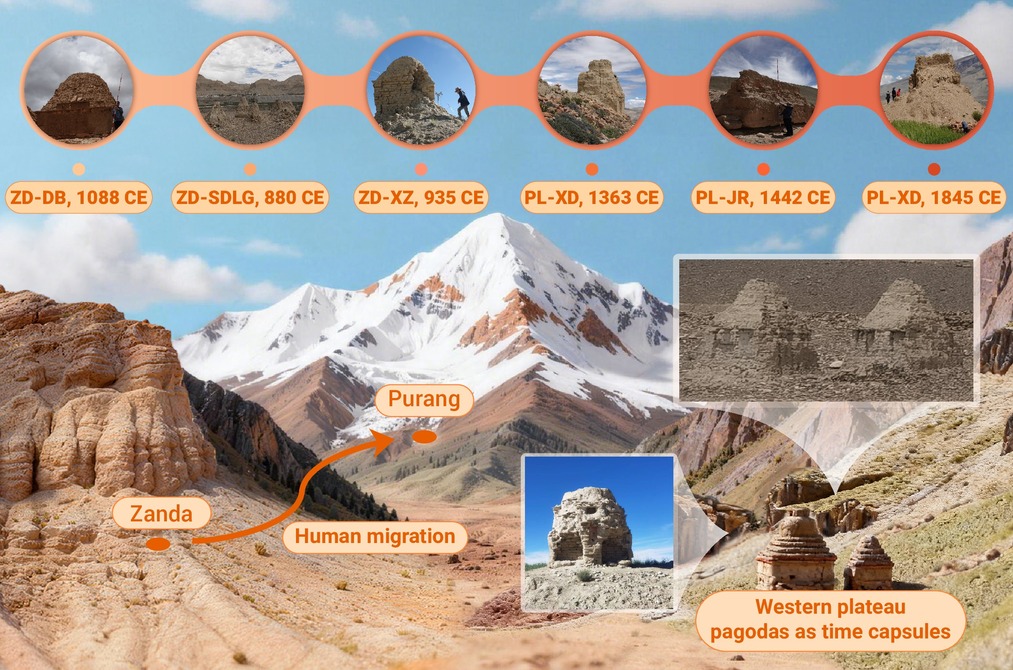
 DownLoad:
Full size image
DownLoad:
Full size image
-
PUBLIC SUMMARY
-
Early Buddhism reached the western Tibetan Plateau much sooner than previously thought.
Pagoda building reveals major population movements.
Pagodas serve as reliable “time capsules” for human history.
-
-
ABSTRACT
The Western Tibetan Plateau (WTP), a nexus of Central, South, and East Asia, played a vital role in shaping early Asian cultural and religious exchanges. Understanding human activities in this region is essential for reconstructing these historical interactions, yet the study of settlement and migration here faces significant obstacles due to limited archaeological research and fragmented historical records. This study employs pagoda construction as a targeted approach to investigate human migration and cultural diffusion. We compiled an extensive dataset of pagoda construction ages across the WTP using radiocarbon (14C) measurements, analyzing organic remains from 29 sites. Our results align 14C ages with documented construction dates, affirming the approach’s consistency. Initial pagoda building in the Zanda Basin aligns with Buddhism’s introduction to the Tibetan Plateau in the early 7th century, suggesting that Buddhism entered via multiple routes, beyond the routes in the eastern plateau. Most pagodas, however, emerged during and after the Later Propagation of Tibetan Buddhism (post-9th century), reflecting a resurgence of religious activity. In Zanda, construction spans 7th-20th centuries, while in Purang, most pagodas postdate 15th century, suggesting a significant migration from Zanda to Purang during the late Guge Kingdom and its decline, likely driven by political turmoil, religious conflicts, and climate change. These spatiotemporal patterns, corroborated by regional relic distributions, demonstrate that pagoda ages can uncover hidden histories of human mobility, providing fresh insights into the intricate interplay of early cultures, religions, and population movements across Asia. -

-
REFERENCES
[1] Akasoy A. and Yoeli-Tlalim R. (2007). Along the Musk routes: Exchange between Tibet and the Islamic world. Asian Med. 3:217−240. DOI:10.1163/157342008x307857 [2] Apple J. B. (2014). Buddhism in Tibetan history. In the Wiley Blackwell companion to East and Inner Asian Buddhism. M. Poceski. (ed). (John Wiley & Sons), pp: 104–123. DOI: 110.1002/9781118610398.ch9781118610395 [3] Petech L. (1997). Western Tibet: Historical introduction. In Tabo, a lamp for the kingdom, early Indo-Tibetan Buddhist art in the Western Himalaya. D.E. Klimburg-Salter. (ed). (Skira Editore), pp: 229–255. https://books.google.com/books/about/Tabo.html?id=-zLqAAAAMAAJ [4] Kathayat G., Cheng H., Sinha A., et al. (2017). The Indian monsoon variability and civilization changes in the Indian subcontinent. Sci. Adv. 3:e1701296. DOI:10.1126/sciadv.1701296 [5] Tucci G. (1988). The religions of Tibet (University of California Press). https://www.ucpress.edu/books/the-religions-of-tibet/paper [6] Akasoy A., Burnett C. and Yoeli-Tlalim R. (2016). Islam and Tibet-Interactions along the Musk routes (Routledge). https://www.routledge.com/Islam-and-Tibet---Interactions-along-the-Musk-Routes/Burnett-Akasoy/p/book/9781138247048 [7] Aldenderfer M. and Moyes H. (2004). Excavations at Dingdun, a pre-Buddhist village site in far Western Tibet. J. Tibetol. 1:47−69. http://www.zangx.com/uploads/ueditor/file/20220606/1654500363.pdf [8] Bellezza J. V. (2003). Bringing to light the forgotten: Major findings of a comprehensive inventory of pre-Buddhist sites in Upper Tibet (Tibet Autonomous Region, Peoples Republic of China). Conducted between 1992–2002. Athena Review 3:16–26. DOI:10.5771/9781442234628-321 [9] Chen Y., Hu Y., Li Z.-Y., et al. (2024). The world’s earliest ground stone needles: Archaeological evidence from the early Holocene of the Western Tibetan Plateau. J. Archaeol. Sci. Rep. 57:104610. DOI:10.1016/j.jasrep.2024.104610 [10] Song J.-X., Lu H.-L., Zhang Z.-W., et al. (2018). Archaeobotanical remains from the mid-first millennium AD site of Kaerdong in western Tibet. Archaeol. Anthropol. Sci. 10:2015−2026. DOI:10.1007/s12520-017-0521-6 [11] Li H.-C., Liu X.-R., Yang F., et al. (2022). Analysis of copper-base and gold artifacts from the Phyi Dbang-Dung Kar site in western Tibet, China, 400 BCE–600 CE. J. Archaeol. Sci. Rep. 46:103726. DOI:10.1016/j.jasrep.2022.103726 [12] Tang L., Lu H.-L., Chen X.-Z., et al. (2022). Prehistoric agricultural decision making in the western Himalayas: Ecological and social variables. Antiquity 96:1214−1231. DOI:10.15184/aqy.2022.80 [13] Wang H.-R., Yang M. A., Wangdue S., et al. (2023). Human genetic history on the Tibetan Plateau in the past 5100 years. Sci. Adv. 9:eadd5582. DOI:10.1126/sciadv.add5582 [14] Zhang G.-Y., Cui C., Wangdue S., et al. (2023). Maternal genetic history of ancient Tibetans over the past 4000 years. J. Genet. Genom. 50:765−775. DOI:10.1016/j.jgg.2023.03.007 [15] Bai F., Liu Y.-C., Wangdue S., et al. (2024). Ancient genomes revealed the complex human interactions of the ancient western Tibetans. Curr. Biol. 34:2594−2605. DOI:10.1016/j.cub.2024.04.068 [16] Gupta A. (2022). Buddhist monasteries of Western Himalaya and its functions. Int. j. res. cult. soc. 6:61−66. DOI:10.2017/IJRCS/202207008 [17] Semple W. (2005). Traditional architecture in Tibet: Linking issues of environmental and cultural sustainability. Mt. Res. Dev. 25:15−19. DOI:10.1659/0276-4741(2005)025[0015:TAIT]2.0.CO;2 [18] Ramble C. (2014). The complexity of Tibetan pilgrimage. In Buddhist pilgrimage in history and present times. M. Deeg. (ed). (Lumbini International Research Institute), pp: 179–196. https://hal.science/hal-03112094/document [19] Chen Y.-T. (2022). Review and prospect of Tibetan stupa research in China during the last hundred years. J. Landscape Res. 14:68−76. DOI:10.16785/j.issn1943-989x.2022.6.018 [20] Wong W. S. (2014). Stupa, Pagoda and Chorten - Origin and meaning of Buddhist architecture. The 4th Annual International Conference on Architecture. https://files01.core.ac.uk/download/pdf/38048989.pdf [21] Copplestone L. (2024). Temple-monasteries, Buddhist monks, and architectural exchange between India, Java, and Tibet in the late 8th century. Religions 15:1338. DOI:10.3390/rel15111338 [22] Tucci G. (2009). Indo-Tibetica (Shanghai Classics Publishing House and Istituto Italiano Per L’Africa E ’Oriente). https://buddhism.lib.ntu.edu.tw/en/search/search_detail.jsp?seq=370778 [23] Cao H.-H., Wang Z.-L., He J.-H., et al. (2023). Performance and inter-comparison tests of the MICADAS at the Radiocarbon laboratory of Lanzhou university, China. Radiocarbon 65:41−50. DOI:10.1017/RDC.2022.1080 [24] Reimer P. J., Austin W. E. N., Bard E., et al. (2020). The INTCAL20 Northern Hemisphere radiocarbon age calibration curve (0-55 cal kBP). Radiocarbon 62:725−757. DOI:10.1017/RDC.2020.41 [25] Ren L.-L., Dong G.-H., Li H.-M., et al. (2018). Dating human settlement in the East-Central Tibetan Plateau during the Late Holocene. Radiocarbon 60:137−150. DOI:10.1017/RDC.2017.117 [26] Sørensen P. K. (1994). The Mirror Illuminating the Royal Genealogies: Tibetan Buddhist Historiography : An Annotated Translation of the XIVth Century Tibetan Chronicle : RGyal-rabs Gsal- Baʼi Me-long (Otto Harrasswitz Wiesbaden). https://www.google.com/books/edition/The_Mirror_Illuminating_the_Royal_Geneal/CeuBznK7RiMC?hl=zh-CN&gbpv=0 [27] Vitali R. (1996). The Kingdoms of Gu.Ge Pu.Hrang: According to Mnga'.Ris Rgyal.Rabs by Gu.Ge Mkhan.Chen Ngag.Dbang Grags.Pa (Weatherhill). https://buddhism.lib.ntu.edu.tw/en/search/search_detail.jsp?seq=600273 [28] Stein R. A. (1972). Tibetan Civilization (Stanford University Press). https://books.google.com/books/about/Tibetan_Civilization.html?id=U7j758TsI8IC [29] Powers J. (2007). Introduction to Tibetan Buddhism (Snow Lion Publications). https://www.google.com/books/edition/Introduction_to_Tibetan_Buddhism/fbxvDwAAQBAJ?hl=zh-CN&gbpv=0 [30] Fang S.-B., Zhao Y.-L., Liu X.-X., et al. (2024). Quantitative characteristics and influencing factors of Tibetan Buddhist religious space with monasteries as the carrier: A case study of U-Tsang, China. Herit. Sci. 12:93. DOI:10.1186/s40494–40024–01208–40492 [31] Petech L. (1977). The kingdom of Ladakh: C. 950-1842 A.D. (Istituto italiano per il Medio ed Estremo Oriente). https://books.google.com/books?id=4oduAAAAMAAJ [32] Liang J., Guo Y.-L., Richter N., et al. (2022). Calibration and application of branched GDGTs to Tibetan lake sediments: The influence of temperature on the fall of the Guge Kingdom in Western Tibet, China. Paleoceanogr. Paleoclimatol. 37:e2021PA004393. DOI:10.1029/2021PA004393 [33] Huang B. (2021). On the Development and Spread of the Gelugpa School in the Guge Area. J. Tibetol. 25. http://www.zangx.com/uploads/ueditor/file/20240104/1704347787.pdf [34] Dotson B. (2009). The Old Tibetan Annals: An annotated translation of Tibet's first history (Ǒsterreichische Akadamie der Wissenschaften Wien). http://archivenepal.s3.amazonaws.com/digitalhimalaya/collections/journals/ebhr/pdf/EBHR_37_13.pdf -
ABOUT THIS ARTICLE
Cite this article:
Hou J., Hu G., Hou X., et al. (2026). Pagoda construction ages reveal historical human migration in the Western Tibetan Plateau. The Innovation Geoscience 4:100202. https://doi.org/10.59717/j.xinn-geo.2026.100202
Welcome!
To request copyright permission to republish or share portions of our works, please visit Copyright Clearance Center's (CCC) Marketplace website at marketplace.copyright.com.
Export File
Citation
Hou J., Hu G., Hou X., et al. (2026). Pagoda construction ages reveal historical human migration in the Western Tibetan Plateau. The Innovation Geoscience 4:100202. https://doi.org/10.59717/j.xinn-geo.2026.100202

Format
Content
-
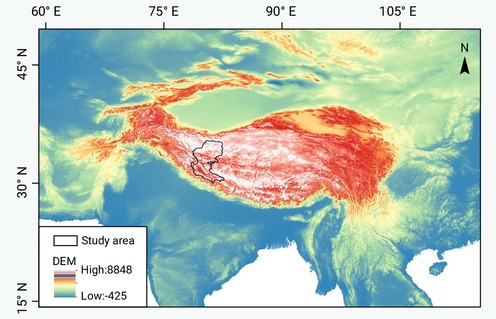
Figure 1.
Geographical location of the Western Tibetan Plateau (black outline), situated at the convergence of Central Asia, South Asia, and East Asia.
-
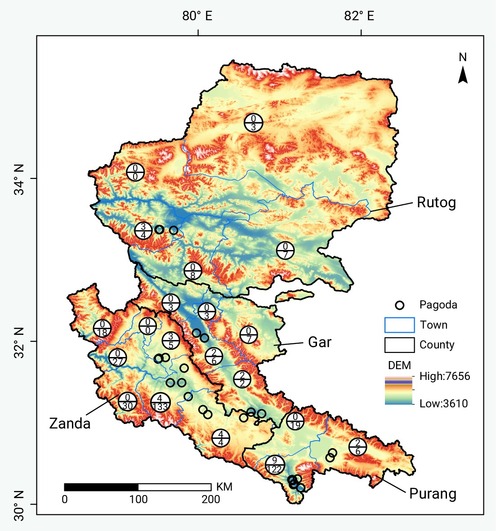
Figure 2.
Pagoda distribution across four counties in the Western Tibetan Plateau (Purang, Zanda, Gar, Rutog)
-
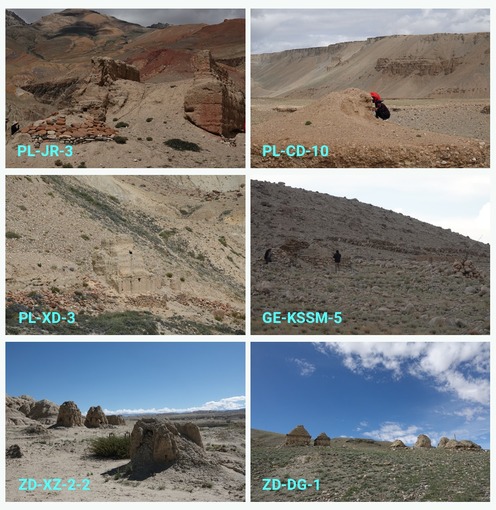
Figure 3.
Representative photographs of sampled pagodas and surrounding landscapes from four counties in the Western Tibetan Plateau
-
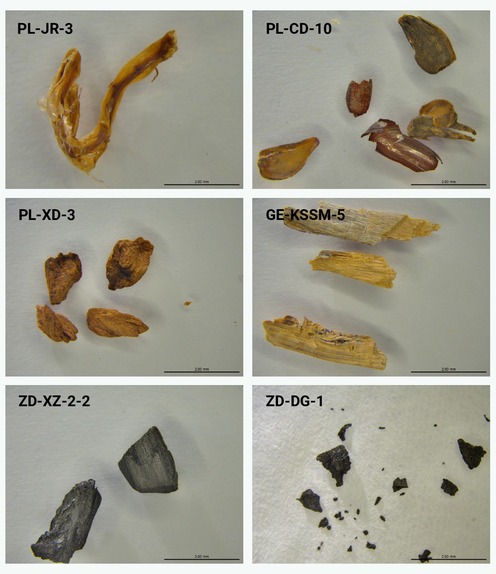
Figure 4.
Macroscopic photographs of organic dating samples extracted from pagodas across four counties in the Western Tibetan Plateau
-
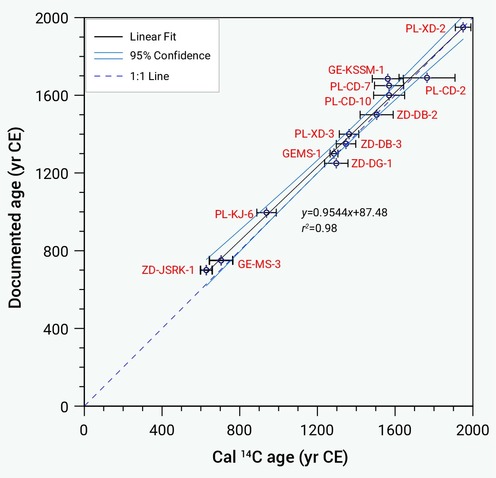
Figure 5.
Correlation between mean calibrated 14C ages (with 1σ error bars) and documented ages for selected pagodas (names indicated)
-
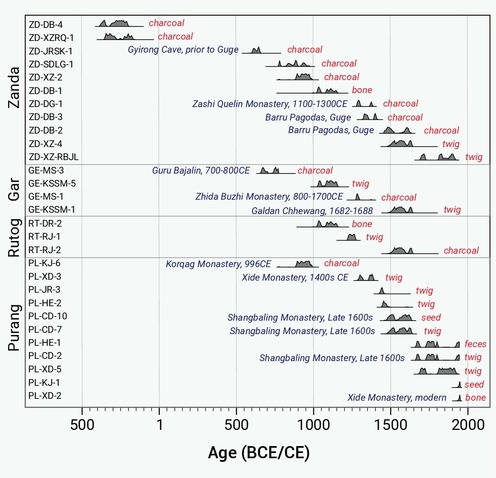
Figure 6.
Distribution of calibrated 14C ages for pagodas in four Western Tibetan Plateau counties (Zanda, Gar, Rutog, Purang)
-
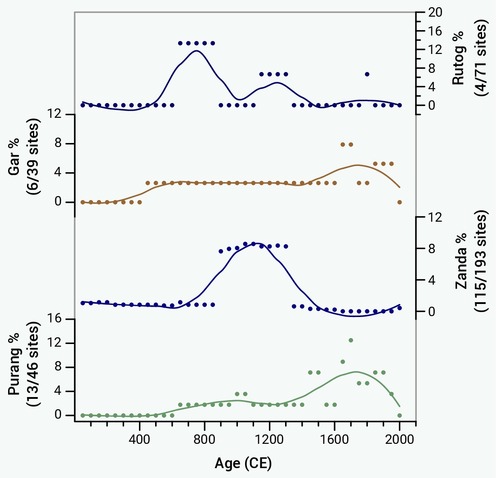
Figure 7.
Temporal frequency distribution of archaeological sites per 50-year interval across four counties in the Western Tibetan Plateau
