
Functional innovation and adaptive evolution of the Proboscidipparion horse during the late Cenozoic in East Asia
-

-
REFERENCES
[1] Deng T., Li Q., Tseng Z. J., et al. (2012). Locomotive implication of a Pliocene three-toed horse skeleton from Tibet and its paleo-altimetry significance. Proc. Natl. Acad. Sci. USA 109:7374−7378. DOI:10.1073/pnas.1201052109 [2] Ma J., Sun B. Y., Bocherens H., et al. (2023). Dietary niche reconstruction of Pliocene and Pleistocene Equidae from the Linxia Basin of northwestern China based on stable isotope analysis. Palaeogeogr. Palaeoclimatol. Palaeoecol. 614:111416. DOI:10.1016/j.palaeo.2023.111416 [3] Qiu Z. X., Huang W. L., and Guo Z. H. (1987). The Chinese hipparionine fossils. Palaeont. Sin. New Ser. C, No. 25 (Science Press), pp: 1-250. [4] Sun B. Y. (2024). Fossil Equidae in the Linxia Basin with biostratigraphic and paleozoogeographic significance. Acta Geol. Sin. (English Edition). 98:1−9. DOI:10.1111/1755-6724.15097 [5] Deng T., Wang X. M., Fortelius M., et al. (2011). Out of Tibet: Pliocene woolly rhino suggests high-plateau origin of Ice Age megaherbivores. Science 333:1285−1288. DOI:10.1126/science.1206594 -
ABOUT THIS ARTICLE
Cite this article:
Deng T., Ma J. and Sun B. (2026). Functional innovation and adaptive evolution of the Proboscidipparion horse during the late Cenozoic in East Asia. The Innovation Geoscience 4:100204. https://doi.org/10.59717/j.xinn-geo.2026.100204
Welcome!
To request copyright permission to republish or share portions of our works, please visit Copyright Clearance Center's (CCC) Marketplace website at marketplace.copyright.com.
Export File
Citation
Deng T., Ma J. and Sun B. (2026). Functional innovation and adaptive evolution of the Proboscidipparion horse during the late Cenozoic in East Asia. The Innovation Geoscience 4:100204. https://doi.org/10.59717/j.xinn-geo.2026.100204

Format
Content
 DownLoad:
-
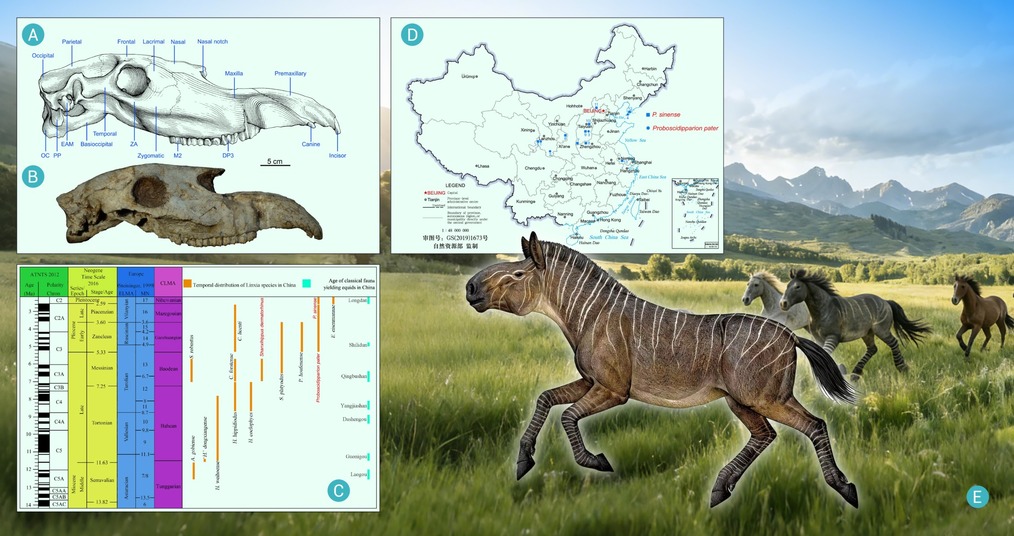
Figure 1.
Fossils, distribution, and reconstruction of Proboscidipparion
