
Increasing risk of compound heatwave-pluvial hazards in highly populated regions
-
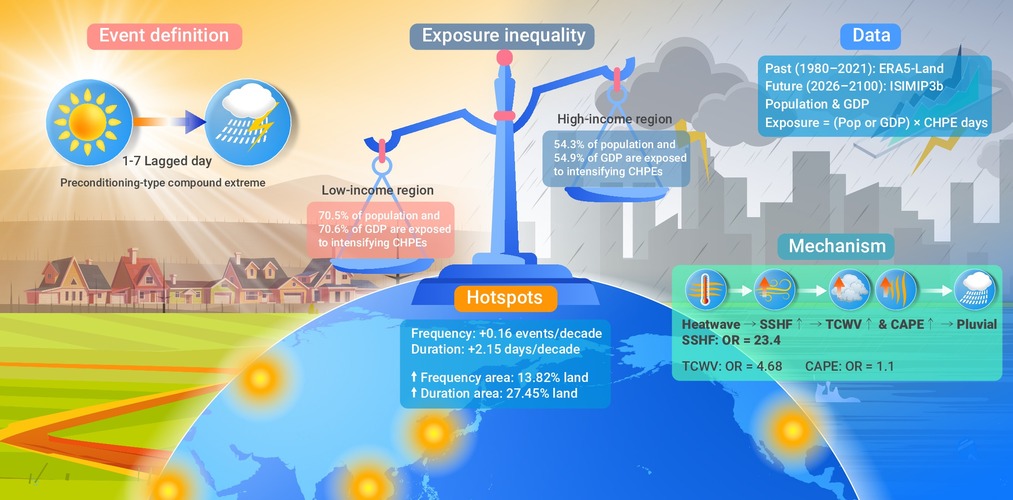
GRAPHICAL ABSTRACT
 DownLoad:
Full size image
DownLoad:
Full size image
-
PUBLIC SUMMARY
-
Compound heatwave–pluvial events (CHPEs)—heatwaves followed by heavy rain within 7 days—are rising worldwide.
1980–2021 saw more and longer CHPEs, with hotspots in Central Europe, East Asia and North America.
Sensible heat flux (SSHF) and total column water vapor (TCWV) promote heatwave-to-pluvial shifts.
Under Shared Socioeconomic Pathway 5-8.5 (SSP5-8.5), exposure rises fastest in low-income countries.
Targeted mitigation and adaptation are needed to protect dense urban hotspots and reduce climate inequality.
-
-
ABSTRACT
Compound heatwave-pluvial events (CHPEs) can cause severe socio-economic damage and are difficult to predict because of their complex transition processes. Moreover, their spatial patterns and impacts on socio-economic systems remain poorly understood. Using an extensive set of atmospheric reanalysis data and model simulations, we observed a significant global increase in the frequency and duration of CHPEs from 1980 to 2021, with hotspots in Central Europe, East Asia, the Tibetan Plateau, Southern Africa, the Amazon Basin, and North America. Low-income countries are projected to experience a significantly higher population (+42.2%) and GDP exposure (+46.4%) to CHPEs than high-income countries under the SSP585. These findings emphasize the ongoing disparities in exposure under future socio-economic scenarios, highlighting the urgent need to develop equitable and just mitigation and adaptation strategies, particularly in less-developed regions. -

-
REFERENCES
[1] AghaKouchak A., Chiang F., Huning L. S., et al. (2020). Climate extremes and compound hazards in a warming world. Annu. Rev. Earth Planet. Sci. 48:519−548. DOI:10.1146/annurev-earth-071719-055228 [2] Alizadeh M. R., Abatzoglou J. T., Adamowski J. F., et al. (2022). Increasing heat-stress inequality in a warming climate. Earth's Future 10. DOI:10.1029/2021EF002488 [3] Angelsen A. and Dokken T. (2018). Climate exposure, vulnerability and environmental reliance: A cross-section analysis of structural and stochastic poverty. Environ. Dev. Econ. 23:257−278. DOI:10.1017/S1355770X18000013 [4] Bustamante M., Roy J., Ospina D., et al. (2023). Ten new insights in climate science 2023. Glob. Sustain. 7:e19. DOI:10.1017/sus.2023.25 [5] Chang M., Liu B., Wang B., et al. (2022). Understanding future increases in precipitation extremes in global land monsoon regions. J. Clim. 35:1839−1851. DOI:10.1175/JCLI-D-21-0409.1 [6] Chen S., Liu Y., Yi Y., et al. (2025). Long-term impacts of heatwaves on accelerated ageing. Nat. Clim. Change 15:1000−1007. DOI:10.1038/s41558-025-02407-w [7] Chen Y., Liao Z., Shi Y., et al. (2021). Detectable increases in sequential flood-heatwave events across China during 1961–2018. Geophys. Res. Lett. 48:e2021GL092549. DOI:10.1029/2021GL092549 [8] Li X., Ryu Y., Xiao J., et al. (2023). New-generation geostationary satellite reveals widespread midday depression in dryland photosynthesis during 2020 western U.S. heatwave. Sci. Adv. 9:eadi0775. DOI:10.1126/sciadv.adi0775 [9] Reddington C. L., Smith C., Butt E. W., et al. (2025). Tropical deforestation is associated with considerable heat-related mortality. Nat. Clim. Change 15:992−999. DOI:10.1038/s41558-025-02411-0 [10] Stangherlin dos Santos L. and dos Santos J. C. C. (2025). Heatwaves worsen educational inequality in Brazil. Nat. Clim. Change 15:1125−1126. DOI:10.1038/s41558-025-02469-w [11] Chiang F., Greve P., Mazdiyasni O., et al. (2022). Intensified likelihood of concurrent warm and dry months attributed to anthropogenic climate change. Water Resour. Res. 58:e2021WR030411. DOI:10.1029/2021WR030411 [12] Diffenbaugh N. S. and Ashfaq M. (2010). Intensification of hot extremes in the United States. Geophys. Res. Lett. 37:L15701. DOI:10.1029/2010GL043888 [13] Diffenbaugh N. S. and Burke M. (2019). Global warming has increased global economic inequality. Proc. Natl. Acad. Sci. USA 116:9808−9813. DOI:10.1073/pnas.1816020116 [14] Fu J., Jian Y., Wang X., et al. (2023). Extreme rainfall reduces one-twelfth of China’s rice yield over the last two decades. Nat. Food 4:416−426. DOI:10.1038/s43016-023-00753-6 [15] Papalexiou S. M. and Montanari A. (2019). Global and regional increase of precipitation extremes under global warming. Water Resour. Res. 55:4901−4914. DOI:10.1029/2018WR024067 [16] Chiang F., Mazdiyasni O. and AghaKouchak A. (2018). Amplified warming of droughts in southern United States in observations and model simulations. Sci. Adv. 4. DOI:10.1126/sciadv.aat2380 [17] Tripathy K. P., Mukherjee S., Mishra A. K., et al. (2023). Climate change will accelerate the high-end risk of compound drought and heatwave events. Proc. Natl. Acad. Sci. USA 120:e2219825120. DOI:10.1073/pnas.2219825120 [18] Mukherjee S. and Mishra A. K. (2021). Increase in compound drought and heatwaves in a warming world. Geophys. Res. Lett. 48:e2020GL090617. DOI:10.1029/2020GL090617 [19] Ridder N. N., Pitman A. J., Westra S., et al. (2020). Global hotspots for the occurrence of compound events. Nat. Commun. 11:5956. DOI:10.1038/s41467-020-19639-3 [20] Liu X., Tang Q., Liu W., et al. (2019). The asymmetric impact of abundant preceding rainfall on heat stress in low latitudes. Environ. Res. Lett. 14:044010. DOI:10.1088/1748-9326/ab018a [21] Zhang W. and Villarini G. (2020). Deadly compound heat stress-flooding hazard across the central United States. Geophys. Res. Lett. 47:e2020GL089185. DOI:10.1029/2020GL089185 [22] Gu L., Chen J., Yin J., et al. (2022). Global increases in compound flood-hot extreme hazards under climate warming. Geophys. Res. Lett. 49:e2022GL097726. DOI:10.1029/2022GL097726 [23] You J., Wang S., Zhang B., et al. (2023). Growing threats from swings between hot and wet extremes in a warmer world. Geophys. Res. Lett. 50:e2023GL104075. DOI:10.1029/2023GL104075 [24] Zhou Z., Zhang L., Zhang Q., et al. (2024). Global increase in future compound heat stress-heavy precipitation hazards and associated socio-ecosystem risks. npj Clim. Atmos. Sci. 7:33. DOI:10.1038/s41612-024-00579-4 [25] Liu J., Chen J., Yin J., et al. (2024). Understanding compound extreme precipitations preconditioned by heatwaves over China under climate change. Environ. Res. Lett. 19:064077. DOI:10.1088/1748-9326/ad50ee [26] Hao Z. (2022). Compound events and associated impacts in China. iScience 25:104689. DOI:10.1016/j.isci.2022.104689 [27] Ridder N. N., Pitman A. J. and Ukkola A. M. (2022). High impact compound events in Australia. Weather Clim. Extremes 36:100457. DOI:10.1016/j.wace.2022.100457 [28] Lüthi S., Fairless C., Fischer E. M., et al. (2023). Rapid increase in the risk of heat-related mortality. Nat. Commun. 14:4894. DOI:10.1038/s41467-023-40599-x [29] Newman R. and Noy I. (2023). The global costs of extreme weather that are attributable to climate change. Nat. Commun. 14:6103. DOI:10.1038/s41467-023-41888-1 [30] Rentschler J., Salhab M. and Jafino B. A. (2022). Flood exposure and poverty in 188 countries. Nat. Commun. 13:3527. DOI:10.1038/s41467-022-30727-4 [31] King A. D. and Harrington L. J. (2018). The inequality of climate change from 1.5 to 2°C of global warming. Geophys. Res. Lett. 45:5030-5033. DOI:10.1029/2018GL078430 [32] Muñoz-Sabater J., Dutra E., Agustí-Panareda A., et al. (2021). ERA5-Land: A state-of-the-art global reanalysis dataset for land applications. Earth Syst. Sci. Data 13:4349−4383. DOI:10.5194/essd-13-4349-2021 [33] Lange S. (2019). Trend-preserving bias adjustment and statistical downscaling with ISIMIP3BASD (v1.0). Geosci. Model Dev. 12:3055-3070. DOI:10.5194/gmd-12-3055-2019 [34] Janssens C., Havlík P., Krisztin T., et al. (2020). Global hunger and climate change adaptation through international trade. Nat. Clim. Change 10:829−835. DOI:10.1038/s41558-020-0847-4 [35] Porkka M., Virkki V., Wang-Erlandsson L., et al. (2024). Notable shifts beyond pre-industrial streamflow and soil moisture conditions transgress the planetary boundary for freshwater change. Nat. Water 2:262−273. DOI:10.1038/s44221-024-00208-7 [36] Kummu M., Taka M. and Guillaume J. H. A. (2018). Gridded global datasets for gross domestic product and human development index over 1990–2015. Sci. Data 5:180004. DOI:10.1038/sdata.2018.4 [37] Jing C., Tao H., Jiang T., et al. (2020). Population, urbanization and economic scenarios over the Belt and Road region under the shared socioeconomic pathways. J. Geogr. Sci. 30:68−84. DOI:10.1007/s11442-020-1715-x [38] Yin J., Guo S., Yang Y., et al. (2022). Projection of droughts and their socioeconomic exposures based on terrestrial water storage anomaly over China. Sci. China Earth Sci. 65:1772−1787. DOI:10.1007/s11430-021-9927-x [39] Mukherjee S., Mishra A. K., Zscheischler J., et al. (2023). Interaction between dry and hot extremes at a global scale using a cascade modeling framework. Nat. Commun. 14:277. DOI:10.1038/s41467-022-35748-7 [40] Jones B., O’Neill B. C., McDaniel L., et al. (2015). Future population exposure to US heat extremes. Nat. Clim. Change 5:652−655. DOI:10.1038/nclimate2631 [41] Zhang P., Jeong J.-H., Yoon J.-H., et al. (2020). Abrupt shift to hotter and drier climate over inner East Asia beyond the tipping point. Science 370:1095−1099. DOI:10.1126/science.abb3368 [42] Zscheischler J., Martius O., Westra S., et al. (2020). A typology of compound weather and climate events. Nat. Rev. Earth Environ. 1:333−347. DOI:10.1038/s43017-020-0060-z [43] Wang S. S. Y., Kim H., Coumou D., et al. (2019). Consecutive extreme flooding and heat wave in Japan: Are they becoming a norm? Atmos. Sci. Lett. 20:e933. DOI:10.1002/asl.933 [44] Intergovernmental Panel On Climate C. (2023). Climate change 2021 – the physical science basis: Working group I contribution to the sixth assessment report of the intergovernmental panel on climate change. Cambridge University Press. DOI:10.1017/9781009157896 [45] Gevaert A. I., Miralles D. G., de Jeu R. a. M., et al. (2018). Soil moisture-temperature coupling in a set of land surface models. J. Geophys. Res. Atmos. 123:1481−1498. DOI:10.1002/2017JD027346 [46] Miralles D. G., van den Berg M. J., Teuling A. J., et al. (2012). Soil moisture-temperature coupling: A multiscale observational analysis. Geophys. Res. Lett. 39:L21707. DOI:10.1029/2012GL053703. [47] Seneviratne S. I., Davin E. L., Corti T., et al. (2010). Investigating soil moisture–climate interactions in a changing climate: a review. Earth-Sci. Rev. 99:125−161. DOI:10.1016/j.earscirev.2010.02.004 [48] Brunner L., Schaller N., Anstey J., et al. (2018). Dependence of present and future European temperature extremes on the location of atmospheric blocking. Geophys. Res. Lett. 45:5805−6320. DOI:10.1029/2018GL077837 [49] Chemke R. (2022). The future poleward shift of Southern Hemisphere summer mid-latitude storm tracks stems from ocean coupling. Nat. Commun. 13:1730. DOI:10.1038/s41467-022-29392-4 [50] Priestley M. D. K. and Catto J. L. (2022). Future changes in the extratropical storm tracks and cyclone intensity, wind speed, and structure. Weather Clim. Dyn. 3:337−360. DOI:10.5194/wcd-3-337-2022 [51] Woollings T., Barriopedro D., Methven J., et al. (2018). Blocking and its response to climate change. Curr. Clim. Change Rep. 4:287−300. DOI:10.1007/s40641-018-0108-z [52] Ding T., Gao H. and Li X. (2024). Increasing risk of a “hot eastern‐pluvial western” Asia. Earths Future 12. DOI:10.1029/2023ef004333 [53] Naumann G., Cammalleri C., Mentaschi L., et al. (2021). Increased economic drought impacts in Europe with anthropogenic warming. Nat. Clim. Change 11:485−491. DOI:10.1038/s41558-021-01044-3 [54] Scholz S. R. and Lora J. M. (2024). Atmospheric rivers cause warm winters and extreme heat events. Nature 636:640−646. DOI:10.1038/s41586-024-08238-7 [55] Papalexiou S. M., AghaKouchak A. and Foufoula‐Georgiou E. (2018). A diagnostic framework for understanding climatology of tails of hourly precipitation extremes in the United States. Water Resour. Res. 54:6725−6738. DOI:10.1029/2018WR022732 [56] Fankhauser S. and McDermott T. K. J. (2014). Understanding the adaptation deficit: Why are poor countries more vulnerable to climate events than rich countries. Glob. Environ. Change 27:9−18. DOI:10.1016/j.gloenvcha.2014.04.014 [57] Hallegatte S., Fay M. and Barbier E. B. (2018). Poverty and climate change: introduction. Environ. Dev. Econ. 23:217−233. DOI:10.1017/S1355770X18000141 [58] Ciais P., Reichstein M., Viovy N., et al. (2005). Europe-wide reduction in primary productivity caused by the heat and drought in 2003. Nature 437:529−533. DOI:10.1038/nature03972 [59] Piao S., Zhang X., Chen A., et al. (2019). The impacts of climate extremes on the terrestrial carbon cycle: A review. Sci. China Earth Sci. 62:1551−1563. DOI:10.1007/s11430-018-9363-5 [60] Li X., Xia K., Wu T., et al. (2024). Increased precipitation has not enhanced the carbon sequestration of afforestation in Northwest China. Commun. Earth Environ. 5:619. DOI:10.1038/s43247-024-01733-9 [61] Lian X., Li Y., Liu J., et al. (2025). Northern ecosystem productivity reduced by Rossby-wave-driven hot–dry conditions. Nat. Geosci. 18:615−623. DOI:10.1038/s41561-025-01722-3 [62] Reichstein M., Bahn M., Ciais P., et al. (2013). Climate extremes and the carbon cycle. Nature 500:287−295. DOI:10.1038/nature12350 [63] Simpson N. P., Mach K. J., Constable A., et al. (2021). A framework for complex climate change risk assessment. One Earth 4:489−501. DOI:10.1016/j.oneear.2021.03.005 [64] Wu H., Su X. and Singh V. P. (2023). Increasing risks of future compound climate extremes with warming over global land masses. Earths Future 11:e2022EF003466. DOI:10.1029/2022EF003466 [65] Fu Z.-H., Zhou W., Xie S.-P., et al. (2024). Dynamic pathway linking Pakistan flooding to East Asian heatwaves. Sci. Adv. 10:eadk9250. DOI:10.1126/sciadv.adk9250 -
ABOUT THIS ARTICLE
Cite this article:
Liang J., Liu X., Yin J., et al. (2026). Increasing risk of compound heatwave-pluvial hazards in highly populated regions. The Innovation Geoscience 4:100210. https://doi.org/10.59717/j.xinn-geo.2026.100210
Welcome!
To request copyright permission to republish or share portions of our works, please visit Copyright Clearance Center's (CCC) Marketplace website at marketplace.copyright.com.
Export File
Citation
Liang J., Liu X., Yin J., et al. (2026). Increasing risk of compound heatwave-pluvial hazards in highly populated regions. The Innovation Geoscience 4:100210. https://doi.org/10.59717/j.xinn-geo.2026.100210

Format
Content
-
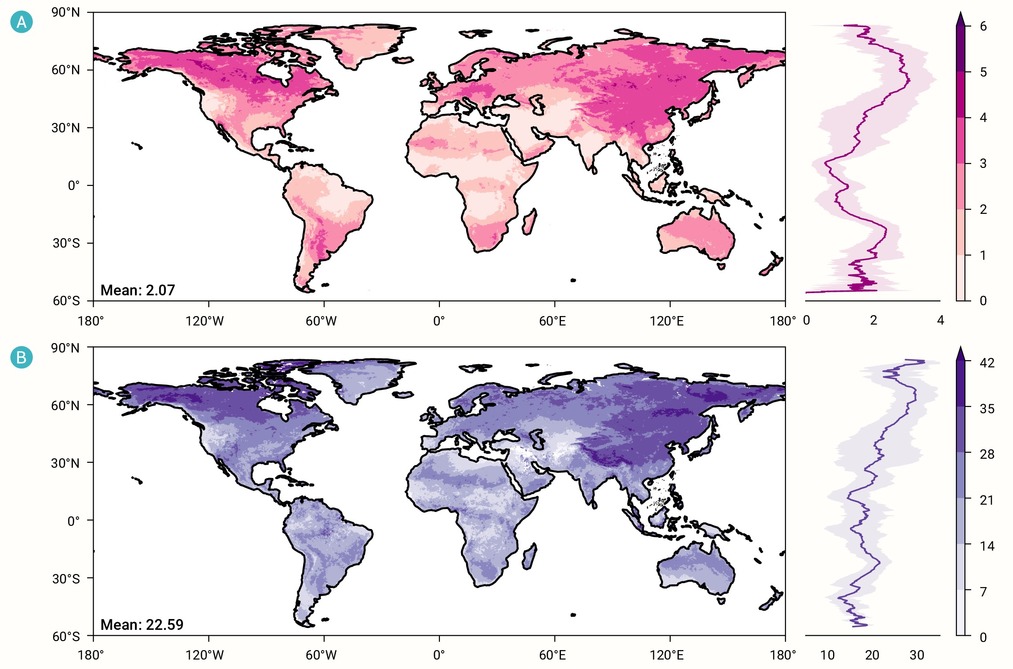
Figure 1.
Spatial characteristics of compound heatwave-pluvial events (CHPEs) from 1980 to 2021
-
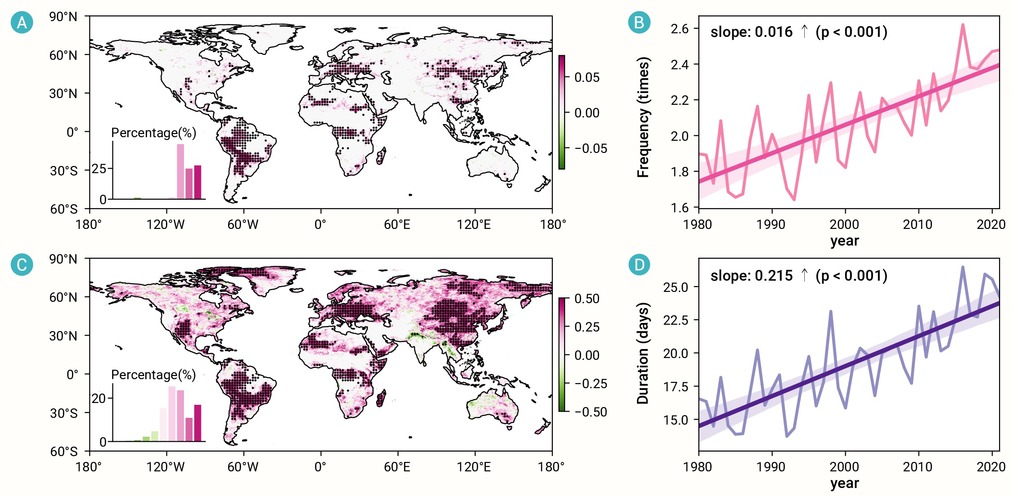
Figure 2.
Trends in CHPEs frequency and duration (1980–2021)
-
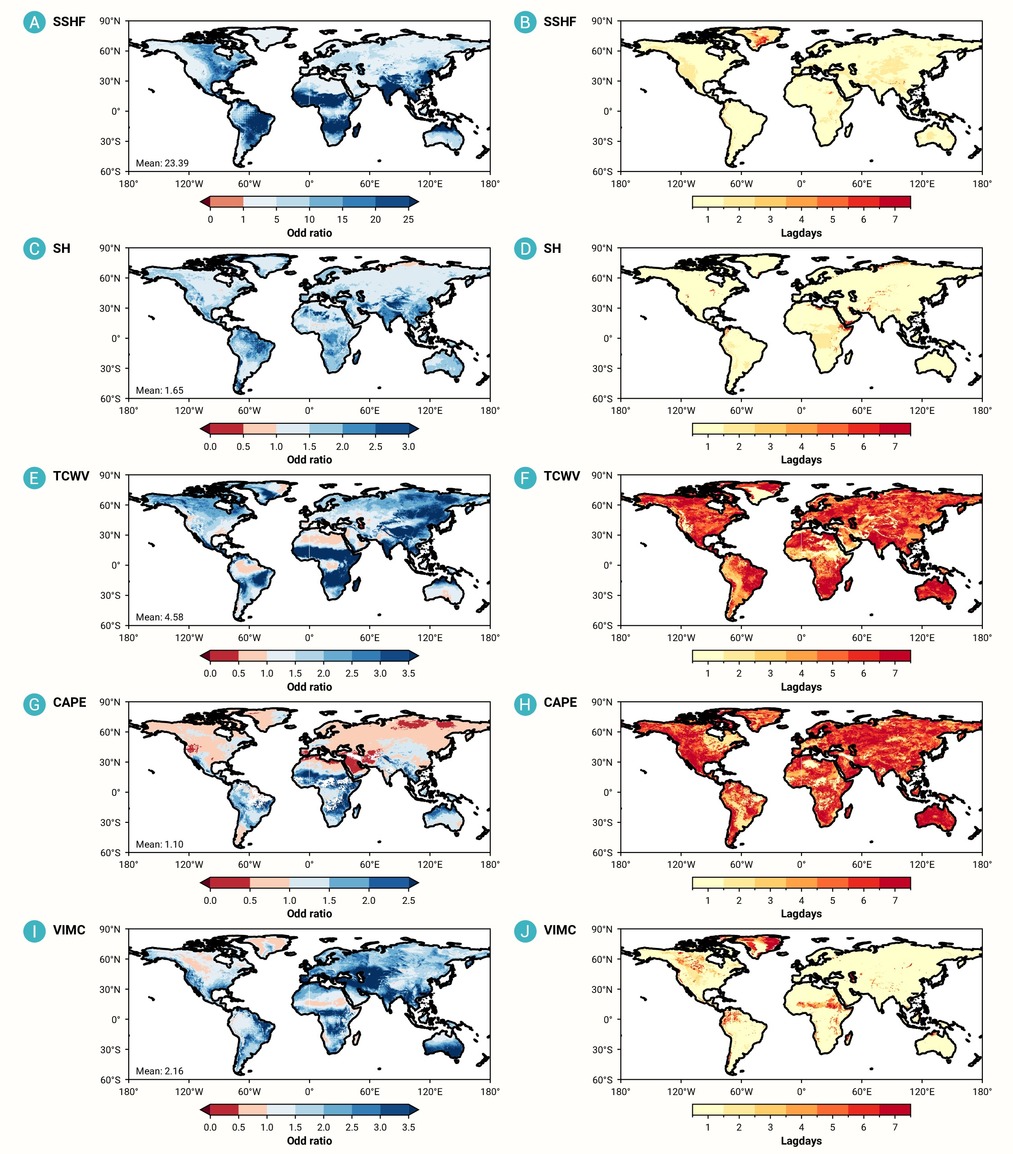
Figure 3.
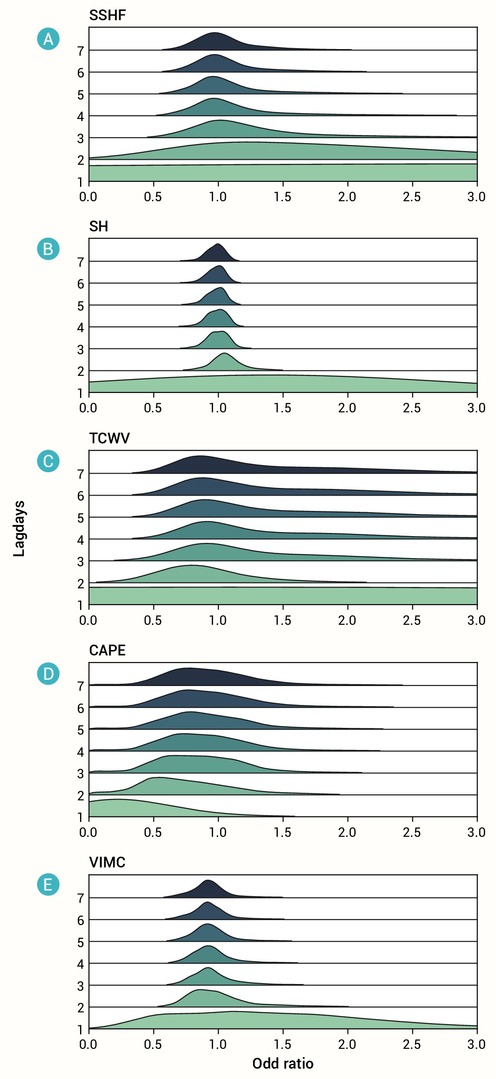
Influence of five hydroclimatic anomalies on the risk of occurrence of CHPEs (including surface sensible heat flux [SSHF], specific humidity [SH], total column water vapor [TCWV], convective available potential energy [CAPE], and vertically integrated moisture converge [VIMC])
-
Figure 4.
Distributions of odds ratios across 1–7-day lags
-
Figure 5.
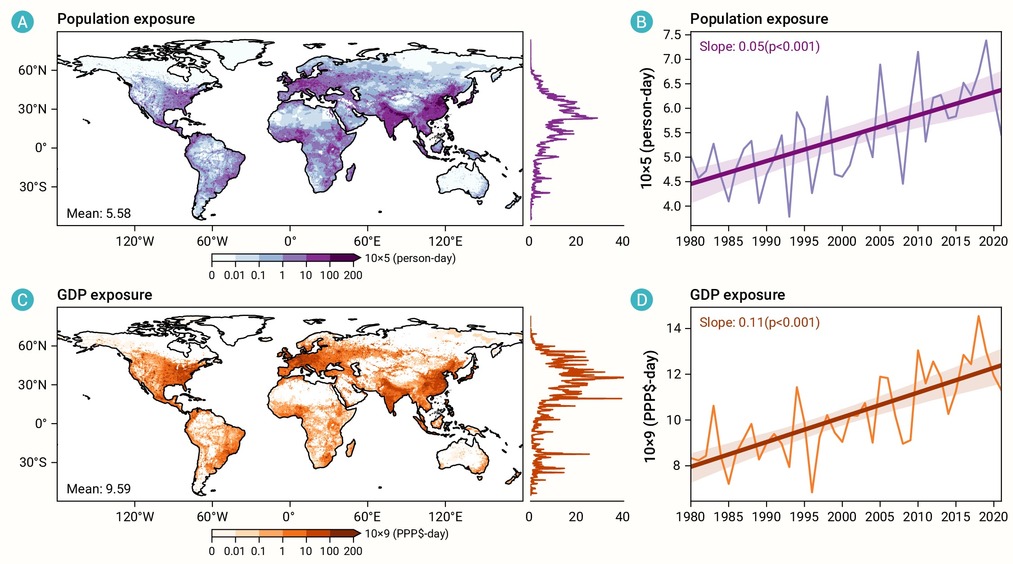
Spatiotemporal characteristics of population and GDP exposure to CHPEs from 1980 to 2021
-
Figure 6.
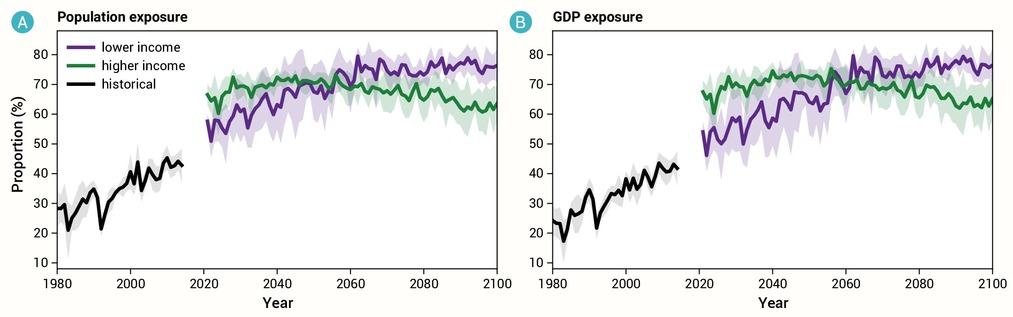
Temporal changes in the global average proportion for exposed population and GDP under SSP5-8.5
-
Figure 7.
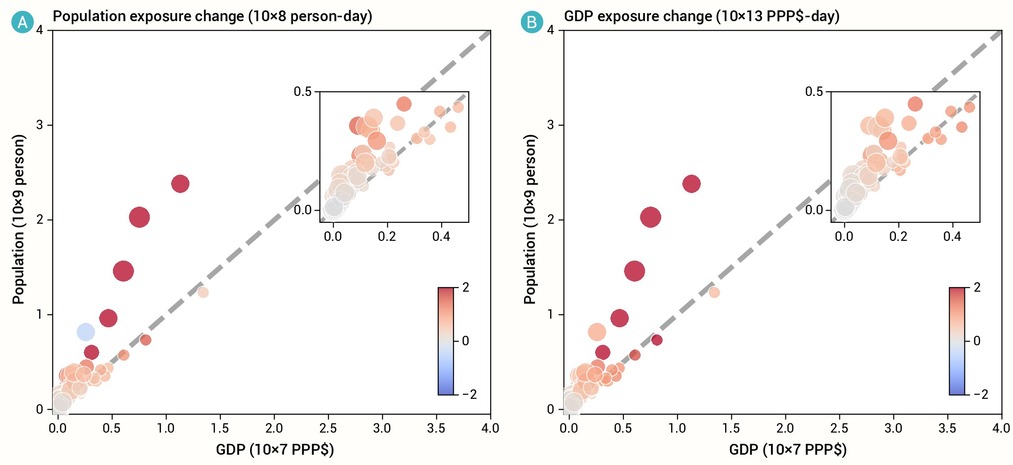
Changes in population (A) and GDP exposure (B) in the future (2021–
2100 ) relative to historical (1980–2014) values are related to socio-economic factors, with statistics by country
