
Earliest molecular evidence of Pu-erh tea uncovered in northwest China
-
-
Keywords:
- Pu-erh Tea /
- Py-GC/MS /
- caffeine /
- theacrine /
- tea trade
-

-
REFERENCES
[1] Jiang J., Lu G., Wang Q., et al. (2021). The analysis and identification of charred suspected tea remains unearthed from Warring State Period Tomb. Sci. Rep. 11:16557. DOI:10.1038/s41598-021-95393-w [2] Lu H., Zhang J., Yang Y., et al. (2016). Earliest tea as evidence for one branch of the Silk Road across the Tibetan Plateau. Sci. Rep. 6:18955. DOI:10.1038/srep18955 [3] Shi Y., Zhang S. R., Sun K., et al. (2022). Characterization of bitter taste theacrine in Pu-erh Tea. J. Food Compos. Anal. 106:104331. DOI:10.1016/j.jfca.2021.104331 [4] Wang S., Chen J., Ma J., et al. (2020). Novel insight into theacrine metabolism revealed by transcriptome analysis in bitter tea Kucha, Camellia sinensis. Sci. Rep. 10:6286. DOI:10.1038/s41598-020-62859-2 [5] Cheng Y., Yan Z., Lu J., et al. (2010). Isolation and preparation of theacrine by high-speed counter-current chromatography from camellia assamica var. kucha. Zhongshan Daxue Xuebao/Acta Scientiarum Natralium Universitatis Sunyatseni 49:65−69. https://xuebaozr.sysu.edu.cn/en/article/43615834/ [6] Xie J., Zhang W., Chen X., et al. (2015). Analysis of changes in aroma constituents during storage of ripe Pu'er tea. Food Sci. 10:154−157. DOI:10.7506/spkx1002-6630-201510031 [7] Zhu Y., Li W., Zhang Y., et al. (2025). Insight into volatile metabolites and key odorants in black teas processed from Jianghua Kucha tea germplasm (Camellia sinensis var. assamica cv. Jianghua). Food Chem. 464:141794. DOI:10.1016/j.foodchem.2024.141794 [8] Xu J., Wei Y., Li F., et al. (2022). Regulation of fungal community and the quality formation and safety control of Pu-erh tea. Compr. Rev. Food Sci. Food Saf. 21:4546−4572. DOI:10.1111/1541-4337.13051 [9] Liu H., Lin X., He L., et al. (2014). The discrimination of Pu'er tea according to region of origin using the content of heavy rare-earth elements. Chaye Kexue. 34:7. DOI:10.3969/j.issn.1000-369X.2014.05.005 [10] Fu C. (2023). The painting: A holding-teacup maid trio. Wenshi zhishi 11: 1-2. https://kns.cnki.net/kcms2/article/abstract?v=ZMT4ddBD2nyrqlLCOTNf9XRPhxzFpDIMu_0X0q4c8P1g0DKFgFdFMY7z3r8tBP6aiJpQ6knILdHt_I9tRrD5WQAaYpyNEdPJtWYNmY_-FBwYx1bWbzl9kglxusrkLxFRGVAAm6zvVH0iebdyApmORO2Ax0AoasIwCInzRkVIkDI=&uniplatform=NZKPT -
ABOUT THIS ARTICLE
Cite this article:
Wang L., Liu W., Wang L., et al. (2026). Earliest molecular evidence of Pu-erh tea uncovered in northwest China. The Innovation Geoscience 4:100226. https://doi.org/10.59717/j.xinn-geo.2026.100226
Welcome!
To request copyright permission to republish or share portions of our works, please visit Copyright Clearance Center's (CCC) Marketplace website at marketplace.copyright.com.
Export File
Citation
Wang L., Liu W., Wang L., et al. (2026). Earliest molecular evidence of Pu-erh tea uncovered in northwest China. The Innovation Geoscience 4:100226. https://doi.org/10.59717/j.xinn-geo.2026.100226

Format
Content
 DownLoad:
-
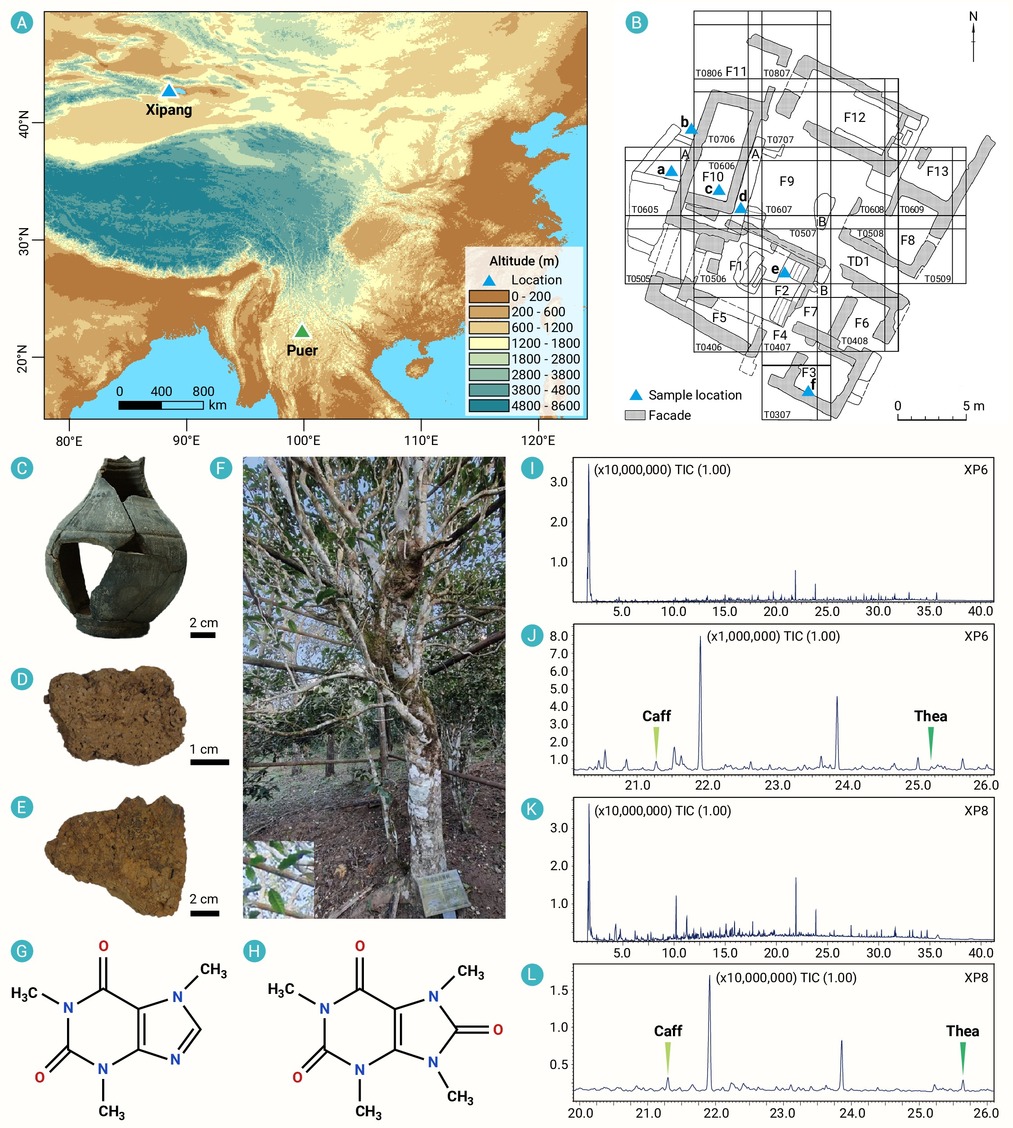
Figure 1.
Ancient tea residue samples uncovered at the Xipang Site
