
-
GRAPHICAL ABSTRACT
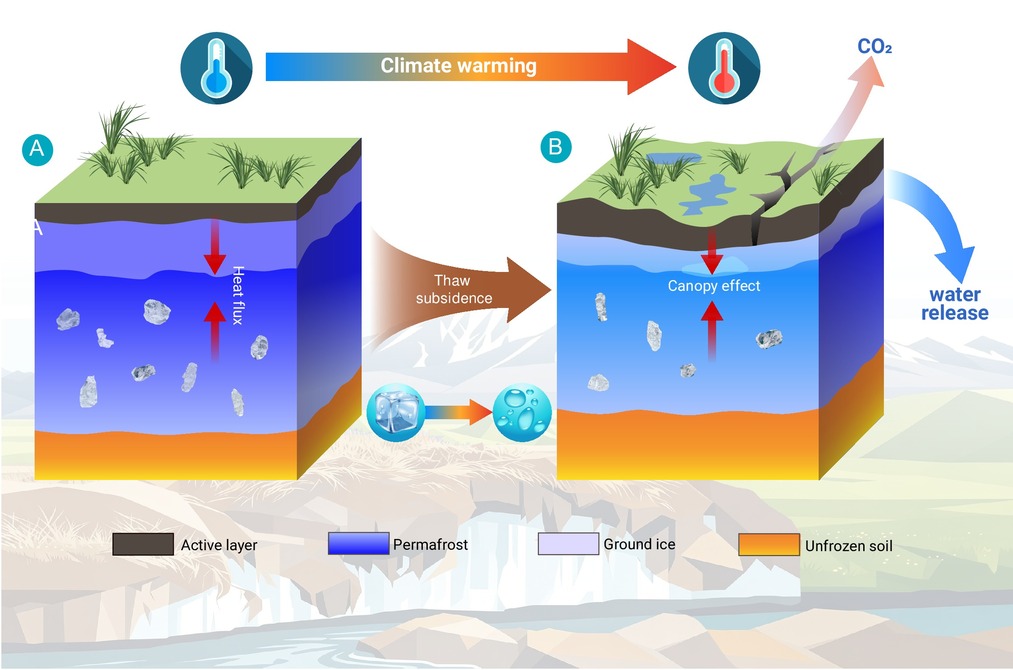
 DownLoad:
Full size image
DownLoad:
Full size image
-
PUBLIC SUMMARY
-
Melting ground ice leads to thaw subsidence, accelerating permafrost loss under warming.
Thaw subsidence can make complete permafrost loss occur decades earlier than expected.
More than 88% of absorbed energy is used to melt ground ice, not simply warm the soil.
Earth system models should include thaw subsidence to improve permafrost-related water and carbon simulations.
-
-
ABSTRACT
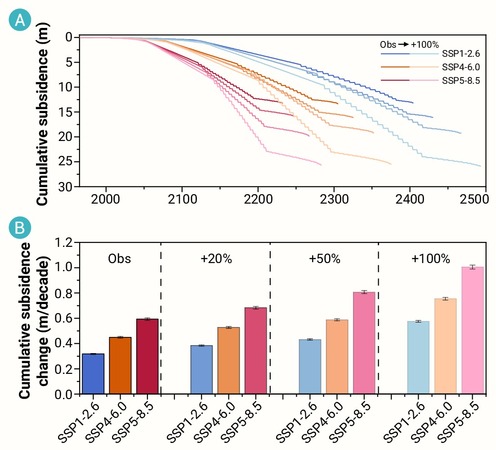
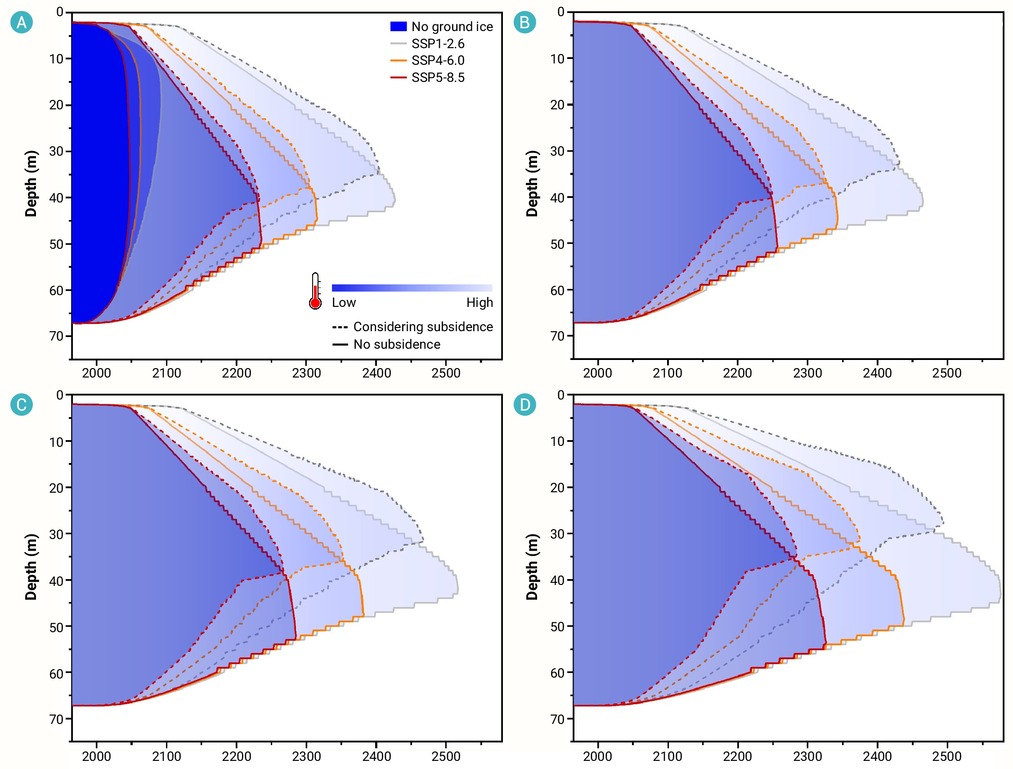
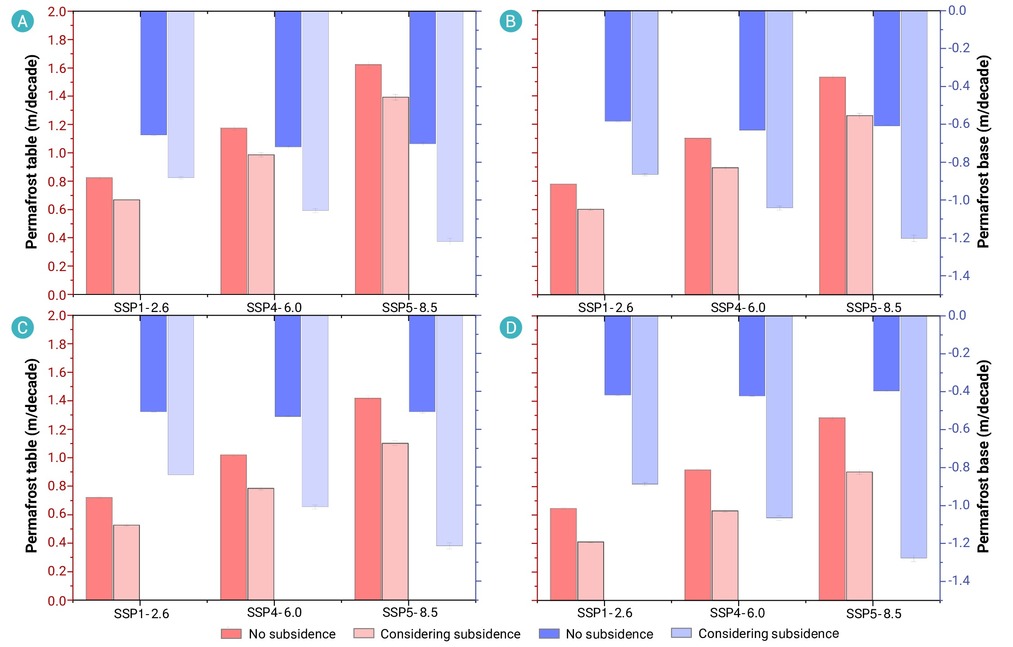
One of the major issues associated with degrading permafrost is thaw subsidence caused by the melting of ground ice. This process has great impacts on engineered structures, hydrological cycles, the carbon cycle, and energy processes under climate change. However, accurately representing thaw subsidence in permafrost dynamics still poses a significant challenge for Earth system models (ESMs). In this study, we used a moving-grid permafrost model (MGPM) incorporating heat transfer processes, the ground ice melting process, and thaw subsidence processes to project that the rates of increase in cumulative thaw subsidence will be 0.43 m/decade, 0.58 m/decade, and 0.77 m/decade under the SSP1-2.6, SSP4-6.0, and SSP5-8.5 scenarios, respectively. On average, accounting for thaw subsidence accelerates the complete degradation of permafrost by over 17 years across future scenarios with varying ground ice conditions. This mainly manifests in the marked acceleration of upward degradation of permafrost due to the warming of the upper boundary, which obstructs the upward transfer of geothermal energy from the lower boundary, creating a canopy effect. When thaw subsidence is accounted for, the initial energy consumed by ground ice melting increases substantially—absorbing 7% more energy on average—thereby accelerating permafrost thinning. Moreover, incorporating thaw subsidence leads to faster release of meltwater from ground ice and accelerated thawing of permafrost-stored carbon. By quantifying its effects, this study enhances understanding of permafrost degradation and its consequences. These findings underscore the need to integrate thaw subsidence into Earth System Models (ESMs) to improve permafrost simulations.-
Keywords:
- Permafrost /
- ground ice /
- thaw subsidence /
- modeling /
- climate change
-

-
REFERENCES
[1] Biskaborn B.K., Smith S.L., Noetzli J., et al. (2019). Permafrost is warming at a global scale. Nat. Commun. 10:264. DOI:10.1038/s41467-018-08240-4 [2] Smith S.L., O'Neill H.B., Isaksen K., et al. (2022). The changing thermal state of permafrost. Nat. Rev. Earth Environ. 3:10−23. DOI:10.1038/s43017-021-00240-1 [3] Zhao L., Zou D., Hu G., et al. (2020). Changing climate and the permafrost environment on the Qinghai-Tibet (Xizang) Plateau. Permafr. Periglac. Process. 31:396−405. DOI:10.1002/ppp.2056 [4] Obu J., Westermann S., Bartsch A., et al. (2019). Northern Hemisphere permafrost map based on TTOP modelling for 2000–2016 at 1 km2 scale. Earth-Sci. Rev. 193:299−316. DOI:10.1016/j.earscirev.2019.04.023 [5] Hu G.J., Zhao L., Zou D.F., et al. (2024). Large variability in permafrost degradation over the Northern Hemisphere. Catena 246:108440. DOI:10.1016/j.catena.2024.108440 [6] Hu G., Zhao L., Sun Z., et al. (2024). Spatiotemporal characteristics and variability in the thermal state of permafrost on the Qinghai-Tibet Plateau. Permafr. Periglac. Process. 35:143−156. DOI:10.1002/ppp.2219 [7] Zhao L., Zou D., Hu G., et al. (2021). A synthesis dataset of permafrost thermal state for the Qinghai-Tibet (Xizang) Plateau, China. Earth Syst. Sci. Data 13:4207−4218. DOI:10.5194/essd-13-4207-2021 [8] Hjort J., Streletskiy D., Doré G., et al. (2022). Impacts of permafrost degradation on infrastructure. Nat. Rev. Earth Environ. 3:24−38. DOI:10.1038/s43017-021-00247-8 [9] Jin H.-J., Wu Q.-B. and Romanovsky V.E. (2021). Degrading permafrost and its impacts. Adv. Clim. Change Res. 12:1−5. DOI:10.1016/j.accre.2021.01.007 [10] Miner K.R., Turetsky M.R., Malina E., et al. (2022). Permafrost carbon emissions in a changing Arctic. Nat. Rev. Earth Environ. 3:55−67. DOI:10.1038/s43017-021-00230-3 [11] Rodenhizer H., Ledman J., Mauritz M., et al. (2020). Carbon thaw rate doubles when accounting for subsidence in a permafrost warming experiment. J. Geophys. Res. Biogeosci. 125:e2019JG005528. DOI:10.1029/2019JG005528 [12] Burke E.J., Zhang Y. and Krinner G. (2020). Evaluating permafrost physics in the coupled model intercomparison project 6 (CMIP6) models and their sensitivity to climate change. Cryosphere 14:3155−3174. DOI:10.5194/tc-14-3155-2020 [13] Hu G., Zhao L., Zou D., et al. (2023). Water and heat coupling processes and its simulation in frozen soils: current status and future research directions. Catena 222:106844. DOI:10.1016/j.catena.2022.106844 [14] Matthes H., Chadburn S.E., Burke E.J., et al. (2025). Advances in permafrost representation: Biophysical processes in Earth system models and the role of offline models. Permafr. Periglac. Process. 36:302−318. DOI:10.1002/ppp.2269 [15] Wang S., Foster A., Lenz E.A., et al. (2023). Mechanisms and impacts of Earth system tipping elements. Rev. Geophys. 61:e2021RG000757. DOI:10.1029/2021RG000757 [16] Zwieback S. and Meyer F.J. (2021). Top-of-permafrost ground ice indicated by remotely sensed late-season subsidence. Cryosphere 15:2041−2055. DOI:10.5194/tc-15-2041-2021 [17] Schädel C., Rogers B.M., Lawrence D.M., et al. (2024). Earth system models must include permafrost carbon processes. Nat. Clim. Change 14:114−116. DOI:10.1038/s41558-023-01909-9 [18] Burn C.R. and Nelson F.E. (2006). Comment on “A projection of severe near-surface permafrost degradation during the 21st century” by David M. Lawrence and Andrew G. Slater. Geophys. Res. Lett. 33:L21503. DOI:10.1029/2006GL027077 [19] Hu G., Zhao L., Sun Z., et al. (2026). The crucial role of ground ice in slowing permafrost degradation. Sci. Bull. 71:1641−1644. DOI:10.1016/j.scib.2025.11.042 [20] Streletskiy D.A., Shiklomanov N.I., Nyland K.E., et al. (2025). Thawing permafrost is subsiding in the Northern Hemisphere: Review and perspectives. Environ. Res. Lett. 20:013006. DOI:10.1088/1748-9326/ada2ff [21] Lee H., Swenson S.C., Slater A.G., et al. (2014). Effects of excess ground ice on projections of permafrost in a warming climate. Environ. Res. Lett. 9:124006. DOI:10.1088/1748-9326/9/12/124006 [22] Sun Z., Zhao L., Hu G., et al. (2022). Numerical simulation of thaw settlement and permafrost changes at three sites along the Qinghai-Tibet Engineering Corridor in a warming climate. Geophys. Res. Lett. 49:e2021GL097334. DOI:10.1029/2021GL097334 [23] Westermann S., Langer M., Boike J., et al. (2016). Simulating the thermal regime and thaw processes of ice-rich permafrost ground with the land-surface model CryoGrid 3. Geosci. Model Dev. 9:523−546. DOI:10.5194/gmd-9-523-2016 [24] Cai L., Lee H., Aas K.S., et al. (2020). Projecting circum-Arctic excess-ground-ice melt with a sub-grid representation in the community land model. Cryosphere 14:4611−4626. DOI:10.5194/tc-14-4611-2020 [25] Sun Z., Zhao L., Hu G., et al. (2024). Effects of ground subsidence on permafrost simulation related to climate warming. Atmosphere 15:12. DOI:10.3390/atmos15010012 [26] Aas K.S., Martin L., Nitzbon J., et al. (2019). Thaw processes in ice-rich permafrost landscapes represented with laterally coupled tiles in a land surface model. Cryosphere 13:591−609. DOI:10.5194/tc-13-591-2019 [27] Creel R., Overeem I., Tanski G., et al. (2024). Permafrost thaw subsidence, sea-level rise, and erosion are transforming Alaska's Arctic coastal zone. Proc. Natl. Acad. Sci. USA 121:e2409411121. DOI:10.1073/pnas.2409411121 [28] Painter S.L., Coon E.T., Khattak A.J., et al. (2023). Drying of tundra landscapes will limit subsidence-induced acceleration of permafrost thaw. Proc. Natl. Acad. Sci. USA 120:e2212171120. DOI:10.1073/pnas.2212171120 [29] Sun Z., Zhao L., Hu G., et al. (2020). Modeling permafrost changes on the Qinghai-Tibetan Plateau from 1966 to 2100: A case study from two boreholes along the Qinghai-Tibet Engineering Corridor. Permafr. Periglac. Process. 31:156−171. DOI:10.1002/ppp.2022 [30] Zhao J.T., Zhao L., Sun Z., et al. (2022). Simulating the current and future northern limit of permafrost on the Qinghai-Tibet Plateau. Cryosphere 16:4823−4846. DOI:10.5194/tc-16-4823-2022 [31] Sun Z., Zhao L., Hu G., et al. (2025). Improving the moving-grid permafrost model to reveal ground deformation and hydrothermal effects caused by permafrost evolution in the source region of the Yangtze River on the Qinghai-Tibet Plateau. Environ. Model. Softw. 193:106613. DOI:10.1016/j.envsoft.2025.106613 [32] Mu C., Zhang T., Wu Q., et al. (2015). Editorial: Organic carbon pools in permafrost regions on the Qinghai-Xizang (Tibetan) Plateau. Cryosphere 9:479−486. DOI:10.5194/tc-9-479-2015 [33] Abbott B.W. and Jones J.B. (2015). Permafrost collapse alters soil carbon stocks, respiration, CH4, and N2O in upland tundra. Glob. Change Biol. 21:4570−4587. DOI:10.1111/gcb.13069 [34] Farquharson L.M., Romanovsky V.E., Cable W.L., et al. (2019). Climate change drives widespread and rapid thermokarst development in very cold permafrost in the Canadian High Arctic. Geophys. Res. Lett. 46:6681−6689. DOI:10.1029/2019GL082187 [35] O'Neill H.B., Smith S.L., Burn C.R., et al. (2023). Widespread permafrost degradation and thaw subsidence in northwest Canada. J. Geophys. Res. Earth Surf. 128:e2023JF007262. DOI:10.1029/2023JF007262 [36] Ding Y., Zhang S., Zhao L., et al. (2019). Global warming weakening the inherent stability of glaciers and permafrost. Sci. Bull. 64:245−253. DOI:10.1016/j.scib.2018.12.028 [37] Wang L.X., Zhao L., Liu L., et al. (2023). Evidence of ground ice melting detected by InSAR and in situ monitoring over permafrost terrain on the Qinghai-Xizang (Tibet) Plateau. Permafr. Periglac. Process. 34:52−67. DOI:10.1002/ppp.2171 [38] Liu S.B., Zhao L., Hu G.J., et al. (2025). The ground ice melting has accelerated the lake expansion in the hinterland of the permafrost region on the Qinghai-Tibet Plateau. J. Hydrol. Reg. Stud. 58:102268. DOI:10.1016/j.ejrh.2025.102268 [39] Nitzbon J., Westermann S., Langer M., et al. (2020). Fast response of cold ice-rich permafrost in northeast Siberia to a warming climate. Nat. Commun. 11:2201. DOI:10.1038/s41467-020-15725-8 [40] Hou B.W., Jin H.J., Flerchinger G., et al. (2023). Canopy effect: Water vapor transmission in frozen soils with impermeable surface. Acta Geotech. 18:5385−5401. DOI:10.1007/s11440-023-01845-0 -
ABOUT THIS ARTICLE
Cite this article:
Hu G., Sun Z., Zhao L., et al. (2026). Thaw subsidence accelerates permafrost degradation. The Innovation Geoscience 4:100242. https://doi.org/10.59717/j.xinn-geo.2026.100242
Welcome!
To request copyright permission to republish or share portions of our works, please visit Copyright Clearance Center's (CCC) Marketplace website at marketplace.copyright.com.
Export File
Citation
Hu G., Sun Z., Zhao L., et al. (2026). Thaw subsidence accelerates permafrost degradation. The Innovation Geoscience 4:100242. https://doi.org/10.59717/j.xinn-geo.2026.100242

Format
Content
-
Figure 1.
Cumulative thaw subsidence (A) and rate of change in cumulative thaw subsidence; (B) under different climate scenarios at the Wudaoliang site
-
Figure 2.
Permafrost degradation process under different climatic scenarios with different ground ice conditions at the Wudaoliang site
-
Figure 3.
Changes in the permafrost table and base under different climate scenarios with and without thaw subsidence at the Wudaoliang site
-
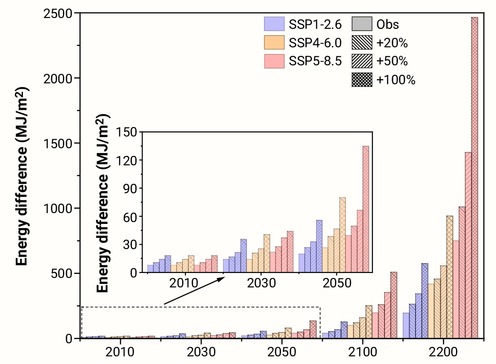
Figure 4.
Difference in energy absorption considering thaw subsidence and not considering thaw subsidence at the Wudaoliang site
-
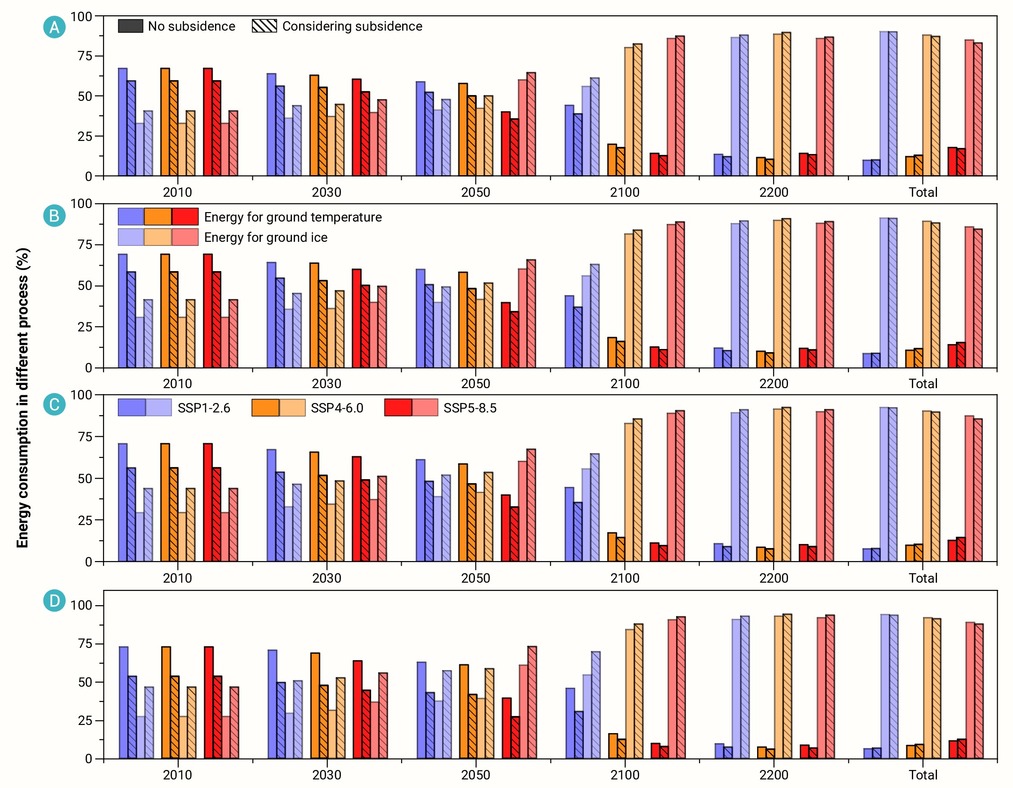
Figure 5.
Proportion of total energy going to increasing ground temperatures and melting ground ice in permafrost under different ground ice content conditions at the Wudaoliang site
-
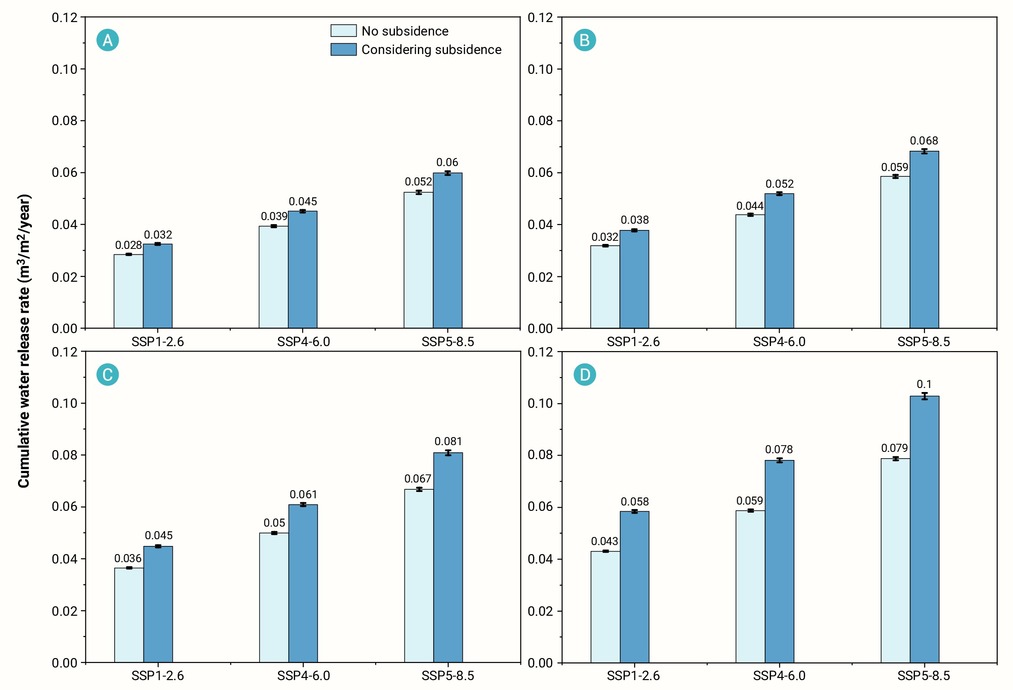
Figure 6.
Change in water release from ground ice melted under different climate scenarios at the Wudaoliang site
