
Accelerated nighttime light growth in China and its relationship with socioeconomic development
-

-
REFERENCES
[1] Jia M., Zeng H., Chen Z., et al. (2024). Nighttime light in China’s coastal zone: The type classification approach using SDGSAT-1 Glimmer Imager. Remote Sens. Environ. 305:114104. DOI:10.1016/j.rse.2024.114104 [2] Kyba C.C.M., Kuester T., Sánchez de Miguel A., et al. (2017). Artificially lit surface of Earth at night increasing in radiance and extent. Sci. Adv. 3:e1701528. DOI:10.1126/sciadv.1701528 [3] Li T., Wang Z., Kyba C.C.M., et al. (2026). Satellite imagery reveals increasing volatility in human night-time activity. Nature 652:379−386. DOI:10.1038/s41586-026-10260-w [4] Boyce P.R. (2019). The benefits of light at night. Build. Environ. 151:356−367. DOI:10.1016/j.buildenv.2019.01.020 [5] Zielinska-Dabkowska K.M., Schernhammer E.S., Hanifin J.P., et al. (2023). Reducing nighttime light exposure in the urban environment to benefit human health and society. Science 380:1130−1135. DOI:10.1126/science.adg5277 [6] Bai X. and Shi P. (2025). China’s urbanization at a turning point-challenges and opportunities. Science 388:eadw3443. DOI:10.1126/science.adw3443 [7] Wang C., Chen Z., Yang C., et al. (2020). Analyzing parcel-level relationships between Luojia 1-01 nighttime light intensity and artificial surface features across Shanghai, China: A comparison with NPP-VIIRS data. Int. J. Appl. Earth Obs. Geoinf. 85:101989. DOI:10.1016/j.jag.2019.101989 [8] Zeng H., Jia M., Ning X., et al. (2025). Quantitative characterization of global nighttime light: A method for measuring energy intensity based on radiant flux and SNPP-VIIRS data. Remote Sens. Environ. 318:114576. DOI:10.1016/j.rse.2024.114576 [9] Guo W., Zhao Y., Kyba C.C.M., et al. (2025). Using a deep learning method to establish 500 m resolution non-saturation nighttime light time series from 1992 to 2022. Int. J. Appl. Earth Obs. Geoinf. 143:104771. DOI:10.1016/j.jag.2025.104771 [10] Li X., Gong P., Zhou Y., et al. (2020). Mapping global urban boundaries from the global artificial impervious area (GAIA) data. Environ. Res. Lett. 15:094044. DOI:10.1088/1748-9326/ab9be3 -
ABOUT THIS ARTICLE
Cite this article:
Zeng H., Jia M., Guo W., et al. (2027). Accelerated nighttime light growth in China and its relationship with socioeconomic development. The Innovation Geoscience 5:100263. https://doi.org/10.59717/j.xinn-geo.2026.100263
Welcome!
To request copyright permission to republish or share portions of our works, please visit Copyright Clearance Center's (CCC) Marketplace website at marketplace.copyright.com.
Export File
Citation
Zeng H., Jia M., Guo W., et al. (2027). Accelerated nighttime light growth in China and its relationship with socioeconomic development. The Innovation Geoscience 5:100263. https://doi.org/10.59717/j.xinn-geo.2026.100263

Format
Content
 DownLoad:
-
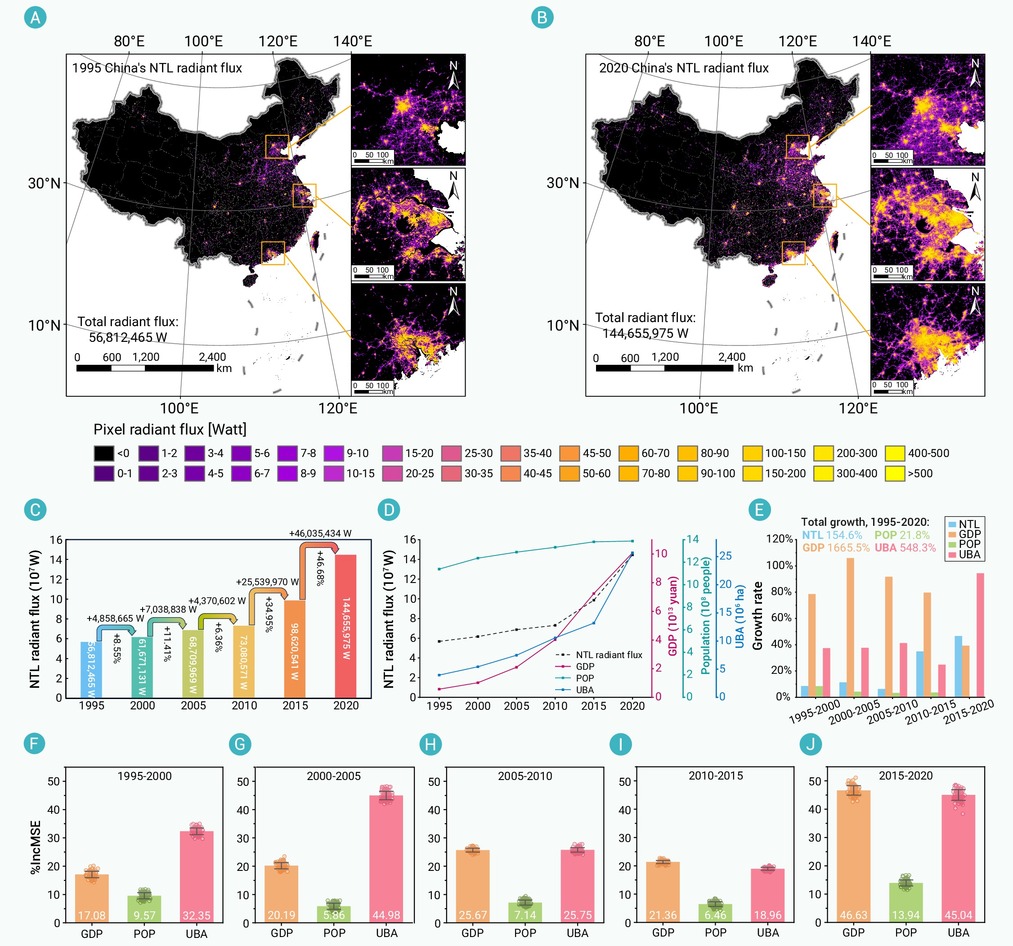
Figure 1.
Growth and influencing factors of nighttime light radiant flux in China, 1995-2020
