
Physics-informed representation learning for a digital-ocean twin: The AlphaOcean framework
-

-
REFERENCES
[1] Hoegh-Guldberg O., Northrop E. and Lubchenco J. (2019). The ocean is key to achieving climate and societal goals. Science 365:1372-1374. DOI:10.1126/science.aaz43 [2] Révelard A., Tintoré J., Verron J., et al. (2022). Ocean integration: The needs and challenges of effective coordination within the ocean observing system. Front. Mar. Sci. 8:737671. DOI:10.3389/fmars.2021.737671 [3] Brown C.F., Kazmierski M.R., Pasquarella V.J., et al. (2025). Alphaearth foundations: An embedding field model for accurate and efficient global mapping from sparse label data. arXiv preprint. DOI:10.48550/arXiv.2507.22291 [4] Tollefson J. (2025). Google AI model creates maps of Earth ‘at any place and time’. Nature 644:313. DOI: 10.1038/d41586-025-02412-1 -
ABOUT THIS ARTICLE
Cite this article:
Yan F., Fan R., Lyne V., et al. (2026). Physics-informed representation learning for a digital-ocean twin: The AlphaOcean framework. The Innovation Informatics 2:100031. https://doi.org/10.59717/j.xinn-inform.2026.100031
Welcome!
To request copyright permission to republish or share portions of our works, please visit Copyright Clearance Center's (CCC) Marketplace website at marketplace.copyright.com.
Export File
Citation
Yan F., Fan R., Lyne V., et al. (2026). Physics-informed representation learning for a digital-ocean twin: The AlphaOcean framework. The Innovation Informatics 2:100031. https://doi.org/10.59717/j.xinn-inform.2026.100031

Format
Content
 DownLoad:
-
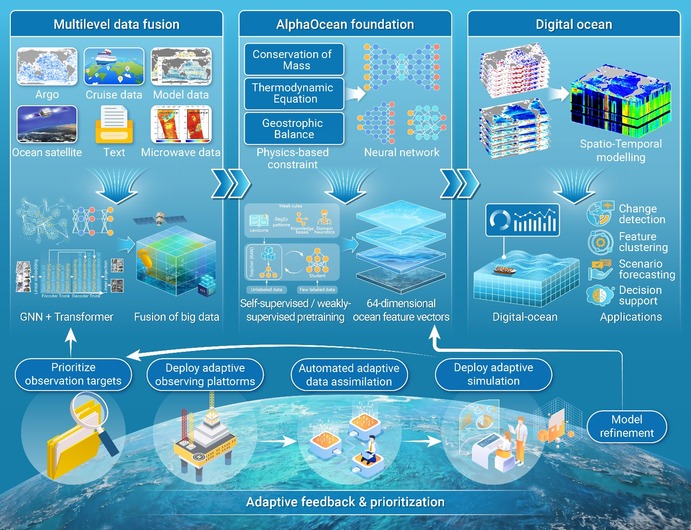
Figure 1.
AlphaOcean foundation framework for digital-ocean intelligence.
