
From language to world: Bridging LLMs and world models for intelligent surgery
-

-
REFERENCES
[1] Marcus H.J., Ramirez P.T., Khan D.Z., et al. (2024). The IDEAL framework for surgical robotics: Development, comparative evaluation and long-term monitoring. Nat. Med. 30:61−75. DOI:10.1038/s41591-023-02732-7 [2] Thirunavukarasu A.J., Ting D.S.J., Elangovan K., et al. (2023). Large language models in medicine. Nat. Med. 29:1930−1940. DOI:10.1038/s41591-023-02448-8 [3] Asciak L., Kyeremeh J., Luo X., et al. (2025). Digital twin assisted surgery, concept, opportunities, and challenges. NPJ Digit. Med. 8:32. DOI:10.1038/s41746-024-01413-0 [4] Ong C.S., Obey N.T., Zheng Y., et al. (2024). SurgeryLLM: A retrieval-augmented generation large language model framework for surgical decision support and workflow enhancement. NPJ Digit. Med. 7:364. DOI:10.1038/s41746-024-01391-3 [5] Mekki Y.M., Luijten G., Hagert E., et al. (2025). Digital twins for the era of personalized surgery. NPJ Digit. Med. 8:283. DOI:10.1038/s41746-025-01575-5 -
ABOUT THIS ARTICLE
Cite this article:
Liu Y., Song Y., Du Y., et al. (2026). From language to world: Bridging LLMs and world models for intelligent surgery. The Innovation Informatics 2:100040. https://doi.org/10.59717/j.xinn-inform.2026.100040
Welcome!
To request copyright permission to republish or share portions of our works, please visit Copyright Clearance Center's (CCC) Marketplace website at marketplace.copyright.com.
Export File
Citation
Liu Y., Song Y., Du Y., et al. (2026). From language to world: Bridging LLMs and world models for intelligent surgery. The Innovation Informatics 2:100040. https://doi.org/10.59717/j.xinn-inform.2026.100040

Format
Content
 DownLoad:
-
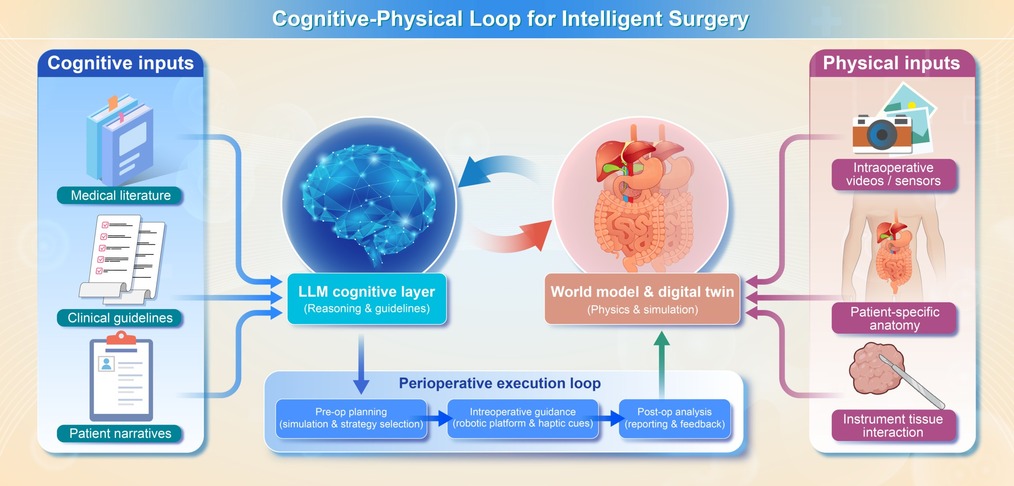
Figure 1.
The cognitive-physical loop for intelligent surgery.
