
Memory-dependent coevolution: A non-Markovian paradigm for behavior-disease dynamics
-

-
REFERENCES
[1] Lai C.C., Shih T.P., Ko W.C., et al. (2020). Severe acute respiratory syndrome coronavirus 2 (SARS-CoV-2) and coronavirus disease-2019 (COVID-19): The epidemic and the challenges. Int. J. Antimicrob. Agents 55:105924. DOI:10.1016/j.ijantimicag.2020.105924 [2] Horsevad N., Mateo D., Kooij R.E., et al. (2022). Transition from simple to complex contagion in collective decision-making. Nat. Commun. 13:1442. DOI:10.1038/s41467-022-28958-6 [3] Granell C., Gómez S. and Arenas A. (2013). Dynamical interplay between awareness and epidemic spreading in multiplex networks. Phys. Rev. Lett. 111:128701. DOI:10.1103/PhysRevLett.111.128701 [4] Feng M., Cai S.M., Tang M., et al. (2019). Equivalence and its invalidation between non-Markovian and Markovian spreading dynamics on complex networks. Nat. Commun. 10:3748. DOI:10.1038/s41467-019-11763-z [5] Reitenbach A., Sartori F., Banisch S., et al. (2025). Coupled infectious disease and behavior dynamics: A review of model assumptions. Rep. Prog. Phys. 88:016601. DOI:10.1088/1361-6633/ad90ef -
ABOUT THIS ARTICLE
Cite this article:
Wang F., Wei K., Zhang Z., et al. (2026). Memory-dependent coevolution: A non-Markovian paradigm for behavior-disease dynamics. The Innovation Informatics 2:100046. https://doi.org/10.59717/j.xinn-inform.2026.100046
Welcome!
To request copyright permission to republish or share portions of our works, please visit Copyright Clearance Center's (CCC) Marketplace website at marketplace.copyright.com.
Export File
Citation
Wang F., Wei K., Zhang Z., et al. (2026). Memory-dependent coevolution: A non-Markovian paradigm for behavior-disease dynamics. The Innovation Informatics 2:100046. https://doi.org/10.59717/j.xinn-inform.2026.100046

Format
Content
 DownLoad:
-
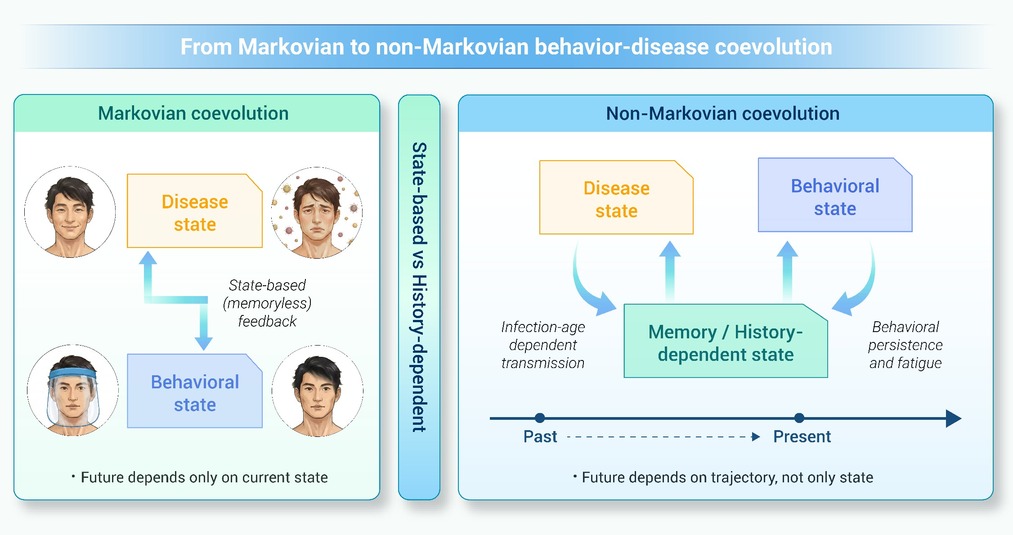
Figure 1.
Markovian vs non-Markovian behavior-disease coevolution
