
-

-
REFERENCES
[1] Tsoukalas G., Kovsharov A., Shirobokov S., et al. (2026). Advancing mathematics research with AI-driven formal proof search. Science 394:234−239. DOI:10.1126/science.aej2213 [2] Hattori S., Matsuzaki T. and Fujiwara M. (2025). Natural language translation of formal proofs through informalization of proof steps and recursive summarization along proof structure. In Proceedings of the 18th International Natural Language Generation Conference. 2025: 376-389. Association for Computational Linguistics. https://aclanthology.org/2025.inlg-main.23/ [3] Ayers E. (2021). A tool for producing verified, explainable proofs. [PhD thesis, University of Cambridge]. DOI:10.17863/CAM.81869 [4] Shin M., Kim J., van Opheusden B., et al. (2023). Superhuman artificial intelligence can improve human decision-making by increasing novelty. Proc. Natl. Acad. Sci. USA 120:e2214840120. DOI:10.1073/pnas.2214840120 -
ABOUT THIS ARTICLE
Cite this article:
Wang J. (2026). From AI formal proofs to reusable mathematical ideas. The Innovation Informatics 2:100077. https://doi.org/10.59717/j.xinn-inform.2026.100077
Welcome!
To request copyright permission to republish or share portions of our works, please visit Copyright Clearance Center's (CCC) Marketplace website at marketplace.copyright.com.
Export File
Citation
Wang J. (2026). From AI formal proofs to reusable mathematical ideas. The Innovation Informatics 2:100077. https://doi.org/10.59717/j.xinn-inform.2026.100077

Format
Content
 DownLoad:
-
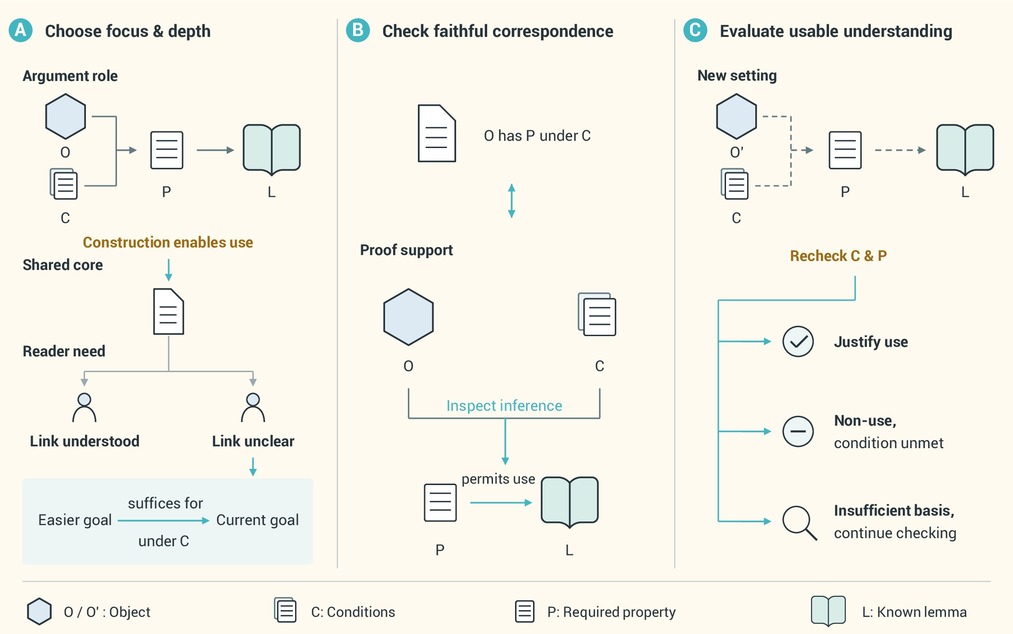
Figure 1.
Three tasks for explaining mathematical arguments
