
Fabrication strategies of porous nanohybrids based on electrospinning
-

-
REFERENCES
[1] Song W., Tang Y., Cheng Q., et al. (2023). Electrospinning spinneret: A bridge between the visible world and the invisible nanostructures. The Innovation 4:100381. DOI:10.1016/j.xinn.2023.100381 [2] Koo W. T., Jang J. S. and Kim I. D. (2019). Metal-organic frameworks for chemiresistive sensors. Chem 5:1938−1963. DOI:10.1016/j.chempr.2019.04.013 [3] Yang C., Wang K., Lyu W., et al. (2024). Nanofibrous porous organic polymers and their derivatives: from synthesis to applications. Adv. Sci. 11:2400626. DOI:10.1002/advs.202400626 [4] Ding C., Breunig M., Timm J., et al. (2021). Flexible, mechanically stable, porous self‐standing microfiber network membranes of covalent organic frameworks: Preparation method and characterization. Adv. Funct. Mater. 31:2106507. DOI:10.1002/adfm.202106507 [5] Chong L., Gao G., Wen J., et al. (2023). La-and Mn-doped cobalt spinel oxygen evolution catalyst for proton exchange membrane electrolysis. Science 380:609−616. DOI:10.1126/science.ade1499 -
ABOUT THIS ARTICLE
Cite this article:
Kang D., Wen Y., Wang Z., et al. (2025). Fabrication strategies of porous nanohybrids based on electrospinning. The Innovation Materials 3:100107. https://doi.org/10.59717/j.xinn-mater.2024.100107
Welcome!
To request copyright permission to republish or share portions of our works, please visit Copyright Clearance Center's (CCC) Marketplace website at marketplace.copyright.com.
Export File
Citation
Kang D., Wen Y., Wang Z., et al. (2025). Fabrication strategies of porous nanohybrids based on electrospinning. The Innovation Materials 3:100107. https://doi.org/10.59717/j.xinn-mater.2024.100107

Format
Content
 DownLoad:
-
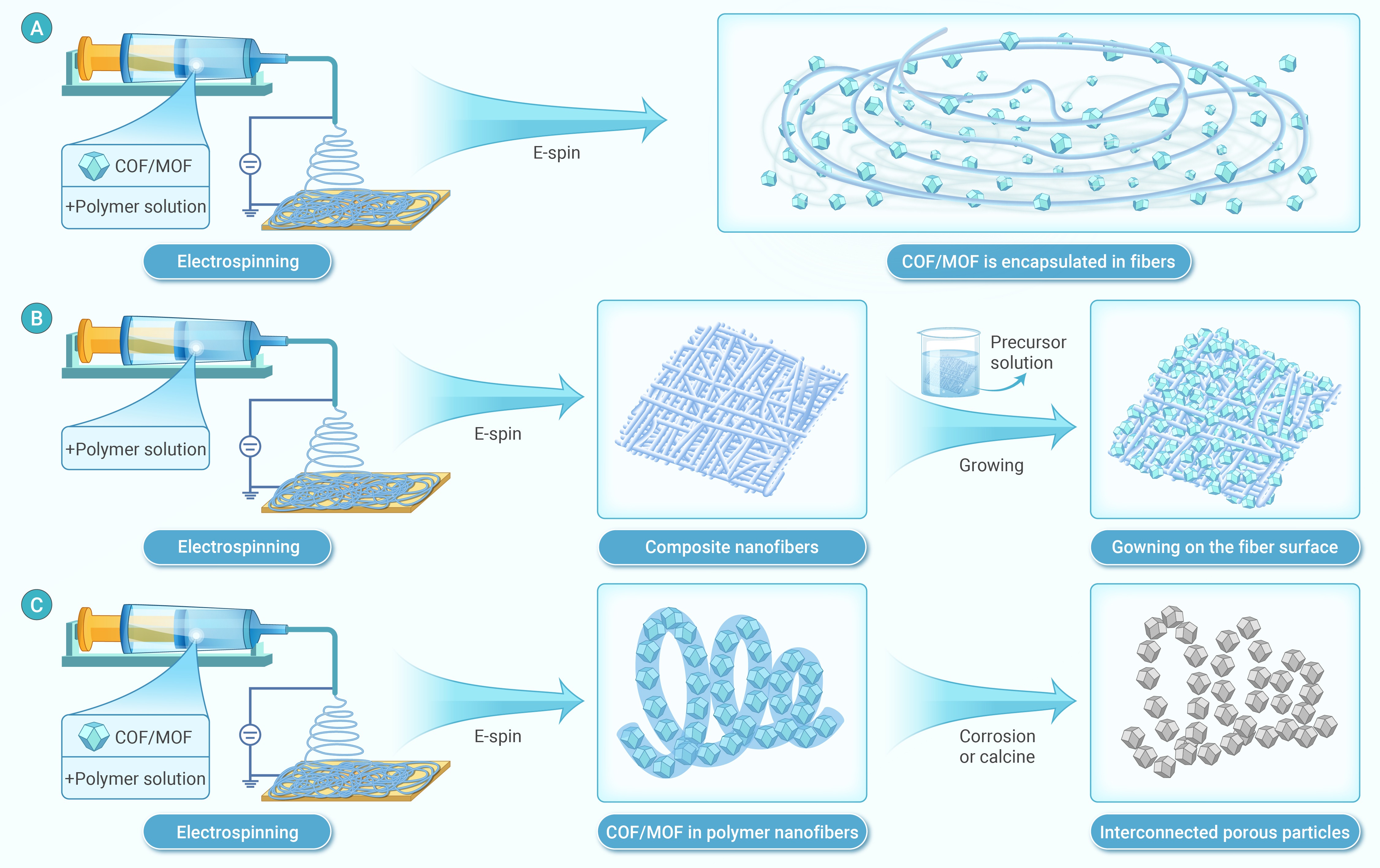
Figure 1.
The electrospinning methods for generating porous fibers
