
Deciphering intermediate excited states in spin-flip transition in carbonyl-nitrogen multi-resonance molecule
-
GRAPHICAL ABSTRACT

 DownLoad:
Full size image
DownLoad:
Full size image
-
PUBLIC SUMMARY
-
Deciphering the intermediate states involved in the spin-flip transition in a multi-resonance (MR) molecule.
The transitions among different electronic states of the MR molecule are slowed by C2h symmetry.
The MR molecule exhibits narrow spectrum with an outstanding external quantum efficiency of up to 32.6%.
-
-
ABSTRACT
Spin-flip process involving multiple excited states plays a key role for the function and application of many organic molecules. However, it remains extremely challenging to experimentally identify and investigate intermediate states in spin-flip transition due to its rapid inactivation via various electronic transitions. Herein, we report the deciphering of intermediate states involved in the spin-flip transition in a tailor-made carbonyl-nitrogen multi-resonance molecule (anti-DIQAO) designed with high symmetry. The transitions among different electronic states of anti-DIQAO are slowed by high molecular symmetry and distinguished using steady-state and transient spectroscopies. The second excited triplet (T2) state is identified as the intermediate state in the spin-flip transition, whose transition to higher energy levels and phosphorescence radiation are recorded. It is demonstrated that, in reverse intersystem crossing, intramolecular vibration drives the rate-dominant reverse internal conversion from the lowest excited triplet (T1) state to the T2 state, and thermal activation triggers transition from mixed T2 and T1 states to the lowest excited singlet (S1) state. Additionally, anti-DIQAO exhibits narrow-bandwidth electroluminescence with an outstanding external quantum efficiency of up to 32.6%. This research provides an effective molecular design to tune the populations of excited states, which is of high significance for exploring efficient luminescent materials. -

-
REFERENCES
[1] Uoyama H., Goushi K., Shizu K., et al. (2012). Highly efficient organic light-emitting diodes from delayed fluorescence. Nature 492:234. DOI:10.1038/nature11687 [2] Endo A., Sato K., Yoshimura K., et al. (2011). Efficient up-conversion of triplet excitons into a singlet state and its application for organic light emitting diodes. Appl. Phys. Lett. 98:083302. DOI:10.1063/1.3558906 [3] Koseki S., Gordon M. S., Schmidt M., et al. (1995). Main group effective nuclear charges for spin-orbit calculations. J. Phys. Chem. 99:12764. DOI:10.1021/j100034a013 [4] Aizawa N., Matsumoto A., Yasuda T. (2021). Thermal equilibration between singlet and triplet excited states in organic fluorophore for submicrosecond delayed fluorescence. Sci. Adv. 7:eabe5769. DOI:10.1126/sciadv.abe5769 [5] Wada Y., Nakagawa H., Matsumoto S., et al. (2020). Organic light emitters exhibiting very fast reverse intersystem crossing. Nat. Photon. 14:643. DOI:10.1038/s41566-020-0667-0 [6] Chen H., Zeng J., Wang J., et al. (2023). An efficient aggregation-enhanced delayed fluorescence luminogen created with spiro donors and carbonyl acceptor for applications as an emitter and sensitizer in high-performance organic light-emitting diodes. Aggregate 4:e244. DOI:10.1002/agt2.244 [7] El-Sayed M. (1963). A. Spin–orbit coupling and the radiationless processes in nitrogen heterocyclics. J. Chem. Phys. 38:2834. DOI:10.1063/1.1733610 [8] Lim B. T., Okajima S., Chandra A. K., et al. (1981). Radiationless transitions in electron donor-acceptor complexes: selection rules for S1→T intersystem crossing and efficiency of S1→S0 internal conversion. Chem. Phys. Lett. 79:22. DOI:10.1016/0009-2614(81)85280-3 [9] Wang Y., Ma Z., Pu J., et al. (2024). Multiple-resonance thermally activated delayed emitters through multiple peripheral modulation to enable efficient blue OLEDs at high doping levels. Aggregate 5:e585. DOI:10.1002/agt2.585 [10] Etherington M. K., Gibson J., Higginbotham H. F., et al. (2016). Revealing the spin–vibronic coupling mechanism of thermally activated delayed fluorescence. Nat. Commun. 7:13680. DOI:10.1038/ncomms13680 [11] Noda H., Chen X. K., Nakanotani H., et al. (2019). Critical role of intermediate electronic states for spin-flip processes in charge-transfer-type organic molecules with multiple donors and acceptors. Nat. Mater. 18:1084. DOI:10.1038/s41563-019-0465-6 [12] Penfold T. J., Gindensperger E., Daniel C., et al. (2018). Spin-vibronic mechanism for intersystem crossing. Chem. Rev. 118:6975. DOI:10.1021/acs.chemrev.7b00617 [13] Hu Y. X., Miao J., Hua T., et al. (2022). Efficient selenium-integrated TADF OLEDs with reduced roll-off. Nat. Photon. 16:803. DOI:10.1038/s41566-022-01083-y [14] Fan X., Wang K., Shi Y., et al. (2023). Ultrapure green organic light-emitting diodes based on highly distorted fused π-conjugated molecular design. Nat. Photon. 17:280. DOI:10.1038/s41566-022-01106-8 [15] Hatakeyama T., Shiren K., Nakajima K., et al. (2016). Ultrapure blue thermally activated delayed fluorescence molecules: efficient HOMO–LUMO separation by the multiple resonance effect. Adv. Mater. 28:2777. DOI:10.1002/adma.201505491 [16] Kondo Y., Yashiura K., Kitera S., et al. (2019). Narrowband deep-blue organic light-emitting diode featuring an organoboron-based emitter. Nat. Photon. 13:678. DOI:10.1038/s41566-019-0476-5 [17] Narsaria A. K., Rauch F., Krebs J., et al. (2020). Computationally guided molecular design to minimize the LE/CT gap in D-π-A fluorinated triarylboranes for efficient TADF via D and π-bridge tuning. Adv. Func. Mater. 30:2002064. DOI:10.1002/adfm.202002064 [18] Fu Y., Liu H., Tang B. Z., et al. (2023). Realizing efficient blue and deep-blue delayed fluorescence materials with record-beating electroluminescence efficiencies of 43.4%. Nat. Commun. 14:2019. DOI:10.1038/s41467-023-37687-3. [19] Waters M. D. J., Skov A. B., Larsen M. A. B., et al. (2019). Symmetry controlled excited state dynamics. Phys. Chem. Chem. Phys. 21:2283. DOI:10.1039/C8CP05950K [20] Jiang Q., Xu Y., Liang X., et al. (2019). Stable high-energy excited states observed in a conjugated molecule with hindered internal conversion processes. J. Phys. Chem. C 123:6190. DOI:10.1021/acs.jpcc.8b12544 [21] Jin J., Chen W., Tan J., et al. (2023). Photo-controllable luminescence from radicals leading to ratiometric emission switching via dynamic intermolecular coupling. Angew. Chem. Int. Ed. 62:e202214281. DOI:10.1002/anie.202214281 [22] Bu F., Duan R., Xie Y., et al. (2015). Unusual aggregation-induced emission of a coumarin derivative as a result of the restriction of an intramolecular twisting motion. Angew. Chem. Int. Ed. 54:14492. DOI:10.1002/anie.201506782 [23] Song Y., Zhang G. (2021). Effect of Fusion Manner of Concave Molecules on the Properties of Resulting Nanoboats. Org. Lett. 23:491. DOI:10.1021/acs.orglett.0c04008 [24] Yamamoto M., Tsujii Y., Tsuchida A. (1989). Near-infrared charge resonance band of intramolecular carbazole dimer radical cations studied by nanosecond laser photolysis. Chem. Phys. Lett. 154:559. DOI:10.1016/0009-2614(89)87152-0 [25] Kaafarani B. R., Risko C., El-Assaad T. H., et al. (2016). Mixedvalence cations of di(carbazol-9-yl) biphenyl, tetrahydropyrene, and pyrene derivatives. J. Phys. Chem. C 120:3156. DOI:10.1021/acs.jpcc.5b11061 [26] Pershin A., Hall D., Lemaur V., et al. (2019). Highly emissive excitons with reduced exchange energy in thermally activated delayed fluorescent molecules. Nat. Commun. 10:597. DOI:10.1038/s41467-019-08495-5 [27] Slipchenko L. V., Krylov A. I. (2003). Electronic structure of the trimethylenemethane diradical in its ground and electronically excited states: Bonding, equilibrium geometries, and vibrational frequencies. J. Chem. Phys. 118:6874. DOI:10.1063/1.1561052 [28] Chen J., Wu X., Liu H., et al. (2023). Towards efficient blue delayed-fluorescence molecules by modulating torsion angle between electron donor and acceptor. CCS Chem. 5:598. DOI:10.31635/ccschem.022.202202196 [29] Zhang D., Song X., Gillett A. J., et al. (2020). Efficient and stable deep-blue fluorescent organic light emitting diodes employing a sensitizer with fast triplet upconversion. Adv. Mater. 32:1908355. DOI:10.1002/adma.201908355 [30] Liu H., Fu Y., Chen J., et al. (2023). Energy-efficient stable hyperfluorescence organic light-emitting diodes with improved color purities and ultrahigh power efficiencies based on low-polar sensitizing systems. Adv. Mater. 35:2212237. DOI:10.1002/adma.202212237 [31] Wu S., Gupta A. K., Yoshida K., et al. (2022). Highly efficient green and red narrowband emissive organic light-emitting diodes employing multi-resonant thermally activated delayed fluorescence emitters. Angew. Chem. Int. Ed. 61:e202213697. DOI:10.1002/anie.202213697 [32] Yu Y., Zou S., Peng C., et al. (2022). Efficient narrowband electroluminescence based on a hetero-bichromophore thermally activated delayed fluorescence dyad. J. Mater. Chem. C 10:4941. DOI:10.1039/D1TC05711A [33] Yu Y.-J., Feng Z.-Q., Meng X.-Y., et al. (2023). Introducing spiro-locks into the nitrogen/carbonyl system towards efficient narrowband deep-blue multi-resonance TADF emitters. Angew. Chem. Int. Ed. 62:e202310047. DOI:10.1002/anie.202310047 [34] Xu J., Wang M., Chen J., et al. (2024). Efficient blue carbonyl-nitrogen multi-resonance molecules for high-performance hyperfluorescence OLEDs. Adv. Opt. Mater. 12:2400739. DOI:10.1002/adom.202400739 [35] Fu Y., Liu H., Yang D., et al. (2021). Boosting external quantum efficiency to 38.6% of sky-blue delayed fluorescence molecules by optimizing horizontal dipole orientation. Sci. Adv. 7:eabj2504. DOI:10.1126/sciadv.abj2504. [36] Xiang Y., Li P., Gong S., et al. (2020). Acceptor plane expansion enhances horizontal orientation of thermally activated delayed fluorescence emitters. Sci. Adv. 6:eaba7855. DOI:10.1126/sciadv.aba7855 -
ABOUT THIS ARTICLE
Cite this article:
Fu Y., Zhuang N., Liu H., et al. (2025). Deciphering intermediate excited states in spin-flip transition in carbonyl-nitrogen multi-resonance molecule. The Innovation Materials 3:100126. https://doi.org/10.59717/j.xinn-mater.2025.100126
Welcome!
To request copyright permission to republish or share portions of our works, please visit Copyright Clearance Center's (CCC) Marketplace website at marketplace.copyright.com.

Supplementary Information
-
download_supplementary
suppl_data
Article Metrics
Relative Articles
Cited by
Export File
Citation
Fu Y., Zhuang N., Liu H., et al. (2025). Deciphering intermediate excited states in spin-flip transition in carbonyl-nitrogen multi-resonance molecule. The Innovation Materials 3:100126. https://doi.org/10.59717/j.xinn-mater.2025.100126

Format
Content


-
Figure 1.
Two-dimensional vibrational space representation of potential energy surfaces when electronic states are
-
Figure 2.
Photophysical properties of the molecules
-
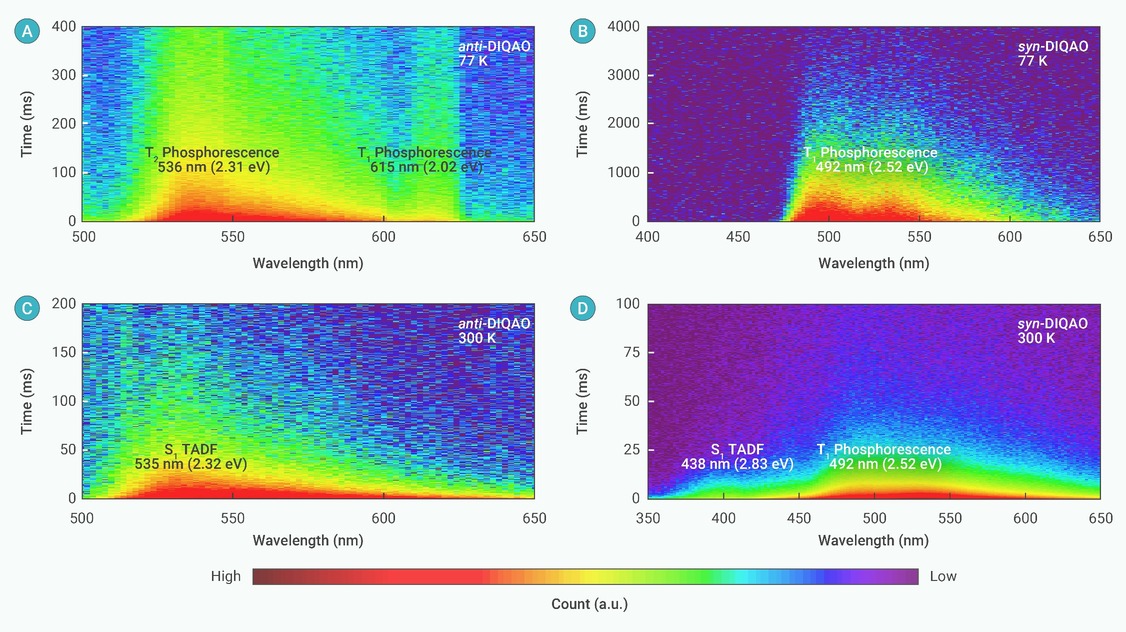
Figure 3.
Time-resolved emission spectra (TRES) of molecules
-
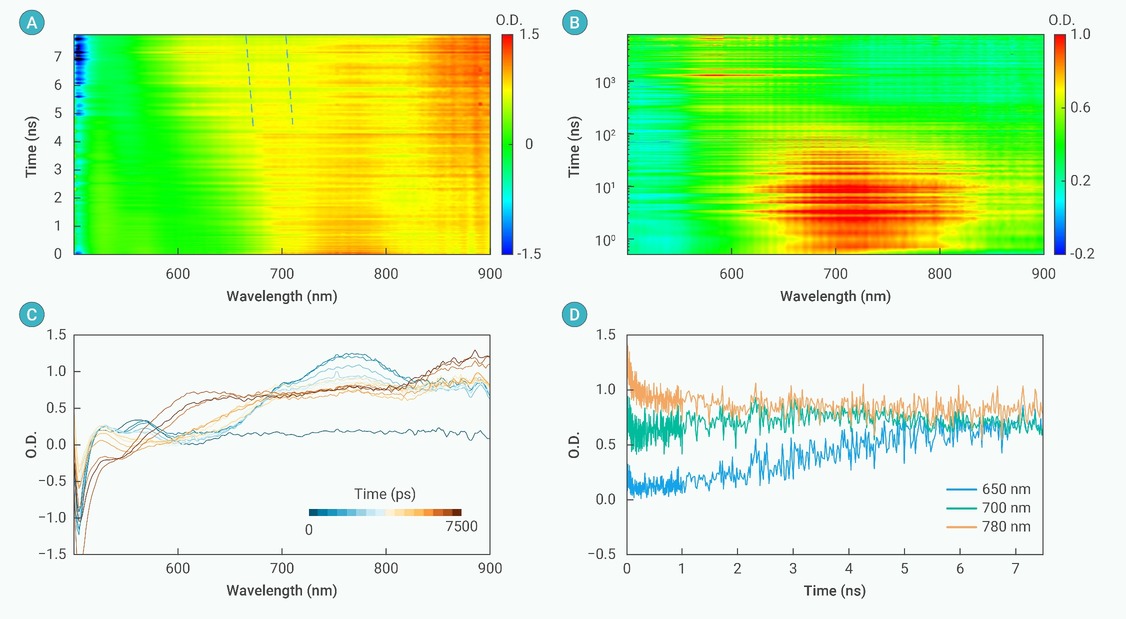
Figure 4.
The analysis of exciton dynamics
-
Figure 5.
Electroluminescence performance of the molecules in doped OLED
