
Hardness augmentation engineering of TiFe2 with doping design and single-crystal realization
-
GRAPHICAL ABSTRACT
 DownLoad:
Full size image
DownLoad:
Full size image
-
PUBLIC SUMMARY
-
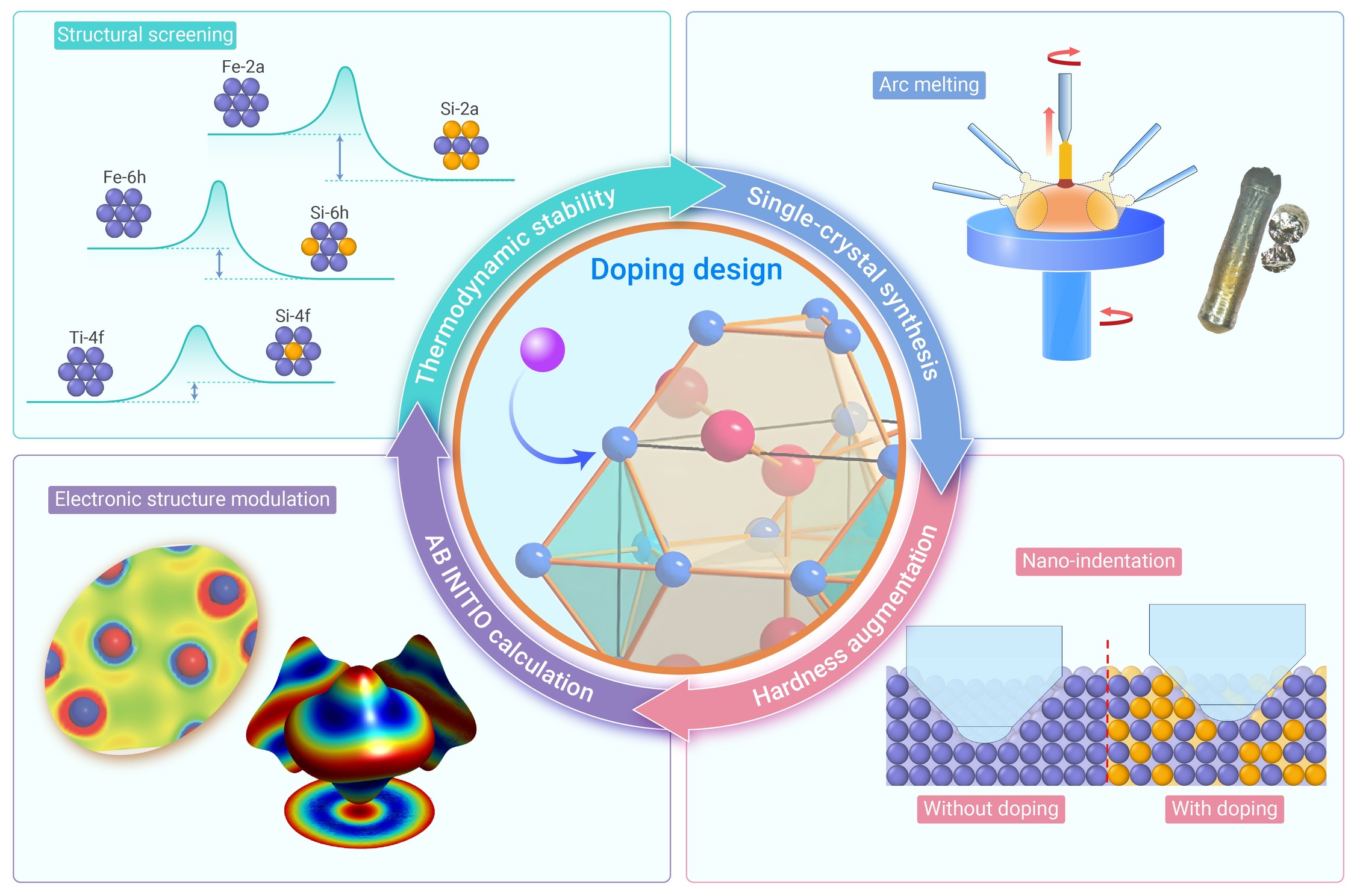
The strengthening effect of silicon on the mechanical properties of TiFe2 was demonstrated.
Single-crystal samples were successfully prepared, and their mechanical properties were measured.
The significant increase in hardness is attributed to the enhancement of interatomic covalent bonding.
-
-
ABSTRACT
As a critical reinforcing phase in high-entropy alloy matrix and coating materials, enhancing the hardness of TiFe2 significantly improves the upper limits of alloy performance through low-concentration doping. However, the mechanism by which doping alters macroscopic hardness through the disturbance of electronic structure remains unclear. Furthermore, there is a lack of robust experimental evidence to substantiate the hardness enhancements predicted by theoretical calculations. This investigation assessed the strengthening effect of silicon (Si) on the hardness of TiFe2 through both calculations and experiments. First-principles calculations indicated that Si alloying enhances the structural stability and hardness of TiFe2. The mechanisms underlying the notable increase in hardness due to Si were thoroughly investigated from the perspective of bonding characteristics. Si alloying disrupted the original symmetric electronic structure and increased the prevalence of directional covalent bonds. Successful single-crystal preparation experiments confirmed the stability of the doped structure. The results of nano-hardness testing address the deficiency of accurate experimental data on hardness enhancement. This study provides a systematic approach to improving the mechanical properties of TiFe2 and offers new insights into the development of advanced materials with enhanced hardness. -

-
REFERENCES
[1] Guo Y., Wang H. and Liu Q. (2020). Microstructure evolution and strengthening mechanism of laser-cladding MoFexCrTiWAlNb refractory high-entropy alloy coatings. J. Alloys Compd. 834:155147. DOI:10.1016/j.jallcom.2020.155147 [2] Moon, J., Jo, H. H., Park S. J., et al. (2021). Ti-bearing lightweight steel with large high temperature ductility via thermally stable multi-phase microstructure. Mater. Sci. Eng. A 808:140954. DOI:10.1016/j.msea.2021.140954 [3] Rabadia C. D., Liu Y. J., Chen L. Y., et al. (2019). Deformation and strength characteristics of Laves phases in titanium alloys. Mater. Design 179:107891. DOI:10.1016/j.matdes.2019.107891 [4] Wang H. M., Cao F., Cai L. X., et al. (2003). Microstructure and tribological properties of laser clad Ti2Ni3Si/NiTi intermetallic coatings. Acta Mater. 51:9. DOI:10.1016/s1359-6454(03)00465-8 [5] Xiang K., Chen L. Y., Chai L., et al. (2020). Microstructural characteristics and properties of CoCrFeNiNbx high-entropy alloy coatings on pure titanium substrate by pulsed laser cladding. Appl. Surf. Sci. 517:146214. DOI:10.1016/j.apsusc.2020.146214 [6] Wang D., van der Wee E. B., Daniele Z., et al. (2021). Quantitative 3D real-space analysis of Laves phase supraparticles. Nat. Commun. 12:3980. DOI:10.1038/s41467-021-24227-0 [7] Wang D., Tonnishtha D., van der Wee E. B., et al. (2021). Binary icosahedral clusters of hard spheres in spherical confinement. Nat. Phys. 17:128−134. DOI:10.1038/s41567-020-1003-9 [8] Hynninen A. P., Thijssen J. H. J., Vermolen E. C. M., et al. (2007). Self-assembly route for photonic crystals with a bandgap in the visible region. Nat. Mater. 6:202−205. DOI:10.1038/nmat1841 [9] Shevchenko E. V., Talapin D. V., Kotov N. A., et al. (2006). Structural diversity in binary nanoparticle superlattices. Nature 439:55−59. DOI:10.1038/nature04414 [10] Edalati P., Floriano R., Mohammadi A., et al. (2020). Reversible room temperature hydrogen storage in high-entropy alloy TiZrCrMnFeNi. Scr. Mater. 178:387−390. DOI:10.1016/j.scriptamat.2019.12.009 [11] Wan C., Jiang X., Yin X., et al. (2020). High-capacity Zr-based AB2-type alloys as metal hydride battery anodes. J. Alloys Compd. 828:154402. DOI:10.1016/j.jallcom.2020.154402 [12] Wijayanti I. D., Denys R., Suwarno et al. (2020). Hydrides of Laves type Ti-Zr alloys with enhanced H storage capacity as advanced metal hydride battery anodes. J. Alloys Compd. 828:154354. DOI:10.1016/j.jallcom.2020.154354 [13] Zhu Y. Y., Yang X. S., Xu Z. L., et al. (2024). Development of AB2-type TiZrCrMnFeCoV intermetallic high-entropy alloy for reversible room-temperature hydrogen storage. J. Energy Storage 75:109553. DOI:10.1016/j.est.2023.109553 [14] Tang X., Sepehri Amin H., Terada N., et al. (2022). Magnetic refrigeration material operating at a full temperature range required for hydrogen liquefaction. Nat. Commun. 13:1817. DOI:10.1038/s41467-022-29340-2 [15] Wakefield J. P., Kang M., Neves P. M., et al. (2023). Three-dimensional flat bands in pyrochlore metal CaNi2. Nature 623:301−306. DOI:10.1038/s41586-023-06640-1 [16] Enz C. P. and Matthias B. T. (1978). P-State Pairing and the Ferromagnetism of ZrZn2. Science 201:828−829. DOI:10.1126/science.201.4358.828 [17] Jiang K., Liu R., Chen K. et al. (2013). Microstructure and tribological properties of solution-treated Tribaloy alloy. Wear 307:22−27. DOI:10.1016/j.wear.2013.08.018 [18] Ramkumar K. R., Nagini M., Ravi R., et al. (2023). High-temperature wear behavior of Tribaloy 400 deposited 17-4 PH stainless steel using spark plasma sintering. Surf. Coat. Tech. 463:129528. DOI:10.1016/j.surfcoat.2023.129528 [19] Renz A., Prakash B., Hardell J., et al. (2018). High-temperature sliding wear behaviour of Stellite®12 and Tribaloy®T400. Wear 402-403:148−159. DOI:10.1016/j.wear.2018.02.013 [20] Pennell S. M., Chappuis B., Carpenter J. A., et al. (2023). Hierarchically porous Iron alloys with high sintering resistance during cyclic steam oxidation and hydrogen reduction. Adv. Funct. Mater. 33:2307470. DOI:10.1002/adfm.202307470 [21] Chen S., Aitken Z. H., Pattamatta S., et al. (2021). Simultaneously enhancing the ultimate strength and ductility of high-entropy alloys via short-range ordering. Nat. Commun. 12:4953. DOI:10.1038/s41467-021-25264-5 [22] Lee S. I., Ha T., Lee Y. S., et al. (2021). EBSD microstructural analysis of AB-type TiFe hydrogen storage alloys. Mater. Charact. 178:111276. DOI:10.1016/j.matchar.2021.111276 [23] Ma E. and Wu X. (2019). Tailoring heterogeneities in high-entropy alloys to promote strength-ductility synergy. Nat. Commun. 10:5623. DOI:10.1038/s41467-019-13311-1 [24] Ye X. C., Wang T., Xu Z. Y., et al. (2020). Effect of Ti content on microstructure and mechanical properties of CuCoFeNi high-entropy alloys. Int. J. Min. Met. Mater. 27:1326−1331. DOI:10.1007/s12613-020-2024-1 [25] Cui P., Ma Y. M., Zhang L. J., et al. (2018). Effect of Ti on microstructures and mechanical properties of high entropy alloys based on CoFeMnNi system. Mater. Sci. Eng. A 737:198−204. DOI:10.1016/j.msea.2018.09.050 [26] Liang H., Gao B. Y., Li Y. N., et al. Microstructures and wear resistance of Al1.5CrFeNiTi0.5 and Al1.5CrFeNiTi0.5W0.5 high entropy alloy coatings manufactured by laser cladding. Mater. Sci. Forum 956:154-159 (2019). DOI:10.4028/www.scientific.net/MSF.956.154. [27] Wang H. B., Liu Q. B., Guo Y. X., et al. (2019). MoFe1.5CrTiWAlNbx refractory high-entropy alloy coating fabricated by laser cladding. Intermetallics 115:106613. DOI:10.1016/j.intermet.2019.106613. [28] Hall E. O. (1954). Variation of Hardness of Metals with Grain Size. Nature 173:948−949. DOI:10.1038/173948b0 [29] Li K., Wang X., Zhang F., et al. (2008). Electronegativity identification of novel superhard materials. Phys. Rev. Lett. 100:235504. DOI:10.1103/PhysRevLett.100.235504 [30] Sun G., Feng X., Wu X., et al. (2022). Is hardness constant in covalent materials. J. Mater. Sci. Tech. 114:215−221. DOI:10.1016/j.jmst.2021.10.032 [31] Li Z. H., Wang Y. J., Ma M. D., et al. (2023). Ultrastrong conductive in situ composite composed of nanodiamond incoherently embedded in disordered multilayer graphene. Nat. Mater. 22:42−49. DOI:10.1038/s41563-022-01425-9 [32] Qiu K. L., Hou J. P., Chen S., et al. (2023). Self-healing of fractured diamond. Nat. Mater. 22:1317. DOI:10.1038/s41563-023-01656-4 [33] Kim S. H., Kim H. and Kim N. J. (2015). Brittle intermetallic compound makes ultrastrong low-density steel with large ductility. Nature 518:77−79. DOI:10.1038/nature14144 [34] Liang J. S., Wan Y. Y., Lv H. F., et al. (2024). Metal bond strength regulation enables large-scale synthesis of intermetallic nanocrystals for practical fuel cells. Nat. Mater. 23:1259. DOI:10.1038/s41563-024-01901-4 [35] Wei H. T., DeSantis D., Wei W., et al. (2017). Dopant compensation in alloyed CH3NH3PbBr3-xClx perovskite single crystals for gamma-ray spectroscopy. Nat. Mater. 16:826−833. DOI:10.1038/nmat4927 [36] Niu W. Z., Feng J., Chen J. F., et al. (2024) High-efficiency C3 electrosynthesis on a lattice-strain-stabilized nitrogen-doped Cu surface. Nat. Commun. 15:7070. DOI:10.1038/s41467-024-51478-4. [37] Szlawska M. and Kaczorowski D. (2013). Single-crystal growth of f-electron intermetallics in a tetra-arc czochralski furnace. Acta Phys. Pol. A 124:336−339. DOI:10.12693/APhysPolA.124.336 [38] Kresse G. and Furthmüller J. (1996). Efficient iterative schemes for ab initio total-energy calculations using a plane-wave basis set. Phys. Rev. B 54:18. DOI:10.1016/0927-0256(96)00008-0 [39] Perdew J. P., Burke K., Ernzerhof M. (1996). Generalized gradient approximation made simple. Phys. Rev. Lett. 77:4. DOI:10.1103/PhysRevLett.77.3865 [40] Perdew J. P., Chevary J. A., Vosko S. H., et al. (1992). Atoms, molecules, solids, and surfaces: Applications of the generalized gradient approximation for exchange and correlation. Phys. Rev. B Condens Matter. 46:6671−6687. DOI:10.1103/physrevb.46.6671 [41] Hill R. (1952). The elastic behaviour of a crystalline aggregate. Proc. Phys. Soc. A 65:6. DOI:10.1088/0370-1298/65/5/307 [42] Pelloth J., Brand R. A., Keun W. (1995). Local magnetic properties of the Fe2Ti Laves phase. J. Magn. Magn. Mater. 140:59−60. DOI:10.1016/0304-8853(94)00836-1 [43] Wertheim G. K., Wernick J. H. and Sherwood R. C. (1970). Model for the Composition-Dependent Ferromagnetic to Antiferromagnetic Transition in Fe2Ti. J. Appl. Phys. 41:1325−1326. DOI:10.1063/1.1658924 [44] Tian Y. F., Zhang P. Y., Zhang W., et al. (2024). Iron alloys of volatile elements in the deep Earth’s interior. Nat. Commun. 15:3320. DOI:10.1038/s41467-024-47663-0 [45] Friedrich R., Usanmaz D., Oses C., et al. (2019). Coordination corrected ab initio formation enthalpies. npj Comput. Mater. 5:59. DOI:10.1038/s41524-019-0192-1 [46] Nong Z. S., Cui P. C., Zhu J. C., et al. (2013). A first-principles study on the structural, elastic and electronic properties of the C14 Laves phase compounds TiX2 (X=Cr, Mn, Fe). Phys. B 419:11−18. DOI:10.1007/s11771-017-3560-3 [47] Gong X. G., Cui C., Yu Q., et al. (2020). First-principles study of phase stability and temperature-dependent mechanical properties of (Cr, M)23C6 (M = Fe, Mo) phases. J. Alloys Compd. 824:153948. DOI:10.1016/j.jallcom.2020.153948 [48] Lv Z. Q., Wang B., Sun S. H., et al. (2015). Effect of atomic sites on electronic and mechanical properties of (Fe, Mo)6C carbides. J. Alloys Compd. 649:1089−1093. DOI:10.1016/j.jallcom.2015.06.249 [49] Gusev V. V., Adamson D., Deligkas A., et al. (2023). Optimality guarantees for crystal structure prediction. Nature 619:68−72. DOI:10.1038/s41586-023-06071-y [50] Otero-de-la-Roza A., Abbasi-Pérez D. and Luaña V. (2011). Gibbs2: A new version of the quasiharmonic model code. II. Models for solid-state thermodynamics, features and implementation. Comput. Phys. Commun. 182:2232−2248. DOI:10.1016/j.cpc.2011.05.009 [51] Chong X., Hu M. Y., Wu P., et al. (2019). Tailoring the anisotropic mechanical properties of hexagonal M7X3 (M=Fe, Cr, W, Mo; X=C, B) by multialloying. Acta Mater. 169:193−208. DOI:10.1016/j.actamat.2019.03.015 [52] Parvinian S., Sievers D. E., Garmestani H., et al. (2021). Evaluation of the influence of B and Nb microalloying on the microstructure and strength of 18% Ni maraging steels (C350) using hardness, spherical indentation and tensile tests. Acta Mater. 215:117071. DOI:10.1016/j.actamat.2021.117071 [53] Senkov O. N., Rao S., Chaput K. J., et al. (2018). Compositional effect on microstructure and properties of NbTiZr-based complex concentrated alloys. Acta Mater. 151:201−215. DOI:10.1016/j.actamat.2018.03.065 [54] Li Y. F., Gao Y. M., Xiao B., et al. (2010). Theoretical study on the stability, elasticity, hardness and electronic structures of W-C binary compounds. J. Alloys Compd. 502:28−37. DOI:10.1016/j.jallcom.2010.04.184 [55] Li Y. Y., Duan Y. H., Peng M. J., et al. (2023). Structural, elastic, and thermal properties of TM5Si3C (TM = Ti, Cr, Y) carbides from first-principles calculations. Vacuum 218:112616. DOI:10.1016/j.vacuum.2023.112616 [56] Li P., Ma L. S., Peng M. J., et al. (2018). Elastic anisotropies and thermal conductivities of WB2 diborides in different crystal structures: A first-principles calculation. J. Alloys Compd. 747:905−915. DOI:10.1016/j.jallcom.2018.03.109 [57] Jian Y. X., Huang Z. F., Xing J. D., et al. (2019). Phase stability, mechanical properties and electronic structures of Ti-Al binary compounds by first principles calculations. Mater. Chem. Phys. 221:311−321. DOI:10.1016/j.matchemphys.2018.09.055 [58] Ji J. S., Bu H. Y., Duan Y. H., et al. (2023). Electronic, elastic and thermal properties of hexagonal TM5Si3N investigated by first-principles calculations. Vacuum 214:112232. DOI:10.1016/j.vacuum.2023.112232 [59] Bai H. X., Duan Y. H., Qi H. R., et al. (2024). Anisotropic elastic and thermal properties and damage tolerance of CrH: A first-principles calculation. Vacuum 222:112962. DOI:10.1016/j.vacuum.2024.112962 [60] Sun Y., Yang A. C., Duan Y. H., et al. (2022). Electronic, elastic, and thermal properties, fracture toughness, and damage tolerance of TM5Si3B (TM = V and Nb) MAB phases. Int. J. Refract. Met. Hard Mater. 103:105781. DOI:10.1016/j.ijrmhm.2022.105781 [61] Wu Y., Ma L. S., Zhou X. L., et al. (2022). Insights to electronic structures, elastic properties, fracture toughness, and thermal properties of M23C6 carbides. Int. J. Refract. Met. Hard Mater. 109:105985. DOI:10.1016/j.ijrmhm.2022.105985 [62] Yang A. C., Duan Y. H., Li C. J., et al. (2022). Theoretical explorations of structure, mechanical properties, fracture toughness, electronic properties, and thermal conductivity of Ag-doped η΄-Cu6Sn5. Intermetallics 141:107437. DOI:10.1016/j.intermet.2021.107437 [63] Simunek A. and Vackar J. (2006). Hardness of covalent and ionic crystals: first-principle calculations. Phys. Rev. Lett. 96:085501. DOI:10.1103/PhysRevLett.96.085501 [64] Vecchio K., Curtarolo S., Kaufmann K. et al. (2024). Fermi energy engineering of enhanced plasticity in high-entropy carbides. Acta Mater. 276:120117. DOI:10.1016/j.actamat.2024.120117 [65] Hu H., Wu X. Z., Wang R., et al. (2016). Phase stability, mechanical properties and electronic structure of TiAl alloying with W, Mo, Sc and Yb: First-principles study. J. Alloys Compd. 658:689−696. DOI:10.1016/j.jallcom.2015.10.270 [66] Mao Q. Q., Mu X., Deng K., et al. (2023). Multisite synergism-induced electron regulation of high-entropy alloy metallene for boosting alkaline hydrogen evolution reaction. Adv. Funct. Mater. 33:2304963. DOI:10.1002/adfm.202304963 -
ABOUT THIS ARTICLE
Cite this article:
Tan X., Liu H., Hou T., et al. (2025). Hardness augmentation engineering of TiFe2 with doping design and single-crystal realization. The Innovation Materials 3:100140. https://doi.org/10.59717/j.xinn-mater.2025.100140
Welcome!
To request copyright permission to republish or share portions of our works, please visit Copyright Clearance Center's (CCC) Marketplace website at marketplace.copyright.com.

Article Metrics
Relative Articles
Cited by
Export File
Citation
Tan X., Liu H., Hou T., et al. (2025). Hardness augmentation engineering of TiFe2 with doping design and single-crystal realization. The Innovation Materials 3:100140. https://doi.org/10.59717/j.xinn-mater.2025.100140

Format
Content


-
Figure 1.
Calculated crystal structure and thermodynamic stability of the TiFe2
-
Figure 2.
Schematic illustration of single crystal preparation process
-
Figure 3.
Structural and compositional characterization
-
Figure 4.
Mechanical properties of TiFe2 and Si-doped TiFe2
-
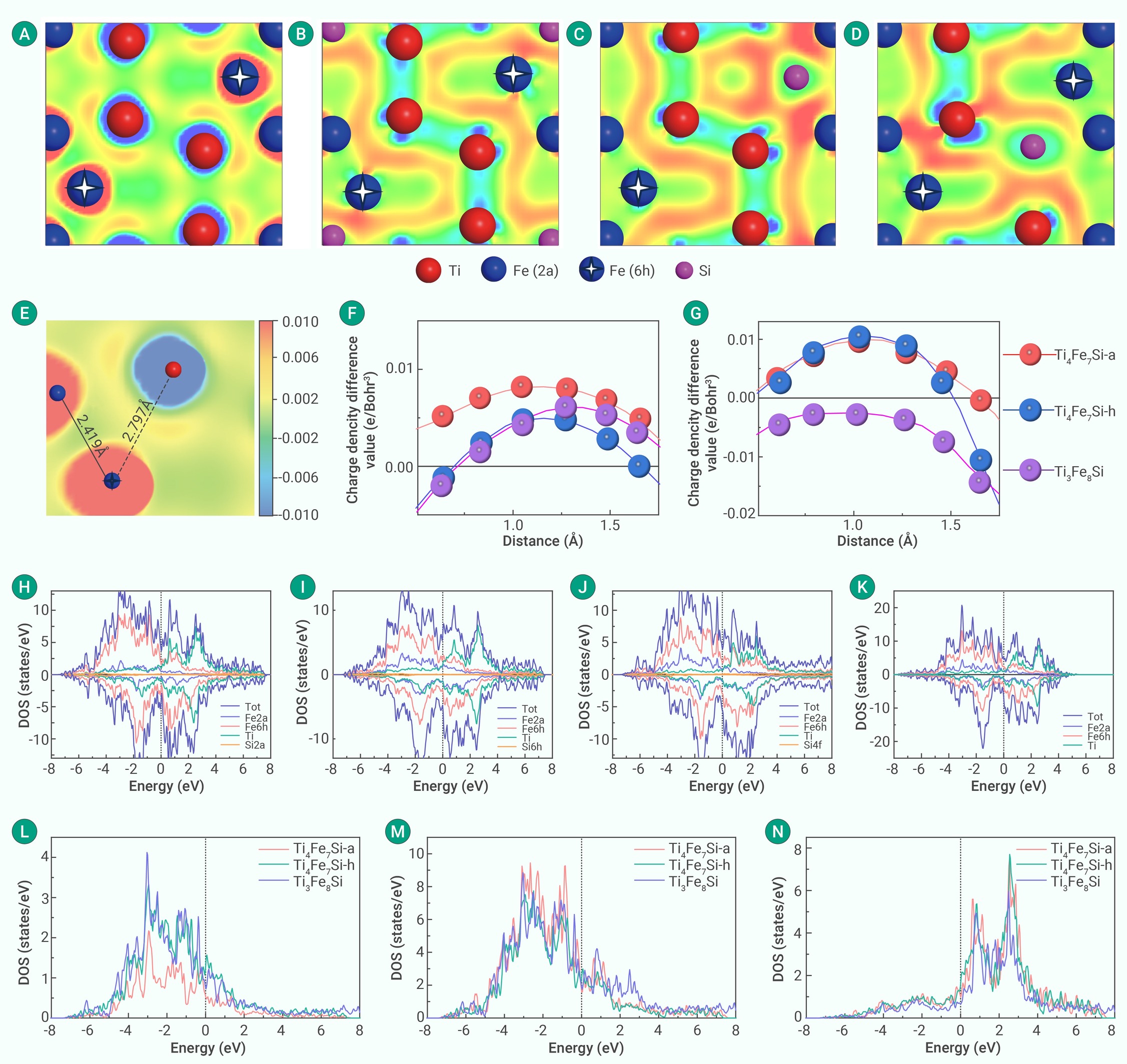
Figure 5.
Electron density difference maps
