
Design achieving flexibility in ceramics through organic-inorganic hybrids and interfacial bond switching
-

-
REFERENCES
[1] Fang W., Mu Z., He Y., et al. (2023). Organic–inorganic covalent–ionic molecules for elastic ceramic plastic. Nature 619:293−299. DOI:10.1038/s41586-023-06117-1 [2] Zhang J., Liu G., Cui W., et al. (2022). Plastic deformation in silicon nitride ceramics via bond switching at coherent interfaces. Science 378:371−376. DOI:10.1126/science.abq7490 [3] Wu X. and Mori T. (2025). Sub-lattice amorphization as a new driver of room temperature plasticity in inorganic semiconductors. The Innovation 6:100891. DOI:10.1016/j.xinn.2025.100891 [4] Hao Y. (2024). The dawn of ultralong flexible semiconductor fibers. The Innovation 5:100613. DOI:10.1016/j.xinn.2024.100613 -
ABOUT THIS ARTICLE
Cite this article:
Xie B. and Zhao M. (2025). Design achieving flexibility in ceramics through organic-inorganic hybrids and interfacial bond switching. The Innovation Materials 3:100167. https://doi.org/10.59717/j.xinn-mater.2025.100167
Welcome!
To request copyright permission to republish or share portions of our works, please visit Copyright Clearance Center's (CCC) Marketplace website at marketplace.copyright.com.
Export File
Citation
Xie B. and Zhao M. (2025). Design achieving flexibility in ceramics through organic-inorganic hybrids and interfacial bond switching. The Innovation Materials 3:100167. https://doi.org/10.59717/j.xinn-mater.2025.100167

Format
Content
 DownLoad:
-
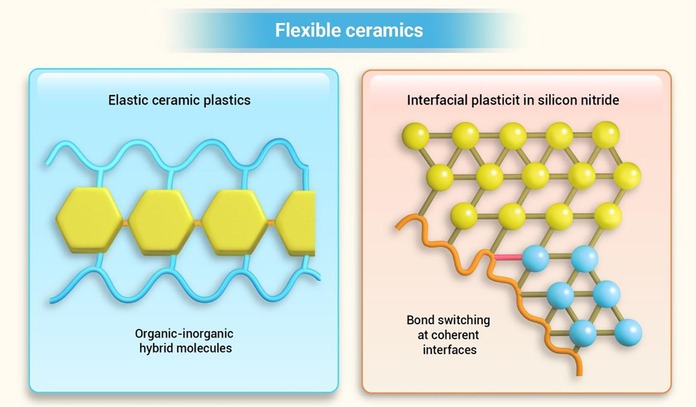
Figure 1.
Comparison of two major approaches toward achieving flexibility in ceramics.
