
Inclusion of BiTEs as consolidation for MRD-negative ALL: Where are we now and where can we go?
-

-
REFERENCES
[1] Litzow M.R., Sun Z., Mattison R.J., et al. (2024). Blinatumomab for MRD-negative acute Lymphoblastic Leukemia in adults. N. Engl. J. Med. 391:320−333. DOI:10.1056/NEJMoa2312948 [2] Aldoss I., Song J., Stiller T., et al. (2017). Correlates of resistance and relapse during blinatumomab therapy for relapsed/refractory acute lymphoblastic leukemia. Am. J. Hematol. 92:858−865. DOI:10.1002/ajh.24783 [3] Feucht J., Kayser S., Gorodezki D., et al. (2016). T-cell responses against CD19+ pediatric acute lymphoblastic leukemia mediated by bispecific T-cell engager (BiTE) are regulated contrarily by PD-L1 and CD80/CD86 on leukemic blasts. Oncotarget 7:76902−76919. DOI:10.18632/oncotarget.12357 [4] Foà R., Bassan R., Vitale A., et al. (2020). Dasatinib-blinatumomab for ph-positive acute lymphoblastic leukemia in adults. N. Engl. J. Med. 383:1613−1623. DOI:10.1056/NEJMoa2016272 [5] Zhang M., Hu Y., Wei G., et al. (2023). Dasatinib and CAR-T Cell therapy for newly diagnosed ph-positive acute lymphoblastic leukemia in adults. Blood 142:891. DOI:10.1182/blood-2023-186225 -
ABOUT THIS ARTICLE
Cite this article:
Zhang S., Wang Y., Xu X., et al. (2025). Inclusion of BiTEs as consolidation for MRD-negative ALL: Where are we now and where can we go? The Innovation Medicine 3:100129. https://doi.org/10.59717/j.xinn-med.2025.100129
Welcome!
To request copyright permission to republish or share portions of our works, please visit Copyright Clearance Center's (CCC) Marketplace website at marketplace.copyright.com.
Export File
Citation
Zhang S., Wang Y., Xu X., et al. (2025). Inclusion of BiTEs as consolidation for MRD-negative ALL: Where are we now and where can we go? The Innovation Medicine 3:100129. https://doi.org/10.59717/j.xinn-med.2025.100129

Format
Content
 DownLoad:
-
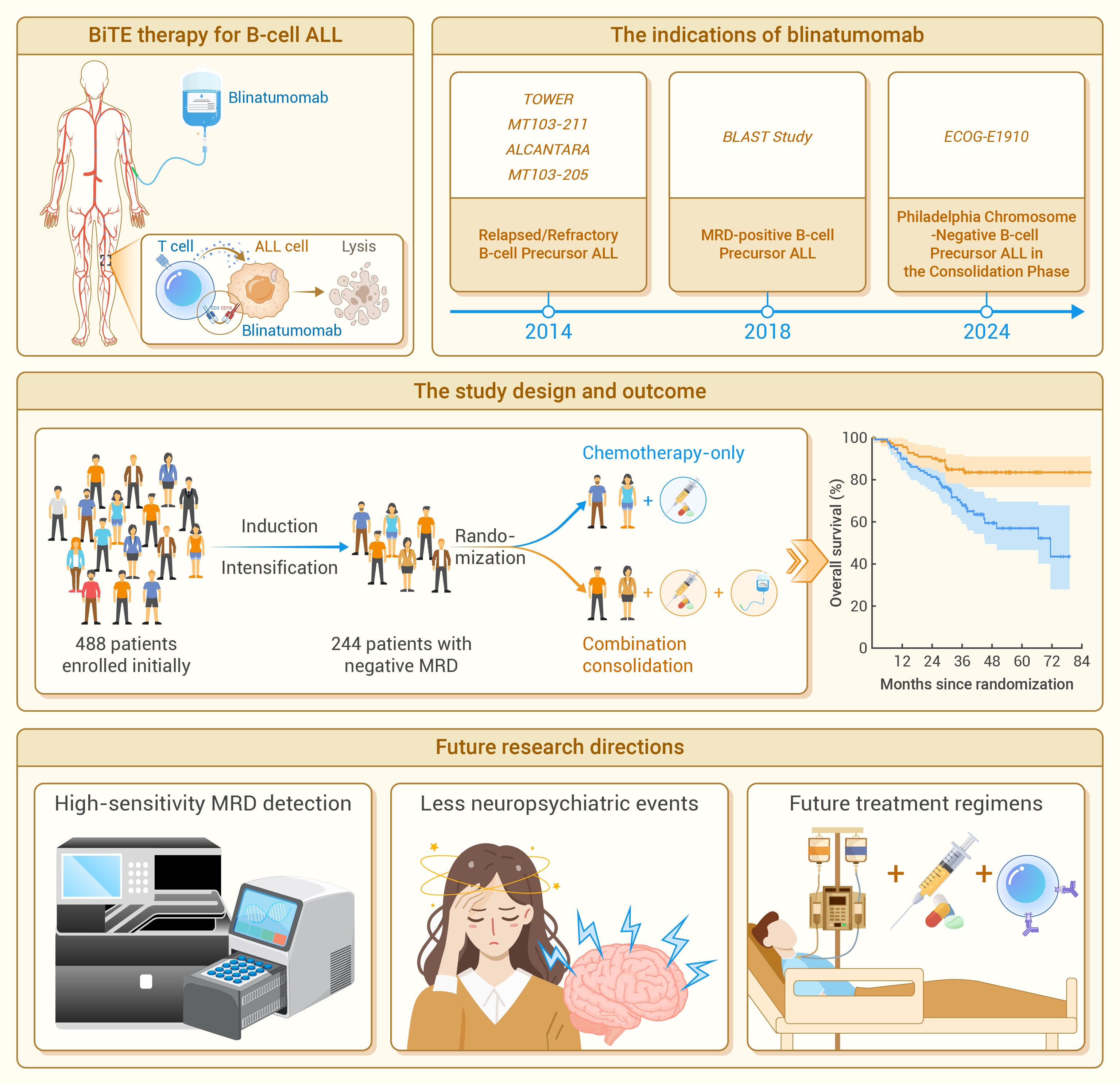
Figure 1.
The development of BiTE treatment for ALL
