
Association of Xuebijing use with 28-day mortality in sepsis: An external validation study using real-world ICU data
-
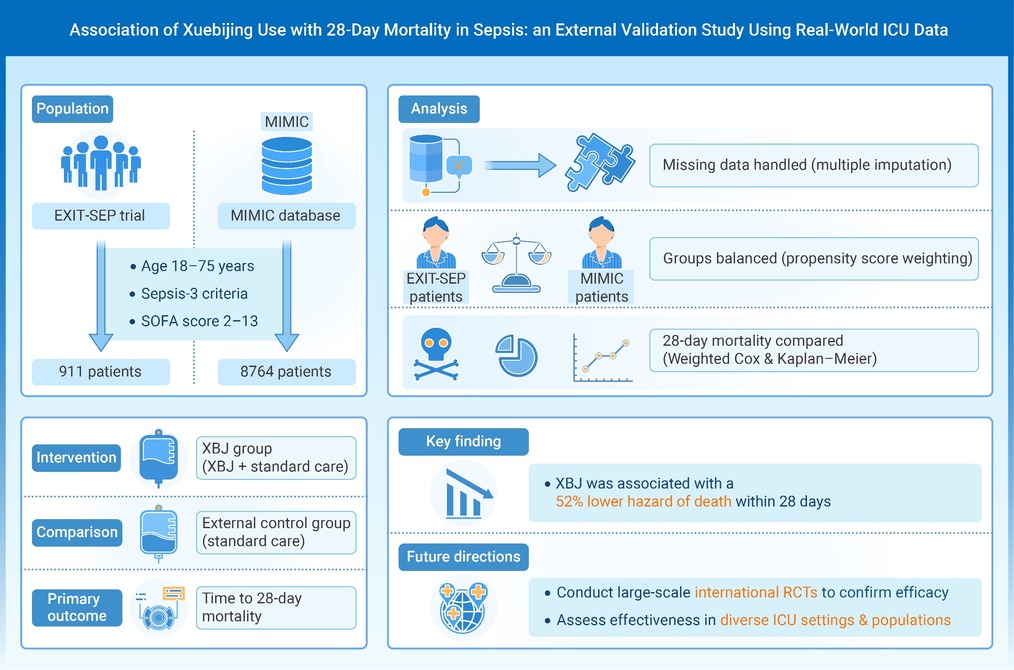
GRAPHICAL ABSTRACT
 DownLoad:
Full size image
DownLoad:
Full size image
-
PUBLIC SUMMARY
-
Sepsis is a life-threatening condition with few proven drug treatments worldwide.
Xuebijing injection (XBJ), a Chinese herbal medicine, showed benefits for sepsis patients in Chinese trials.
We performed an external validation using U.S. ICU data (Medical Information Mart for Intensive Care IV, MIMIC-IV).
Compared to the MIMIC-IV cohort, trial emulation showed XBJ lowered 28-day death risk (HR 0.48).
-
-
ABSTRACT
BackgroundMost pharmacologic interventions for sepsis have failed to show survival benefits in randomized trials. Xuebijing injection (XBJ), an approved intravenous drug widely used in China for sepsis, reduced mortality in two large randomized trials. However, its generalizability to non-Chinese populations remains uncertain. Our study aimed to assess the potential generalizability of the survival benefit of XBJ, previously observed in a Chinese randomized trial, to a non-Chinese ICU population and evaluated whether the treatment effect size was consistent across these different clinical settings.MethodsWe conducted a retrospective comparative effectiveness study, conceptualized as a single-arm trial of XBJ with an external control cohort from the MIMIC-IV database, designed using trial emulation principles aligned with the EXIT-SEP trial. Patients with Sepsis-3 septic shock were included. The primary outcome was time to 28-day all-cause mortality. Propensity scores were estimated with generalized boosted models, overlap weighting was applied, and missing data were handled with multiple imputation. Secondary outcomes included ICU-free days, ventilator-free days, and hospital length of stay.ResultsAmong 911 patients treated with XBJ and 8,764 controls, unadjusted 28-day mortality rates were 18.1% and 15.5%, respectively. In the primary overlap-weighted analysis, XBJ was associated with a significantly reduced risk of 28-day mortality compared with external controls (HR, 0.48; 95% CI, 0.31–0.73). Findings were consistent across sensitivity analyses. ICU and hospital stays were longer among XBJ-treated patients (ICU: 10.3 vs 6.7; difference, 3.7 days [95% CI, 2.6–4.7]; hospital: 16.2 vs 12.4; difference, 4.0 days [95% CI, 2.6–5.4]).ConclusionsIn this external validation using real-world ICU data, XBJ use was associated with reduced 28-day mortality among patients with sepsis. These findings support its potential generalizability beyond the original trial population but warrant confirmation in prospective studies across diverse settings. -

-
REFERENCES
[1] Meyer N. J. and Prescott H. C. (2024). Sepsis and septic shock. N. Engl. J. Med. 391:2133−2146. DOI:10.1056/nejmra2403213 [2] Ford J. S., Morrison J. C., Kyaw M., et al. (2025). The effect of severe sepsis and septic shock management bundle (Sep-1) compliance and implementation on mortality among patients with sepsis: A systematic review. Ann. Intern. Med. 178:543−557. DOI:10.7326/annals-24-02426 [3] Fujii T., Salanti G., Belletti A., et al. (2022). Effect of adjunctive vitamin C, glucocorticoids, and vitamin B1 on longer-term mortality in adults with sepsis or septic shock: A systematic review and a component network meta-analysis. Intensive Care Med. 48:16−24. DOI:10.1007/s00134-021-06558-0 [4] Cheng C., Ren C., Li M. Z., et al. (2024). Pharmacologically significant constituents collectively responsible for anti-sepsis action of Xuebijing, a Chinese herb-based intravenous formulation. Acta. Pharmacol. Sin. 45:1077−1092. DOI:10.1038/s41401-023-01224-1 [5] Song Y., Yao C., Yao Y., et al. (2019). Xuebijing injection versus placebo for critically ill patients with severe community-acquired pneumonia: A randomized controlled trial. Crit. Care Med. 47:e735−e743. DOI:10.1097/ccm.0000000000003842 [6] Liu S., Yao C., Xie J., et al. (2023). Effect of an herbal-based Injection on 28-day mortality in patients with sepsis: The EXIT-SEP randomized clinical trial. JAMA Intern. Med. 183:647−655. DOI:10.1001/jamainternmed.2023.0780 [7] Hu T. (2023). Xuebijing injection for sepsis treatment: When will It be approved outside of China. JAMA Intern. Med. 183:1280−1281. DOI:10.1001/jamainternmed.2023.4398 [8] Yang Z., Zhao H., Zhang M., et al. (2025). Revisiting real-world data studies: Progress, value, and challenges. Innov. Med. 3:100143. DOI:10.59717/j.xinn-med.2025.100143 [9] Cashin A. G., Hansford H. J., Hernán M. A., et al. (2025). Transparent reporting of observational studies emulating a target trial: The target statement. BMJ 390:e087179. DOI:10.1136/bmj-2025-087179 [10] Noghrehchi F., Stoklosa J., Penev S., et al. (2021). Selecting the model for multiple imputation of missing data: Just use an IC! Stat. Med. 40:2467−2497. DOI:10.1002/sim.8915 [11] VanderWeele T. J. and Ding P. (2017). Sensitivity analysis in observational research: Introducing the E-value. Ann. Intern. Med. 167:268−274. DOI:10.7326/m16-2607 [12] Ware L. B., Files D. C., Fowler A., et al. (2024). Acetaminophen for prevention and treatment of organ dysfunction in critically ill patients with sepsis: The Aster randomized clinical trial. JAMA 332:390−400. DOI:10.1001/jama.2024.8772 [13] Pan B., Sun P., Pei R., et al. (2023). Efficacy of Ivig therapy for patients with sepsis: A systematic review and meta-analysis. J. Transl. Med. 21:765. DOI:10.1186/s12967-023-04592-8 [14] Bloos F., Held J., Kluge S., et al. (2022). (1 → 3)-β-D-Glucan-guided antifungal therapy in adults with sepsis: The Candisep randomized clinical trial. Intensive Care Med. 48:865−875. DOI:10.1007/s00134-022-06733-x [15] Lamontagne F., Masse M. H., Menard J., et al. (2022). Intravenous vitamin C in adults with sepsis in the intensive care unit. N. Engl. J. Med. 386:2387−2398. DOI:10.1056/nejmoa2200644 [16] Cui J., Deng Y., Li X., et al. (2025). Herbal-based Xuebijing injection ameliorated vascular endothelial dysfunction via inhibiting Acly/Myb/Rig-i axis in sepsis-associated lung injury. Phytomedicine 140:156573. DOI:10.1016/j.phymed.2025.156573 [17] Lv J., Guo X., Zhao H., et al. (2022). Xuebijing administration alleviates pulmonary endothelial inflammation and coagulation dysregulation in the early phase of sepsis in rats. J. Clin. Med. 11. DOI:10.3390/jcm11226696. [18] Zhou W., Lai X., Wang X., et al. (2021). Network pharmacology to explore the anti-inflammatory mechanism of Xuebijing in the treatment of sepsis. Phytomedicine 85:153543. DOI:10.1016/j.phymed.2021.153543 [19] Martin-Loeches I., Sprung C. L., Wolsztynski E., et al. (2025). End-of-life decision disparities according to the gross national income in critically ill patients: a secondary analysis of the Ethicus-2 study. Ann. Intensive Care 15:29. DOI:10.1186/s13613-025-01419-1 [20] Avidan A., Sprung C. L., Schefold J. C., et al. (2021). Variations in end-of-life practices in intensive care units worldwide (Ethicus-2): A prospective observational study. Lancet Respir. Med. 9:1101−1110. DOI:10.1016/s2213-2600(21)00261-7 [21] Thomas L. E., Li F. and Pencina M. J. (2020). Overlap weighting: A propensity score method that mimics attributes of a randomized clinical trial. JAMA 323:2417−2418. DOI:10.1001/jama.2020.7819 [22] Feng G., Zhao Y., Yan F., et al. (2025). Escaping the data misuse maze: Reorienting medical research toward clinical needs. Innov. Med. 3:100153. DOI:10.59717/j.xinn-med.2025.100153 [23] Hernán M. A., Wang W. and Leaf D. E. (2022). Target trial emulation: A framework for causal inference from observational data. JAMA 328:2446−2447. DOI:10.1001/jama.2022.21383 [24] Liu Y., Zhou K. and Sims K. D. (2025). Tipping point analysis: assessing the potential impact of missing data. JAMA 334:265−266. DOI:10.1001/jama.2025.7420 -
ABOUT THIS ARTICLE
Cite this article:
Li Y., Kang J., Liu S., et al. (2025). Association of Xuebijing use with 28-day mortality in sepsis: An external validation study using real-world ICU data. The Innovation Medicine 3:100164. https://doi.org/10.59717/j.xinn-med.2025.100164
Welcome!
To request copyright permission to republish or share portions of our works, please visit Copyright Clearance Center's (CCC) Marketplace website at marketplace.copyright.com.
Article Metrics
Relative Articles
Cited by
Export File
Citation
Li Y., Kang J., Liu S., et al. (2025). Association of Xuebijing use with 28-day mortality in sepsis: An external validation study using real-world ICU data. The Innovation Medicine 3:100164. https://doi.org/10.59717/j.xinn-med.2025.100164

Format
Content
-
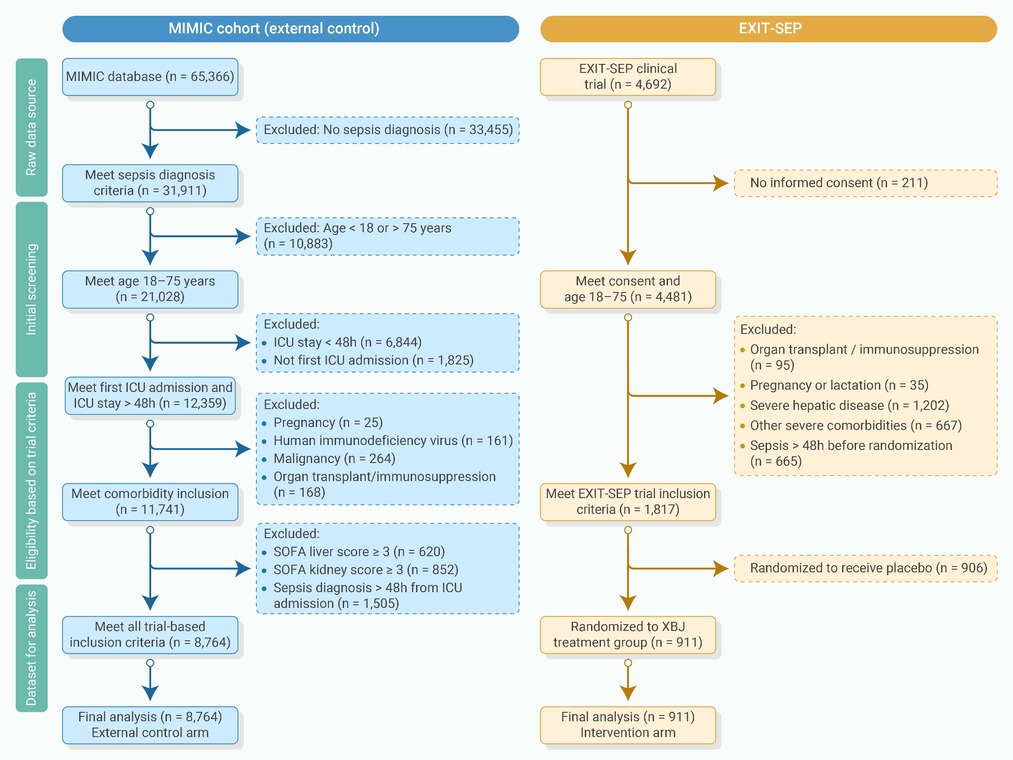
Figure 1.
Study flow diagram.
-
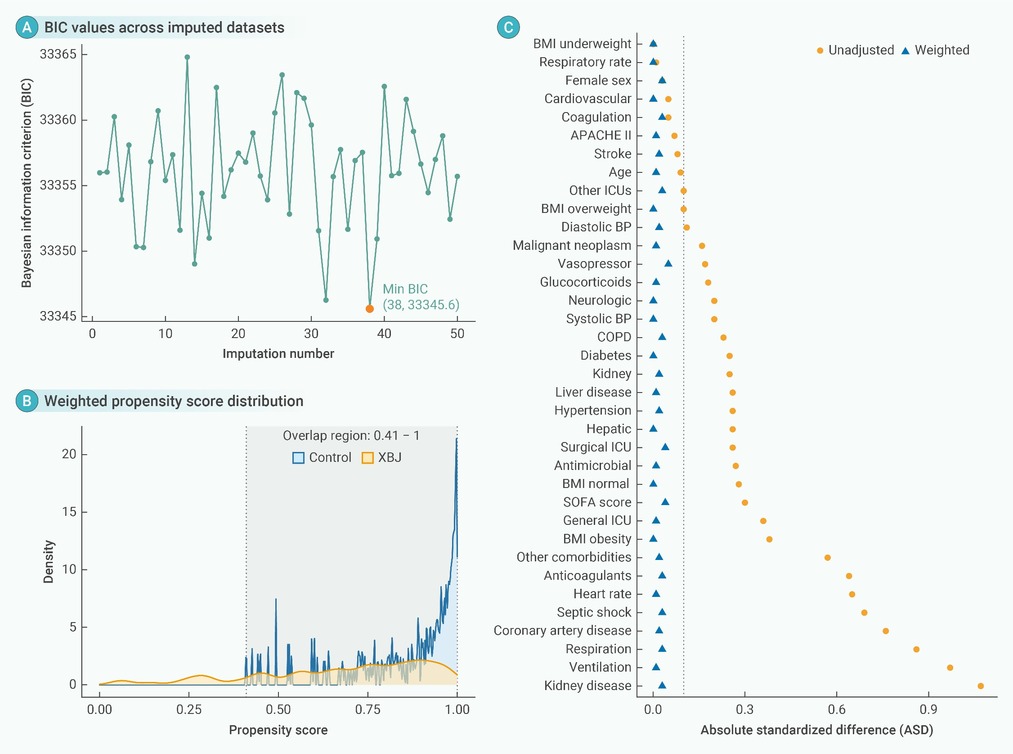
Figure 2.
Imputation dataset selection and covariate balance assessment
-
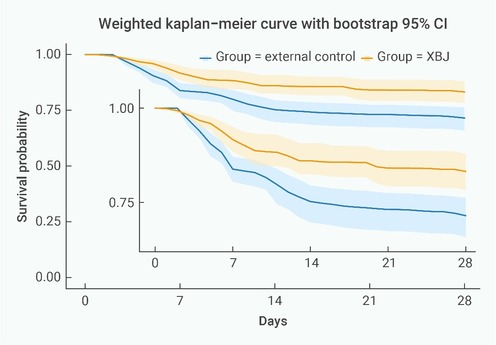
Figure 3.
Weighted Kaplan–Meier survival curves with 95% bootstrap confidence intervals, estimated using propensity score overlap weighting.
