
Structural blueprint for next-generation mpox therapeutics
-

-
REFERENCES
[1] Wang L., Zhang T., Wang N., et al. (2025). Recent progress in the discovery of anti-mpox agents. Med. Res. Rev. Online ahead of print DOI:10.1002/med.70004 [2] Moss B. (2024). Understanding the biology of monkeypox virus to prevent future outbreaks. Nat. Microbiol. 9:1408−1416. DOI:10.1038/s41564-024-01690-1 [3] Meola A., Vernuccio R., Battini L., et al. (2025). Structural basis of poxvirus fusion regulation and anti-A16/G9 antibody-mediated neutralization and protection. Cell 188:6266−6282.e18. DOI:10.1016/j.cell.2025.07.040 [4] Fantin R.F., Yuan M., Park S.C., et al. (2025). Human monoclonal antibodies targeting A35 protect from death caused by mpox. Cell 188:6236−6252.e18. DOI:10.1016/j.cell.2025.08.004 [5] Ju B., Liu C., Zhang J., et al. (2025). Structurally conserved human anti-A35 antibodies protect mice and macaques from mpox virus infection. Cell 188:6253−6265.e14. DOI:10.1016/j.cell.2025.08.005 -
ABOUT THIS ARTICLE
Cite this article:
Zhou Z., Zou W., Liu X., et al. (2026). Structural blueprint for next-generation mpox therapeutics. The Innovation Medicine 4:100191. https://doi.org/10.59717/j.xinn-med.2026.100191
Welcome!
To request copyright permission to republish or share portions of our works, please visit Copyright Clearance Center's (CCC) Marketplace website at marketplace.copyright.com.
Export File
Citation
Zhou Z., Zou W., Liu X., et al. (2026). Structural blueprint for next-generation mpox therapeutics. The Innovation Medicine 4:100191. https://doi.org/10.59717/j.xinn-med.2026.100191

Format
Content
 DownLoad:
-
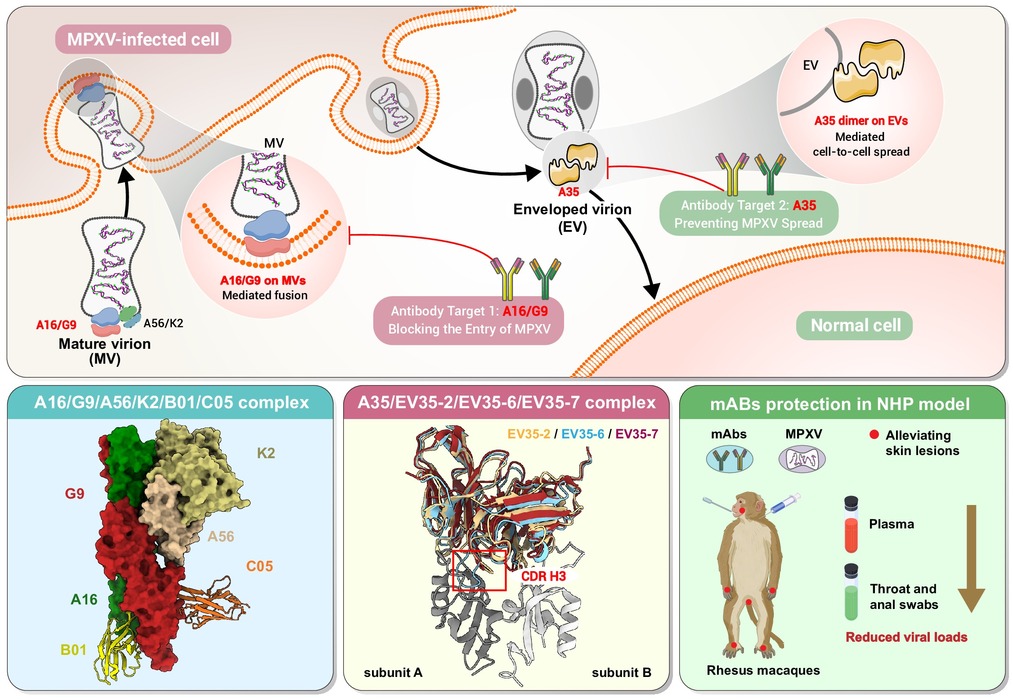
Figure 1.
The roles of subcomplex A16/G9 and protein A35 in MPXV infection, and the antibody-related research conducted by Guardado-Calvo, Coelho, Zhang, and their colleagues
