
Awakening ancient mobile DNA drives aggressive lung cancer
-

-
REFERENCES
[1] Zhang T., Zhao W., Wirth C., et al. (2025). Uncovering the role of LINE-1 in the evolution of lung adenocarcinoma. Nature 650:230−241. DOI:10.1038/s41586-025-09825-y [2] Gerstung M., Jolly C., Leshchiner I., et al. (2020). The evolutionary history of 2,658 cancers. Nature 578:122−128. DOI:10.1038/s41586-019-1907-7 [3] Alexandrov L.B., Kim J., Haradhvala N.J., et al. (2020). The repertoire of mutational signatures in human cancer. Nature 578:94−101. DOI:10.1038/s41586-020-1943-3 [4] Jin W., Yu C., Zhang Y., et al. (2025). Mechanism of DNA targeting by human LINE-1. Science 390:eadu3433. DOI:10.1126/science.adu3433 [5] Baldwin E.T., van Eeuwen T., Hoyos D., et al. (2024). Structures, functions and adaptations of the human LINE-1 ORF2 protein. Nature 626:194−206. DOI:10.1038/s41586-023-06947-z -
ABOUT THIS ARTICLE
Cite this article:
Zhang T. and Landi M.T. (2026). Awakening ancient mobile DNA drives aggressive lung cancer. The Innovation Medicine 4:100219. https://doi.org/10.59717/j.xinn-med.2026.100219
Welcome!
To request copyright permission to republish or share portions of our works, please visit Copyright Clearance Center's (CCC) Marketplace website at marketplace.copyright.com.
Export File
Citation
Zhang T. and Landi M.T. (2026). Awakening ancient mobile DNA drives aggressive lung cancer. The Innovation Medicine 4:100219. https://doi.org/10.59717/j.xinn-med.2026.100219

Format
Content
 DownLoad:
-
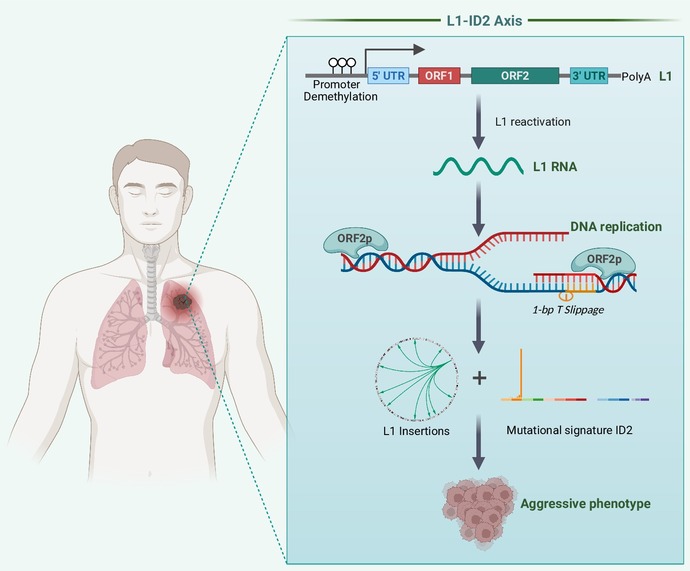
Figure 1.
The L1–ID2 axis as a mutational pathway driving tumor aggressiveness
