
Targeting the hallmarks of cancer: A nutritional epigenetics framework for prevention and intervention
-
ABSTRACT
Nearly 38% of cancer cases worldwide are attributable to modifiable risk factors. Emerging evidences suggest that nutrient-sensitive regulatory networks serve as molecular intermediaries connecting the exposome to cancer hallmark acquisition. Epigenetic plasticity positions diet as a modifiable determinant of cancer susceptibility, with phytochemicals, caloric restriction, and microbiome-derived metabolites modulating chromatin-modifying enzymes. However, context-dependent dual effects complicate nutritional intervention. We propose an integrative framework unifying modifiable risk factors, epigenetic regulation, and nutritional interventions within the Hallmarks of cancer paradigm, repositioning nutrition as an upstream determinant of hallmark acquisition rather than an adjunctive consideration. This framework supports precision nutrition strategies in cancer prevention, though challenges in biomarker validation, accessibility, and patient adherence remain. -

-
REFERENCES
[1] Hanahan D. (2022). Hallmarks of cancer: New dimensions. Cancer Discov. 12:31−46. DOI:10.1158/2159-8290.CD-21-1059 [2] Fink H., Langselius O., Vignat J., et al. (2026). Global and regional cancer burden attributable to modifiable risk factors to inform prevention. Nat. Med. 32:1306−1315. DOI:10.1038/s41591-026-04219-7 [3] Maas S. C. E., Baraibar I., Lemler L., et al. (2026). Epigenetic fingerprints link early-onset colon and rectal cancer to pesticide exposure. Nat. Med. 32:1827−1837. DOI:10.1038/s41591-026-04342-5 [4] Barrero M. J., Cejas P., Long H. W., et al. (2022). Nutritional epigenetics in cancer. Advances in nutrition (Bethesda, Md.) 13:1748−1761. DOI:10.1093/advances/nmac039 [5] Harre P., Hohenberger K., Krammer S., et al. (2025). Dietary omega-3 polyunsaturated fatty acids (PUFAs) reduce cholesterol-driven non-small cell lung cancer (NSCLC) progression in mouse models of disease. Commun Med. 5:432. DOI:10.1038/s43856-025-01193-y [6] Ngo B., Van Riper J. M., Cantley L. C., et al. (2019). Targeting cancer vulnerabilities with high-dose vitamin C. Nat. Rev. Cancer 19:271−282. DOI:10.1038/s41568-019-0135-7 [7] Omenn G. S., Goodman G., Thornquist M., et al. (1994). The beta-carotene and retinol efficacy trial (CARET) for chemoprevention of lung cancer in high risk populations: Smokers and asbestos-exposed workers. Cancer Res. 54:2038s−2043s. [8] Klein E. A., Thompson I. M., Jr., Tangen C. M., et al. (2011). Vitamin E and the risk of prostate cancer: the Selenium and Vitamin E Cancer Prevention Trial (SELECT). JAMA 306:1549−1556. DOI:10.1001/jama.2011.1437 -
ABOUT THIS ARTICLE
Cite this article:
Gu C., Shi X., Xing B., et al. (2026). Targeting the hallmarks of cancer: A nutritional epigenetics framework for prevention and intervention. The Innovation Nutrition 1:100040. https://doi.org/10.59717/j.xinn-nutri.2026.100040
Welcome!
To request copyright permission to republish or share portions of our works, please visit Copyright Clearance Center's (CCC) Marketplace website at marketplace.copyright.com.
Export File
Citation
Gu C., Shi X., Xing B., et al. (2026). Targeting the hallmarks of cancer: A nutritional epigenetics framework for prevention and intervention. The Innovation Nutrition 1:100040. https://doi.org/10.59717/j.xinn-nutri.2026.100040

Format
Content
 DownLoad:
-
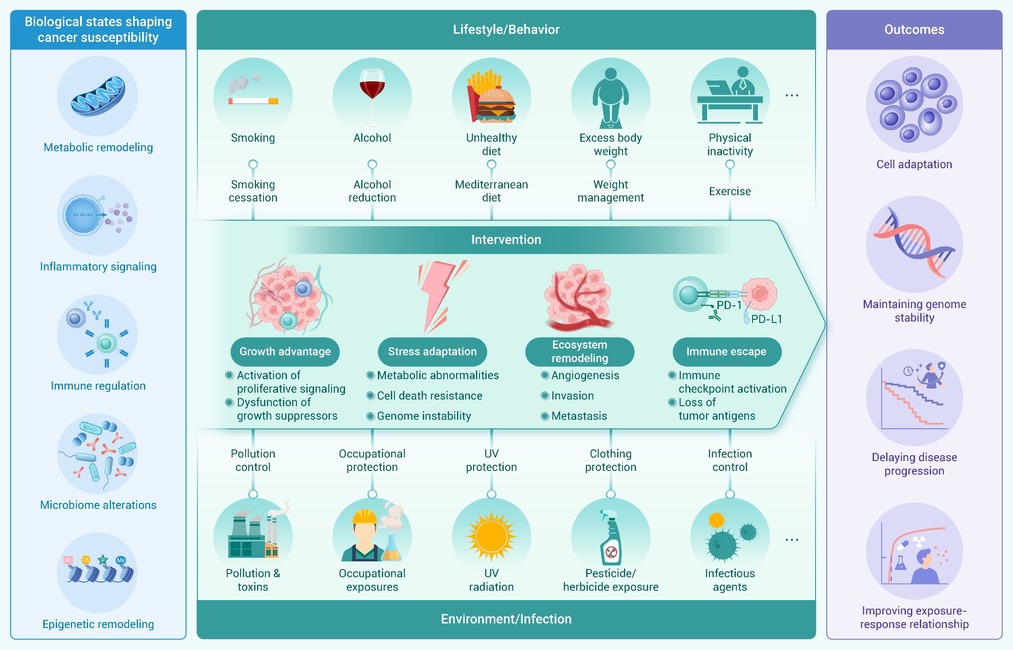
Figure 1.
A Hallmarks-Inspired Framework Linking Modifiable Risk Factors, Biological States, and Nutritional Interventions in Cancer.
