
Diet conditions the gut microbiome for cancer immunotherapy
-

-
REFERENCES
[1] Desharnais L., Swaby A., Messaoudene M., et al. (2026). Diet–microbiome synergy underlies obesity-associated immunotherapy efficacy. Nature 657:505-516. DOI:10.1038/s41586-026-10750-x. [2] McQuade J.L., Daniel C.R., Hess K.R., et al. (2018). Association of body-mass index and outcomes in patients with metastatic melanoma treated with targeted therapy, immunotherapy, or chemotherapy: A retrospective, multicohort analysis. Lancet Oncol. 19:310−322. DOI:10.1016/S1470-2045(18)30078-0 [3] Baruch E.N., Youngster I., Ben-Betzalel G., et al. (2021). Fecal microbiota transplant promotes response in immunotherapy-refractory melanoma patients. Science 371:602−609. DOI:10.1126/science.abb5920 [4] Kennedy M.S., Freiburger A., Cooper M., et al. (2025). Diet outperforms microbial transplant to drive microbiome recovery in mice. Nature 642:747−755. DOI:10.1038/s41586-025-08937-9 [5] Joachim L., Göttert S., Sax A., et al. (2023). The microbial metabolite desaminotyrosine enhances T-cell priming and cancer immunotherapy with immune checkpoint inhibitors. eBioMedicine 97:104834. DOI:10.1016/j.ebiom.2023.104834 -
ABOUT THIS ARTICLE
Cite this article:
Sun F. and Fu T. (2026). Diet conditions the gut microbiome for cancer immunotherapy. The Innovation Nutrition 1:100045. https://doi.org/10.59717/j.xinn-nutri.2026.100045
Welcome!
To request copyright permission to republish or share portions of our works, please visit Copyright Clearance Center's (CCC) Marketplace website at marketplace.copyright.com.
Export File
Citation
Sun F. and Fu T. (2026). Diet conditions the gut microbiome for cancer immunotherapy. The Innovation Nutrition 1:100045. https://doi.org/10.59717/j.xinn-nutri.2026.100045

Format
Content
 DownLoad:
-
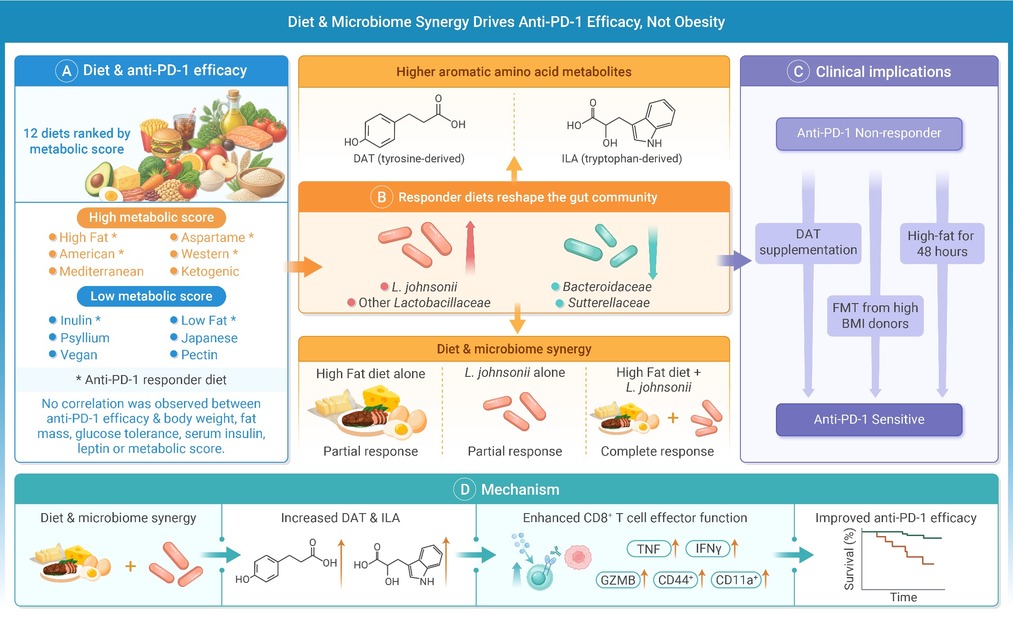
Figure 1.
Dietary context, not obesity, shapes microbial metabolism and the anti-PD-1 response
