
Redefining the tumor digital twin through cross-domain manifold mapping
-

-
REFERENCES
[1] Zong W., Rahman T., Zhu L., et al. (2023). Transcriptomic congruence analysis for evaluating model organisms. Proc. Natl. Acad. Sci. USA 120:e2202584120. DOI:10.1073/pnas.2202584120 [2] Mourragui S., Loog M., van de Wiel M.A., et al. (2019). PRECISE: A domain adaptation approach to transfer predictors of drug response from pre-clinical models to tumors. Bioinformatics 35:i510−i519. DOI:10.1093/bioinformatics/btz372 [3] Zou J., Shah O., Chiu Y.C., et al. (2024). Systems approach for congruence and selection of cancer models towards precision medicine. PLoS Comput. Biol. 20:e1011754. DOI:10.1371/journal.pcbi.1011754 [4] Laubenbacher R., Mehrad B., Shmulevich I., et al. (2024). Digital twins in medicine. Nat. Comput. Sci. 4:184−191. DOI:10.1038/s43588-024-00607-6 [5] Jentzsch V., Osipenko L., Scannell J.W., et al. (2023). Costs and causes of oncology drug attrition with the example of insulin-like growth factor-1 receptor inhibitors. JAMA Netw. Open 6:e2324977. DOI:10.1001/jamanetworkopen.2023.24977 -
ABOUT THIS ARTICLE
Cite this article:
Hu Y., Zong W., Wang J., et al. (2026). Redefining the tumor digital twin through cross-domain manifold mapping. The Innovation Oncology 1:100012. https://doi.org/10.59717/j.xinn-oncol.2026.100012
Welcome!
To request copyright permission to republish or share portions of our works, please visit Copyright Clearance Center's (CCC) Marketplace website at marketplace.copyright.com.
Export File
Citation
Hu Y., Zong W., Wang J., et al. (2026). Redefining the tumor digital twin through cross-domain manifold mapping. The Innovation Oncology 1:100012. https://doi.org/10.59717/j.xinn-oncol.2026.100012

Format
Content
 DownLoad:
-
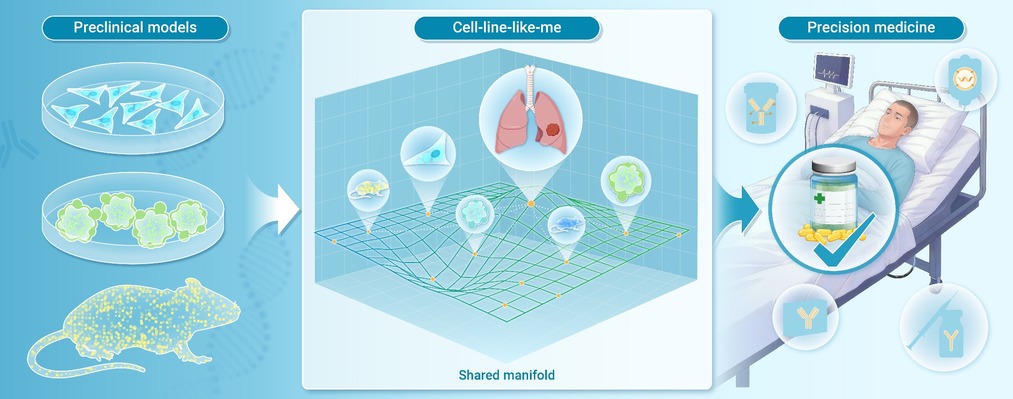
Figure 1.
Conceptual overview of the Cell-Line-Like-Me framework
